
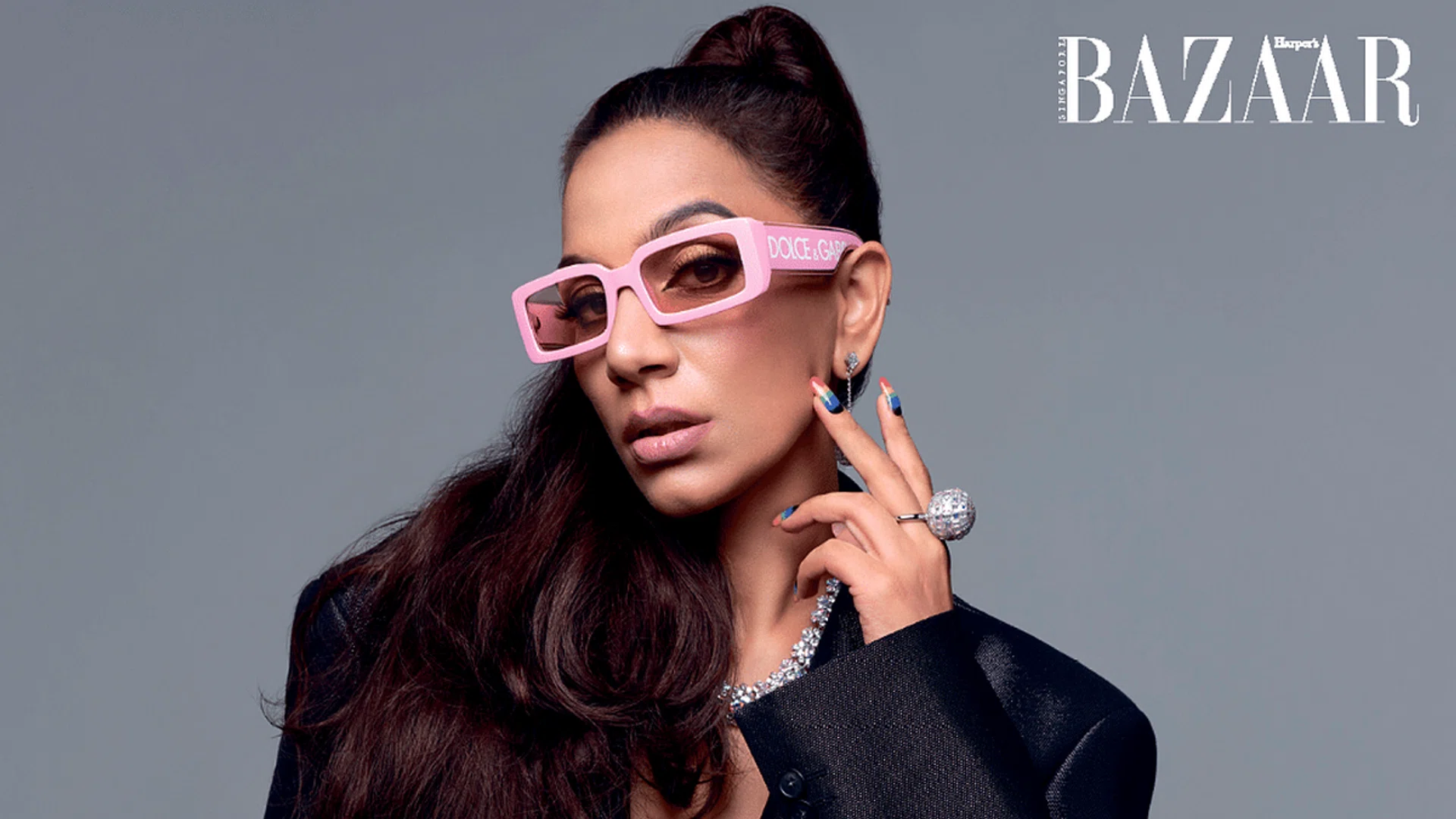
BAZAAR Power List 2023: Sharul Channa
Stand-up comedy is not for the faint of heart, nor for the slow of wit. And Channa has proven she has guts and the talent to thrive.
By Renée Batchelor - published
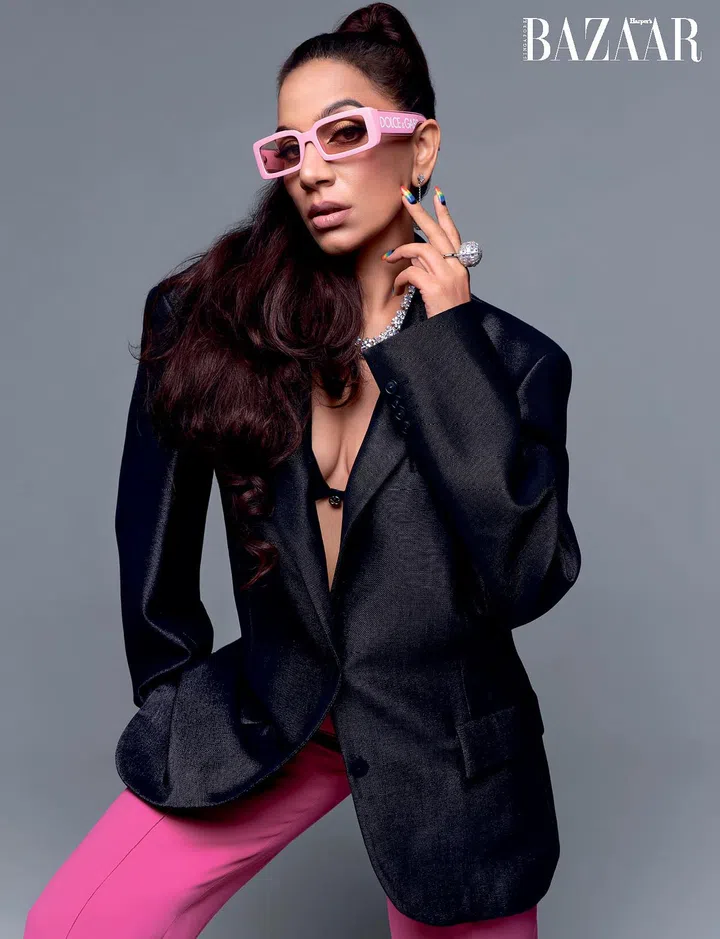
Blazer, Sportmax. Sunglasses, Dolce&Gabbana. Earrings; ring; necklace, Kate Spade New York. Trousers; bra, Sharul’s own
This year, we celebrate Singapore’s comedy queens and funny girls who have captured our hearts, tickled our ribs and got us thinking and reflecting on ourselves and society at large. Whether it’s through stand-up, sketches, or film, these funny girls have the courage, flair and smarts to not only succeed in the world of comedy, but to also thrive in it. Meet Sharul Channa, a 35-year-old stand-up comedian.
When did you first discover that you had the gift of making someone laugh, and what did you do with that discovery?
So, unconsciously, I knew that whenever I would go to a relative's house, or we were in India, or they came over, and the moment they walked out to go tour Sentosa, I would mimic all my relatives, and my family would sit around and laugh. So I'd be like, 'You know what? My family thinks I'm funny' or 'I'm a clown. I'm a goofball.' So that was unconscious.
But, consciously, it happened when I jumped up to do Comedy Masala 12 years back, and there were no Singaporean woman jumping up to do stand-up at that time. So the owner said, 'Why don't you just do three minutes?' And I said, 'Okay, three minutes.' And when I went up and I had people laughing at my impromptu jokes as well, I'm was like, 'Shit. I'm making people laugh.' I was getting validation from people. Because as a woman of Indian descent in this country, you don't get a lot of attention from men
Related article: 28 Singapore Films And Shows To Watch On Netflix This August
when you're growing up. So at the first audience, there were three white men present, and considering our relationship with colonisation, it was very validating to have white men laugh at your jokes. Of course, eventually I got over it. And I realised that 'Hey, we're all equal and it doesn't matter,' and you need to take that whole power struggle out of your head.
Comedy is powerful because...
Because you are like a politician with no actual consequence. It's powerful because you have the authority of a politician. But you don't have the consequences of being one.
Over the years, how have you honed your comedy skills and what have you discovered about how your mind works?
So I have made sure that I travel to different parts of Southeast Asia or Asia to try out new rooms and try out my comedy as much as possible. So that's the way I have found my skill. I make sure that I do as many open mics because that's where you sharpen your comedy skills. What I've realised about myself is I love to do audience interaction, I love to speak to people and maybe string a story on the spot. A lot of comedians are writer-comedians or writer-actors. I like to do both. I like to do a lot of audience interaction. I love impromptu comedy, more than written comedy. It's just magic when it happens, right? When someone says something to you, and you can give back an answer. And it's funny. People know that you didn't write that beforehand, and it proves how skilful you are on stage.
What are the challenges in making comedy a career, and in that sense, treating it as a business?
I think being a woman, and in stand-up, is not an easy thing. Because the easiest part is going up on stage and making people laugh. There are other challenges around that you have to deal with. It's a boys club, all over the place. So you have to make sure you stick with it, whether there's any kind of prejudice, or sexual harassment that happens. Sometimes sexist remarks. You have to fight all of that. So push forward. It's so little to do with the going onstage, but it's so much about what happens around different countries and different scenes.
And not just in Asia, elsewhere as well. See, I've done Australia, but I've not experimented much in the US or London. I prefer the way comedy is don in Malaysia right now, because you're allowed to be raw. And comedians in the West have already spoken out so much that now the voice is of the Asian person, which is why a Malaysian-Chinese lady winning the Oscars as Best Actress is being celebrated, right? Because of course she's talented, but we now come with a new voice.
What is your proudest achievement or accomplishment to date?
I don't think I've found it yet. I don't know if I can say there's been a proudest moment. But I remember when I got picked for the Melbourne Comedy Festival. That was the first time a lot of the comedians in the scene who went up to me and said, 'How did you get that?' Well, one of the producers was silently watching my shows. And he called me for Comedy Zone Asia. I was the first Singaporean to be called for that show.
Is there anything you won’t joke about?
Yes, I won't speak about rape or tragedies. I don't like to do jokes on that. Because I believe in freedom of speech, but I also feel it doesn't matter what job you're in, you have to be empathetic. And empathy is so important. There's consequence to everything. So tragedies and rape, I do not joke about .
Who or what makes you laugh?
I laugh at the most ridiculous jokes, I laugh at fart jokes. I go for the lowest denominator. I love it. Because I've heard so many sophisticated jokes. I know how it's written. I know how it's done. I know the method, the way and the style. So I laugh at things that are just simple, basic... like dog videos and videos of animals on Instagram.
What does power look like to you?
Power is when you are comfortable with your vulnerabilities, and showing them. When you're not afraid to go up and say that 'I'm afraid. But I'm still going to do this.' That is very powerful to me.
In what mode do you feel most powerful?
When I'm the most vulnerable. If I had a bad day, I'll say, 'I had a bad day. And this is why I had a bad day.' And I try to change that into humour for myself. Because I laugh at it first, and then I let them [the audience] laugh. So that, to me, is very powerful. Vulnerability is very powerful.
Related article: Singaporean Director He Shuming Reflects On Life After ‘Ajoomma’
What’s one thing you would change about your industry?
One thing I would like to change about my industry is actually not so much about my industry, it's more of a change in society. The more educated and more sensitive and more empathetic a society gets, the more people grow. So I hope people understand that if a man goes up on stage and does dick jokes, people laugh at it. But the moment a woman talks about her anatomy, or pads or pregnancy, suddenly people are like, 'Why [are] women always talking about this?'
So I want society to start opening up and acknowledging that a woman comedian is a completely different product. I wish for people to be educated. But I think it's my responsibility to change things by educating them. And of course, whoever goes up [on stage takes responsibility for it.
What’s the most fulfilling thing about what you do?
Sometimes when people laugh, I hear the sound of coins falling on the floor. That's my currency. Laughter is my currency. So I actually hear it. Even if it's a gig that doesn't pay you that much - some gigs are not high-paying gigs - you are not thinking about the money at that point. You're making all these people happy today and you're uniting the room. And that is so fulfilling.
Can you share more about a time when humour helped you get through something difficult?
When I lost my grandmother, I did an entire set on her funeral. And that helped me cope with it. And then when we lost our friend during COVID, we still kept doing comedy.
My grandmother never saw me do stand-up because she was in India. But I was trying to make her laugh as much as possible. She did not understand the concept of stand-up because she was from an older generation. So she didn't get me. She asked me, 'What do you do?' She couldn't fathom it. She accepted it, but she didn't know what that was like. She didn't know that the sacrifices that her, and my ancestors, have made have led to me having a voice. She's part of the journey, but she doesn't know it.
The biggest misconception about my job is...
Is that we're clowns all the time, offstage, onstage.,, I've done photo shoots and they're like, 'Can you pull a funny face? Like, why?' We're normal human beings who can have a personality, who can look sexy on stage and who have a voice. We're not clowns. Clowns are a different genre.
What do you think is the most important quality for a comedian?
To be truthful. A lot of people go up on stage and they do jokes because they think people are going to find it funny. But you have to speak your truth and let people find the funny in it. If I know it's an audience of bankers, and I am going to write bank jokes or a banker's jokes - I'm doing it for them. I'm not doing it for myself. But it's way funnier when you've experienced it. So it has to come from within. Not necessarily everything is for the audience.
Related article: Musician Benjamin Kheng Opens Up About Life In The New Normal And Turning 30
Who are your heroes and icons?
It's going to be so cliché, but my parents are my heroes. My dad's a chef and my mom went out to work as a teacher. I saw my dad in the kitchen, and I saw my mom go out to work, so we did not know gender roles at all. So all their three daughters are outspoken, because we learned a lot from their struggles as immigrant parents. So they're my heroes and icons. They're really funny people. They are really weird, funny people with a wicked sense of humour. You might say I got it from them.
This interview has been edited and condensed for clarity.
Photographed by Wee Khim
Creative direction and styling by Windy Aulia
Producers: Cindy Ow, Navin Pillay
Makeup and Hair: Andrea Joan Dom using Kimchi Chic Beauty
Stylist’s assistants: Naysa Pradhan, Zoe Tauro