
Elijah Woods On Vulnerability, Viral Hits And Making Pop That Matters
Elijah Woods is making music that heals, and he’s just getting started.

By Aaron Kok - published
It’s a Tuesday evening in Los Angeles when I speak to Elijah Woods, and he’s got that mix of post-tour glow and jet-lag grogginess. He’s just returned from an Asian tour—Osaka, Seoul, Singapore and a few other stops—and he’s hanging out with his pet corgi in his studio.
It’s quiet now, but just weeks earlier, fans across the region were scream-singing the lyrics to his music, including the breakout hit “24/7, 365”, which is the kind of heart-on-sleeve pop anthem that turns up in cafes, shopping malls, and yes, even your brow technician’s Spotify playlist. For an artist who doesn’t have a major label machine behind him, the visibility is surreal. But for Woods, it’s also the payoff of years of steadfast work.
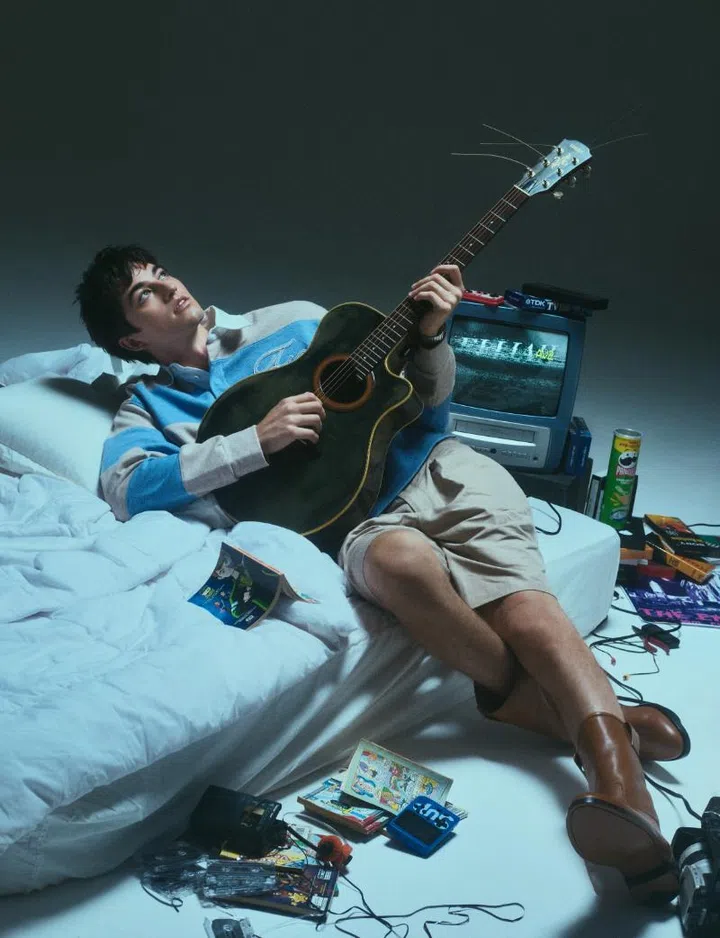
Sweater; shorts, Tommy Hilfiger. Boots, Loro Piana. Jewellery and watch (worn throughout), Woods’ own.
Related article: “I Just Want to Do Work That Feels Honest”: Manny Jacinto On Acting, Identity And Finding Emotional Truth
Later this month, Woods will release his debut full-length album, Can We Talk?—a milestone project that comes after a slew of EPs over the past few years, hundreds of songs, and more than 350 million streams. “I’ve always wanted my first album to feel like it captured something bigger than a moment,” he says. “And this one did.”
That “something bigger” is etched into every corner of the record. The throughline, he explains, came from the kind of late-night conversations that change you—talks with friends about self-worth, conflict, forgiveness, how to let go, and how to move on. “The songs started to feel like a larger conversation, not just a snapshot of one feeling,” he says. “That’s when I knew it wasn’t an EP.”
Thematically, Can We Talk? explores the emotional greys: uncertainty, self-assessment, the stuff that doesn’t always come with a neat answer. In the standout track titled “Cutting The Grass,” Woods croons mid-sentence: “Am I cutting the grass to watch it grow?”—a question disguised as a lyric, or maybe the other way around.
“That song came from this moment of self-inquiry,” he says. “Like, am I showing up for my life? Or just going through the motions?” It’s existential, sure, but not in a detached way. After all, Woods is the kind of artist who sings about the hard stuff without ever making you feel heavy.

Jacket; trousers, Prada. Sunglasses, Gentle Monster.
Related article: “We’re Done Playing Perfect”: Actors Ross Butler and Lim Yu-Beng On Letting Go And Telling Real Asian Stories
There’s a tenderness to his music that fans often describe in feelings rather than genres. When I asked my friends how they’d sum up his songs, the answers came quickly and varied: “sunrises and sunsets”, “a tub of ice cream”, “a good cry”.
Elijah laughs when I tell him this. “Those have been on my moodboard for a long time,” he says. “That’s the energy I write for. The quiet moments.”
And yet, for all the softness, there’s rigour in his process. Woods recorded more than 150 songs for this album, before paring them down to 11. “Writing is the easy part,” he says. “The hardest part was making sure they flowed, that the story made sense not just song to song, but emotionally too.”
At one point, with everything locked and mastered, he reordered the entire tracklist just before sending the album off to be produced. “My wife and I were sitting in the car and I was like, ‘what if this song goes first?’ She then countered, going something like ‘what if this other one follows after?’, and it just clicked. That’s the kind of thing you don’t get with singles. You only get that with an album.”
Even sonically, Can We Talk? feels more intimate and refined. “This is the most guitar-forward project I’ve ever done,” he says. “But not in a big, showy way. It’s subtle, and there are more muted tones, warm textures, that sort of thing.”
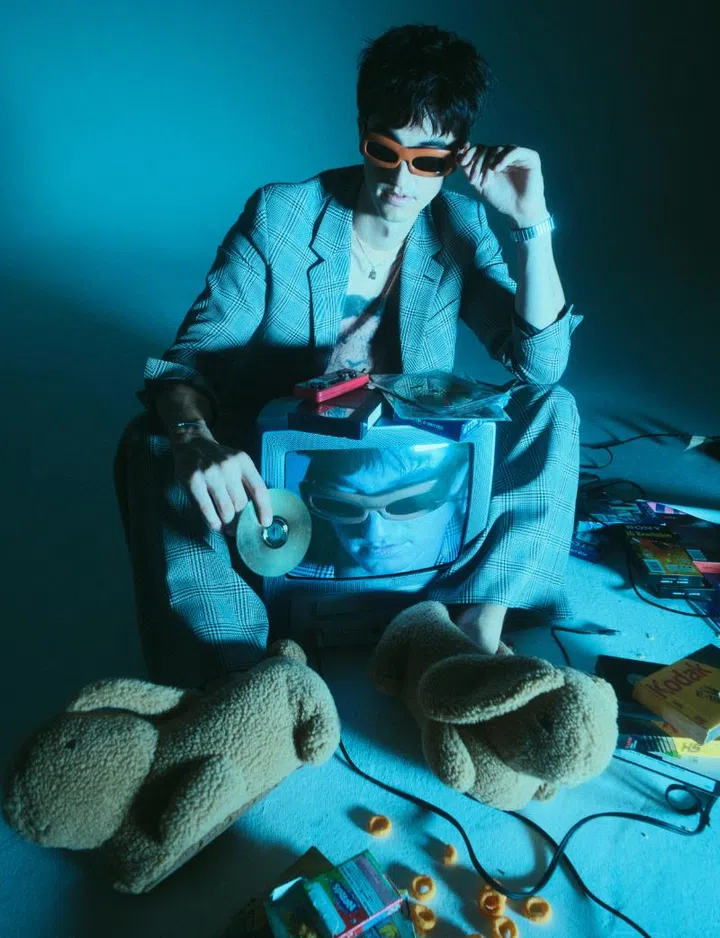
Sunglasses; t-shirt; blazer; trousers; loafers, Coach.
Woods is no stranger to production: the man engineers his own vocals, and has written and produced for others too. But with Can We Talk?, he wanted to strip away anything that didn’t feel necessary. “I tried not to overwrite. It’s easy to fall into the trap of turning a song into a journal entry. But I didn’t want to make a record that was just for me. I wanted it to be specific enough to feel honest, but open enough that people could see themselves in it.”
That vulnerability comes through strongest in songs like “Dynamite”, which basically wrote itself after Woods went through a falling out with a close friend. “It took something real to finish that one,” he says. “It was a reminder that sometimes the song already knows what it’s about. You just haven’t lived it yet.”
As we speak, there’s a softness to how Woods carries himself. He’s reflective, present, occasionally self-deprecating, but never closed off. Even on stage, he brings his dry wit and charisma to the forefront, earning him legions of screaming fans. The suave looks and his doe-eyed charm help, sure, but fans will tell you pre-show that they follow him because he’s refreshingly relatable. You get the sense that if he wasn’t making music, he’d still be asking the same questions, except maybe it’d be written in a notebook instead of putting it out there on Spotify for the world to take in.

Cardigan, GUCCI.
Related article: Fourth Nattawat On Overcoming Obstacles Early In His Career And Giving Back To His Fans
He talks about his fans in Asia with warmth and a kind of stunned gratitude. “There’s a different kind of attentiveness there,” he says. “They show up early. They sing every word. They’re there for the music.”
That connection, especially in Southeast Asia, has only deepened since “24/7, 365” took off. “It’s crazy,” he adds. “I remember writing that chorus and thinking, oh, this one’s different. But you never know. And then to hear it in malls, at shows, to see people cry-sing it back to me in countries I’d never been to? That’s a whole different level of surreal.”
It’s also why he chose Krabi, Thailand, as the next location for his Sunset Sessions video series. “We found this old studio in the middle of nowhere,” he explains.
“It had a vintage Neve console, and nobody had used it in years. It felt perfect.” The session, filmed live with his band, captures stripped-down versions of songs from Can We Talk?, and serves as a kind of living companion to the record. “I wanted to give people another way to experience the songs, but in a different light.”
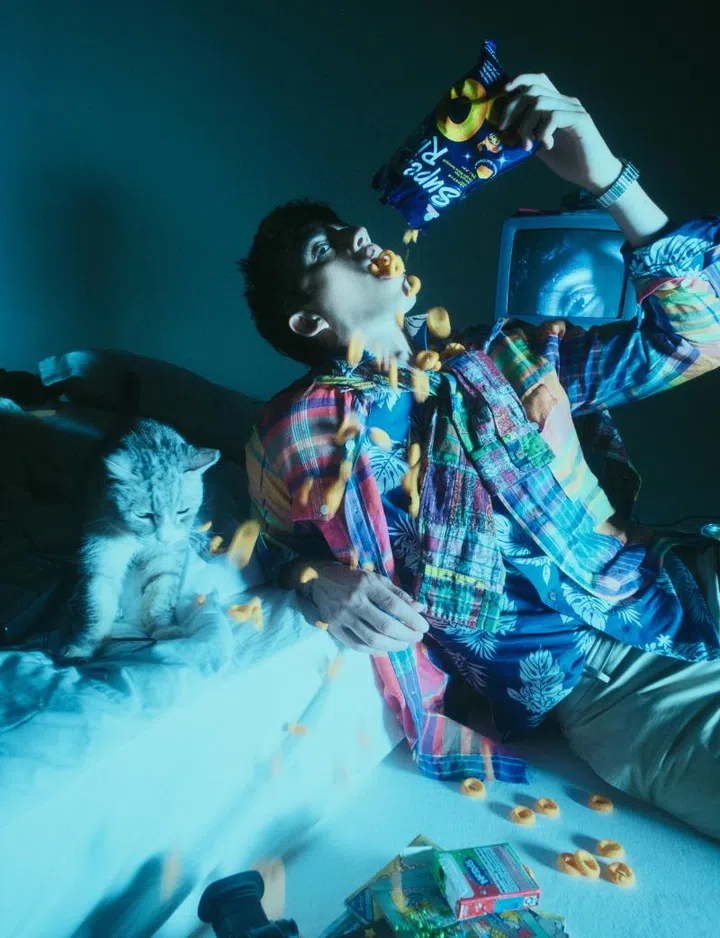
Floral shirt (worn inside); checked shirt; patchwork shirt (worn around
the neck), Polo Ralph Lauren. Trousers, Tommy Hilfiger.
Here in Singapore, Woods had another surprise planned: a city-wide trail of Elijah Woods-themed photo booths scattered across different neighbourhoods, leading up to the album’s release. It was a quirky, tangible way of turning fandom into memory-making. “We wanted to do something fun,” he says. “Something that felt like a love letter back to the people who’ve supported me.”
When I ask what he hopes people feel when they hear Can We Talk?, he pauses. “Clarity,” he surmises. “Not in a neat-tied-up-bow kind of way, but maybe just enough to feel seen, and to keep going.”
Pop music hasn’t always been treated kindly by critics, but Woods isn’t concerned with posturing. “The hardest thing in the world is to make a great song that’s also popular,” he says. “That’s the magic of pop. You take something everyone’s done and make it undeniable. That takes skill. Pop gets a bad rep, but what people forget is that it’s incredibly difficult to make a number one hit. That itself is impressive. It deserves respect.”
He references the Kate Bush renaissance, when “Running Up That Hill” exploded thanks to Stranger Things. “That song had existed for decades, but the culture caught up to it,” he says. “Suddenly, the sound was trendy. And then people wanted more of it. That’s essentially pop music for you: it evolves. It morphs. But at its core, it’s always about connecting.”
Social media, he adds, has accelerated the pop pendulum. “The industry’s schizophrenic. One minute it’s folk, the next it’s trap, then alt-pop,” he muses. “But I try not to chase that. My job is to keep doing what I do, and wait for people to catch up.” He pauses, then adds with a knowing laugh, “Or maybe they won’t. But I have to stay honest to my sound.”
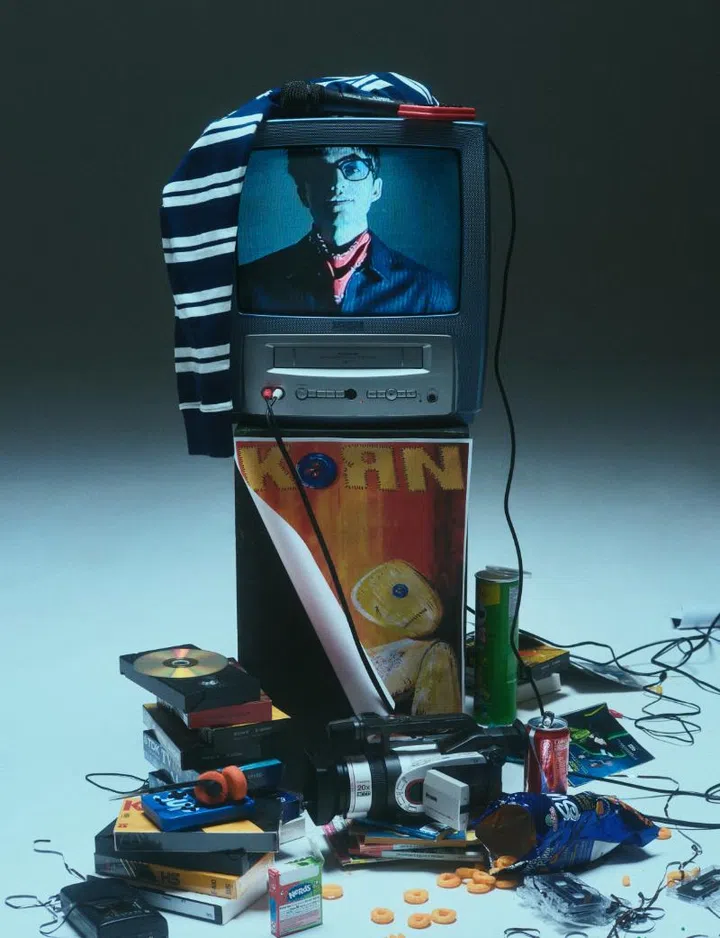
Sunglasses, Gentle Monster. Scarf, shirt, Givenchy. Sweater (on TV), Tommy Hilfiger.
This commitment to authenticity is also what led him to write “Matthew,” a track he describes as one of his proudest creative achievements. Though it doesn’t appear on the new album, its emotional weight still lingers in our conversation, three years after its production. The song is a tribute to his late brother, who passed away in a car accident when Woods was 14. It took him years to write; after years of avoidance, journalling and therapy.
“I played it for my dad in a Costco parking lot,” he shares. “We both cried. He thanked me for giving him a place to go visit his son.” It was cathartic not just for Woods, but for his family too. “It became a box where we could put everything we’ve buried [with his passing], and we could go back to it whenever we needed.”
Even now, the memory still sits heavy in his voice. “That song reminded me that music can be more than just a soundtrack. It can be a shelter. A safe space to grieve, to remember, and to feel understood without having to explain a thing.”
It’s a philosophy that underscores everything Woods wants to build as an artist: something enduring, something deeply human. “That’s the goal, really,” he says. “To make music that can hold space for someone else. I want to keep connecting. I want to be vulnerable. I want to stay soft.”
Editor-in-Chief: Kenneth Goh
Photography: Shawn Paul Tan
Styling: Aaron Kok
Makeup: Wee Ming using Dior Beauty
Hair: Christvian Goh using Oribe
Photographer’s assistant: Melvin Leong
Hair assistant: Nicole Ang
Stylist’s assistant: Laila Mishazira