
A Deep Dive Into 100 Years of Trinity With Cartier
Kenneth Goh looks into the development, mastery and skill behind the best of the best at the Maison’s headquarters in Paris.
By Kenneth Goh - published
It’s not every day you get to celebrate a centennial birthday—much less an indulgent four days luxuriating in the best restaurants, museums and spaces that Paris has to offer. But I did just that when Cartier brought me up to the City of Lights to commemorate its Trinity 100 collection. This party marked the culmination of a three-part launch that started in New York, followed by London and finally Paris. All locations were chosen to mark the Maison’s iconic stores (and the three Cartier brothers) on Fifth Avenue, New Bond Street and Rue de la Paix. The evening event was headlined by Sia, Labrinth and Diplo, following a performance by dance collective, La Horde.
Related article: Jisoo, Jackson Wang, Paul Mescal And Yara Shahidi Dazzled At Cartier’s Trinity 100 Celebration In Paris
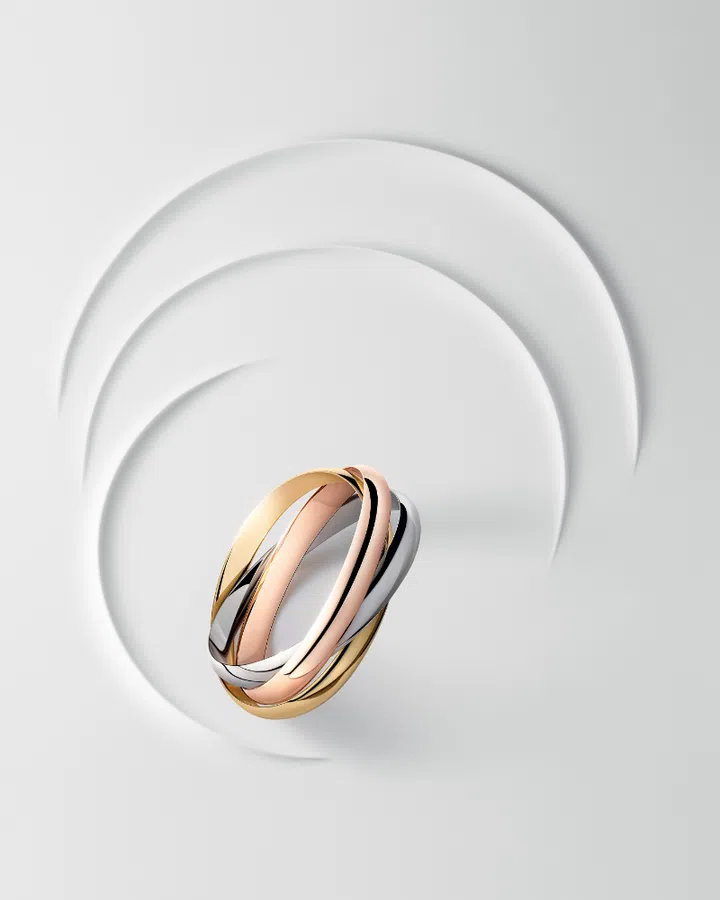
The next day, as I contemplated the previous night’s revelry, I decided to look into the storied history of Cartier’s Trinity ring. Created in 1924, this iconic piece of jewellery has transcended time, embodying the essence of Cartier’s most cherished values for a century now. It’s a world where diversity, love, and creativity are unified—in the intertwining of yellow, rose and white gold rings.
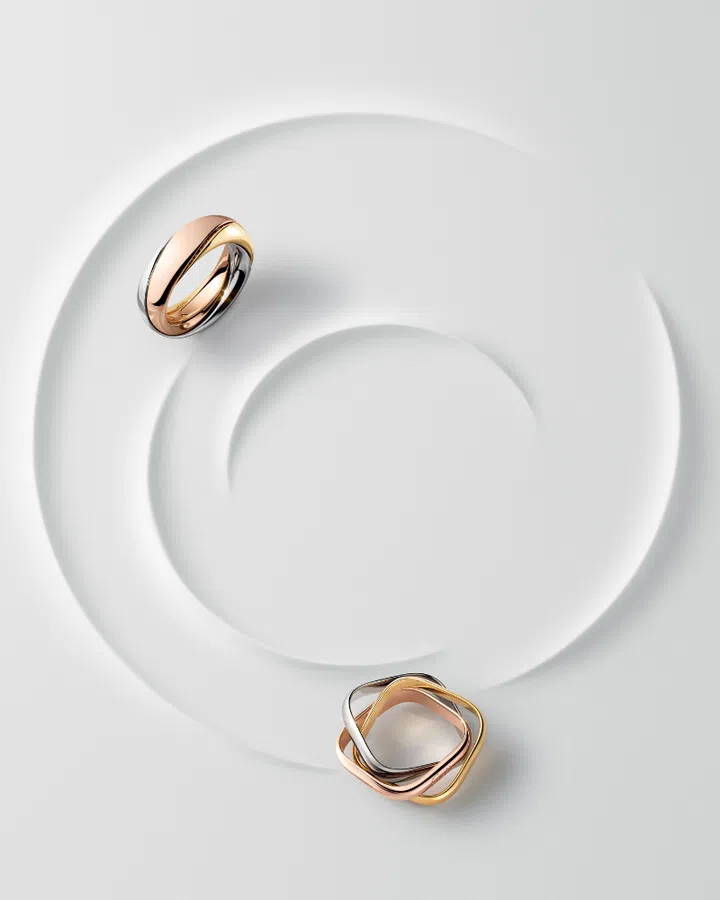
From top to bottom: Trinity ring, large model, white gold, rose gold, yellow gold, $5,550; Trinity ring, white gold, rose gold, yellow gold, $37,600, Cartier
Conceived by Louis Cartier, the Trinity ring defied conventions of its time, becoming the cornerstone of Cartier’s design ethos. Rooted in the history of the three Cartier brothers and their iconic boutiques in Paris, London, and New York, Trinity embodies the essence of unity and universality.
Yet, Trinity’s brilliance lies not only in its illustrious past but also in its ability to reinvent itself over the years. Cartier’s creative prowess has continuously breathed new life into Trinity, exploring diverse materials, shapes, and designs while staying true to its timeless elegance. From fine rings to wider bands, from classic gold to dazzling diamonds, Trinity has always embraced innovation.
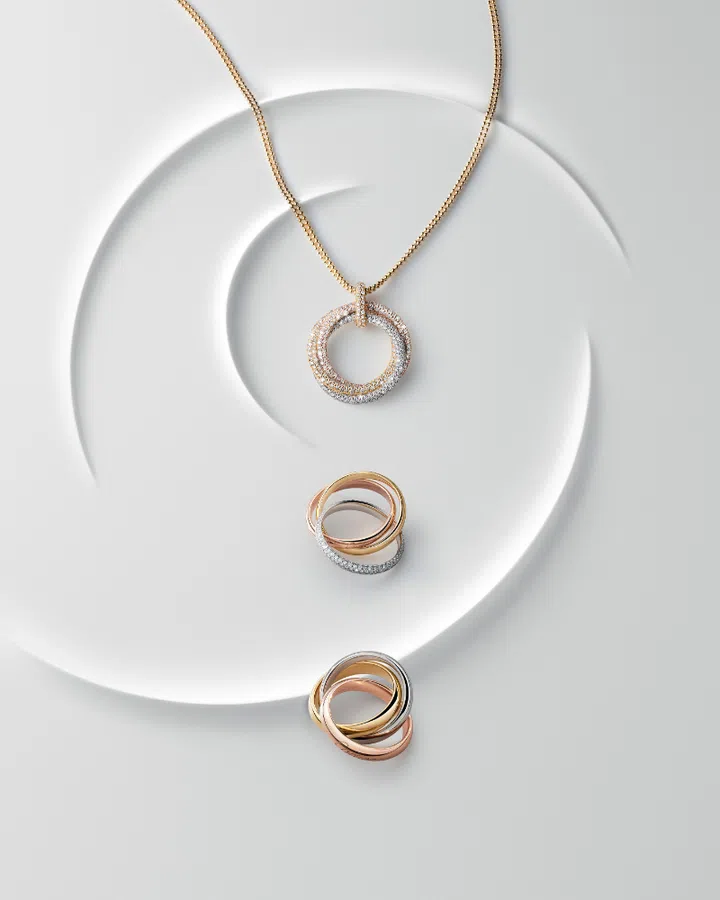
From top to bottom: Trinity necklace, large model, white gold, rose gold, yellow gold, diamonds, $32,000; Trinity ring, medium model, white gold, rose gold, yellow gold, diamonds, $14,100; Trinity ring, large model, white gold, rose gold, yellow gold, $5,050, Cartier
In the Trinity’s centennial, Cartier has unveiled a series of creations that pay homage to its illustrious heritage while embracing the spirit of modernity. The introduction of a cushion-shaped version and a modular design reflects Cartier’s commitment to pushing boundaries and challenging conventions. The XL bracelet from the 2000s—a cult creation—has been reissued, and an XL version of the iconic ring has been launched.
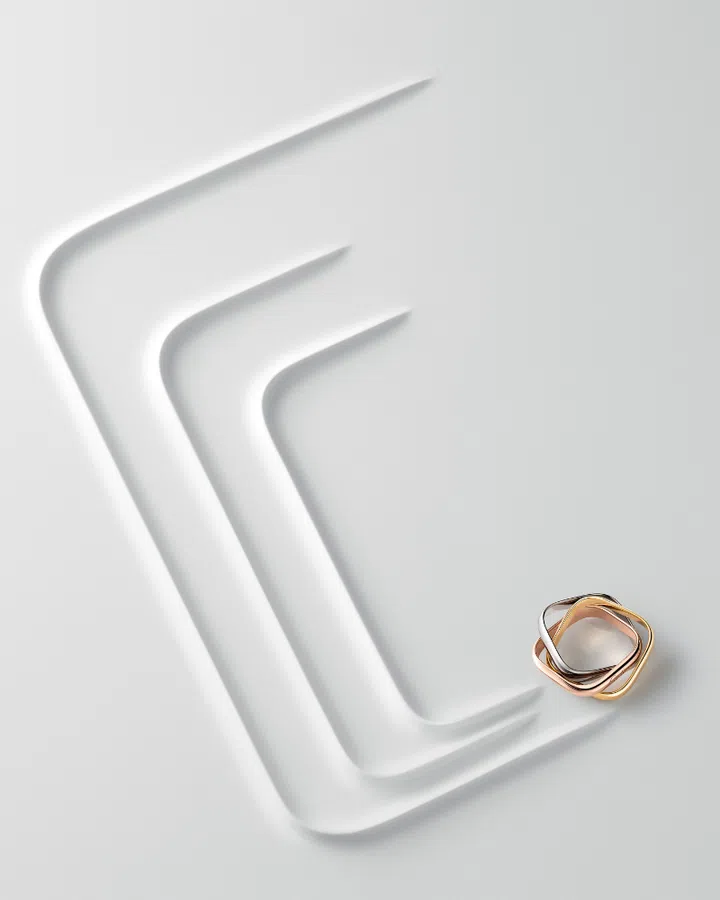
Trinity ring, large model, white gold, rose gold, yellow gold, $5,550, Cartier
The cushion shaped version’s three rings slide one above the other with the same naturalness as the round version. It was not a mere aesthetic choice, but the result of a bespoke approach that prioritises innovation and precision. Similarly, a modular version can be worn as one wide, large band, or as three. Interlocking, the three bands unfold like a construction game, revealing diamonds as they move.
Related article: BAZAAR Exclusive: A First Look At Jisoo, Jackson Wang And Paul Mescal For Cartier’s Trinity Centenary Campaign
Trinity bracelet, extra-large model, white gold, rose gold, yellow gold, $40,000, Cartier
I, for one, adore the new supersized versions. Cartier is reissuing the Trinity bracelet, a true cult creation, as a maximalist model. Three spectacular bands replicate the mobility and fluidity of the ring—but are made to encircle the wrist. Cartier has increased the volume of the three bands in this XL version.
Beyond its aesthetic appeal, Trinity holds great significance in Cartier’s cultural legacy. From lighters to pens, Trinity’s iconic design has permeated every aspect of Cartier’s lifestyle collections.
I speak to Marie-Laure Cérède, director of watchmaking and jewellery design, about the new Trinity collection:
Tell me about the creative process of designing something so iconic, to marry something modern with heritage and history?
M: It’s a classic design and shape. We always start with a hand drawing and the first question was, what is Trinity today for us? It’s three independent bands that are inseparable, so it has intimacy with the wearer. It’s also a story of inclusion because the Trinity is very contemporary. Like a sculptor we start from a classic shape, and then we work it, compress it, expand it and isolate each band till we reach this cushion shape and then millimetre by millimetre, we adjust it till it rolls, and is so smooth, aesthetic and ergonomic.
Related article: Cartier Goes Wild With Bejewelled Novelties At Watches & Wonders 2024
What excites you about jewellery design today?
M: There is no gender in jewellery today. So it’s more a question of concept; of meaning. It’s about finding something beautiful and thoughtful at the same time. It’s not about whether it’s fashionable, or how many carats the stone is or about decoration. What do you want this jewel to say? Like our modular design is not one ring, but two. One ring with two different worlds inside. Perhaps one for day and one for night.
What are the qualities that define a modern woman today?
M: She has to be audacious, authentic and free. Now, those qualities define men as well, and Cartier’s aim to spread the message of love, diversity and creativity certainly calls out to me. I’ll be putting in my order for a supersized one ’cos, like all things I love, why settle for small when size matters?