
Introducing Singaporean Artist Jane Lee, On Display Now At Singapore Art Museum
Lee is known for her multi-dimensional works and innovative use of everyday materials in her practice.
By Gloria Tso - published
Harper's BAZAAR editions worldwide have always been dedicated to celebrating the global achievements of women in art. In that spirit, Harper's BAZAAR Singapore is pleased to introduce pre-eminent Singaporean artist, Jane Lee, to the world ahead of the final weekend of her exhibition at the Singapore Art Museum, Lila: Unending Play. Known for her multi-dimensional works and innovative use of everyday materials in her practice, Lee is already a household name to many familiar with contemporary Southeast Asian art.
Lee's other installation in Singapore, In Praise of Silence, held at STPI Creative Workshop and Gallery, recently closed to rave reviews. The exhibit marked a new chapter for her, exploring the concepts of yin and yang, light and shadow, and rebirth and renewal, returning to the roots of Eastern philosophy. It's a more solemn and austere step back for Lee, who says the exhibition reflects her own return to the practice of 'Return to Zero,' an Eastern teaching which encourages letting go of one's attachments to the material world. Read ahead for our insightful interview with the renowned artist.
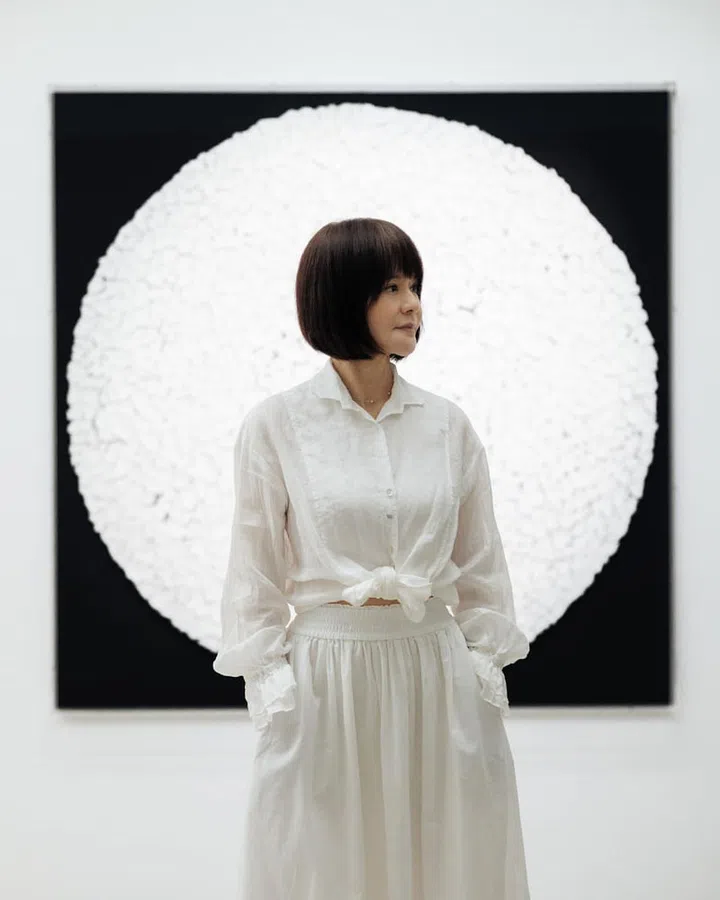
Jane Lee. Photo by Toni Cuhadi. Image courtesy of STPI – Creative Workshop & Gallery, Singapore.
Jane Lee
For readers who aren’t as familiar with your work, could you describe your foray into the fine arts? What drew you away from your initial work in fashion design? Did your training as a designer inform your work as an artist or vice-versa?
Jane Lee (JL): I was originally trained as a fashion designer, specifically designing teenage streetwear. However, l later realised that designing fashion in Singapore could be quite creatively limiting. Because of our weather, local fashion seems to be more focused on functionality. I also realised that after my designs were passed on to other departments, the final product ended up being quite far from my original ideas. That’s why I moved into fine art – I felt this path allowed me full control over my ideas, and allowed me to expand the breadth of my creativity. I trained in realism painting, but also felt that it did not satisfy me either.
I studied in London for a year, hoping to discover and understand contemporary art, as well as what I wanted to achieve in my own artistic journey. It felt like starting from zero all over again. It was in one of my painting lessons where I embraced freedom and spontaneity. Thus, I found the answer I was seeking: play! I wanted my art process to allow me to play, play like a child! This is a basic principle that has underscored my practice to this day. Although I no longer do fashion design and realism painting, I believe the training I received still influences my contemporary art practice, even if on a subconscious level.
Related article: ART SG: Acclaimed Thai Artist Pinaree Sanpitak Reimagines Valentino’s Toile Iconographe
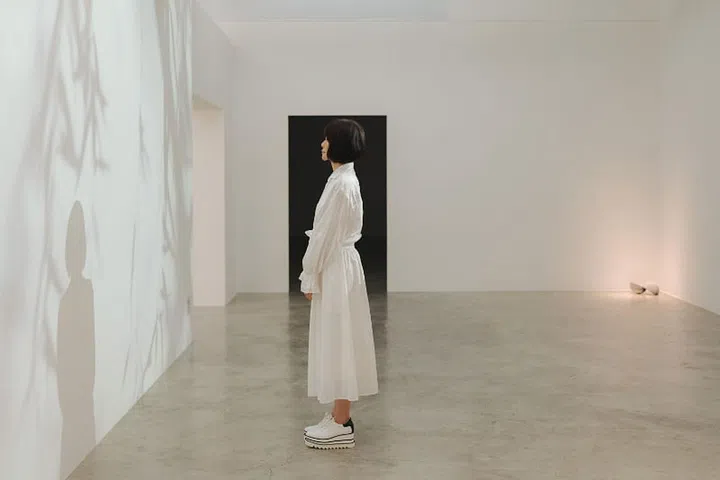
Jane Lee. Photo by Toni Cuhadi. Image courtesy of STPI – Creative Workshop & Gallery, Singapore.
Jane Lee
As one of the pre-eminent Singaporean artists in the industry today, could you speak more to how your identity translates through your work?
JL: The beauty of art is that the making of it is a reflection of the artist, and their growth throughout their various stages of life. In my earlier years, my interest was in the material world. My earlier showcases, which consisted of vibrant colours, reflected this state of being.
Now, I am interested in finding the essence of being, a journey of looking inwards. In my own life, I have been searching for my true self – who I am fundamentally. This spiritual growth has shaped me tremendously in terms of what I think and do, and so naturally, it affects how I approach my artistic practice.
My latest works [created with STPI] are mainly monochromatic, although some utilise the natural colours found in the materials I am playing with. This reduces the use of manipulated or man-made colours, which may distract viewers from the concepts I wish to express.
Pieces from Jane Lee's recent exhibition at STPI, In Praise of Silence. Image courtesy of STPI – Creative Workshop & Gallery, Singapore.
Pieces from Jane Lee's recent exhibition at STPI, In Praise of Silence. Image courtesy of STPI – Creative Workshop & Gallery, Singapore.
What challenges have you faced learning to re-examine your own knowledge of Western painting practices in a post-colonial Southeast Asian context? How have you learned to develop and assert your own artistic identity in this context, straddling both cultures in the ‘post-colonial’ sense? Are there aspects of your work you find to be distinctly Western, distinctly Southeast Asian, or neither?
JL: Most of the subject matters I explore are relevant to all living things – be it the essence of painting, or the essence of our human existence. Rather than human subjects, I create artworks that reflect upon universal concepts that transcend social terms and boundaries. When I first started painting, because I was trained in the Western practice, I created works by adding layers upon layers to achieve the surfaces and textures I desired. Through the years, however, I began to embrace subtraction, deduction and negative space, as I became more influenced by Chinese landscape ink painting. Although these practices are aesthetically and culturally very different, I believe that there is a universal language that links all human beings. We are all one – united together on a deeper level.
Your paintings simultaneously explore layers in both the literal and figurative sense – layers of textures for sure, but also layers of meaning. What do you think stands out about paint as opposed to other mediums? Is there something you feel can’t be communicated the same way through other forms of art?
JL: I believe each material has its own life and a story to tell – if we allow it. The medium and materials I choose to use will be an integral part of the story of each work, whether it is the essence of the painting, or what paper can do. For example, the elements in the paint medium (paint, canvas, stretchers, etc) all become main figures in the story of my painting.
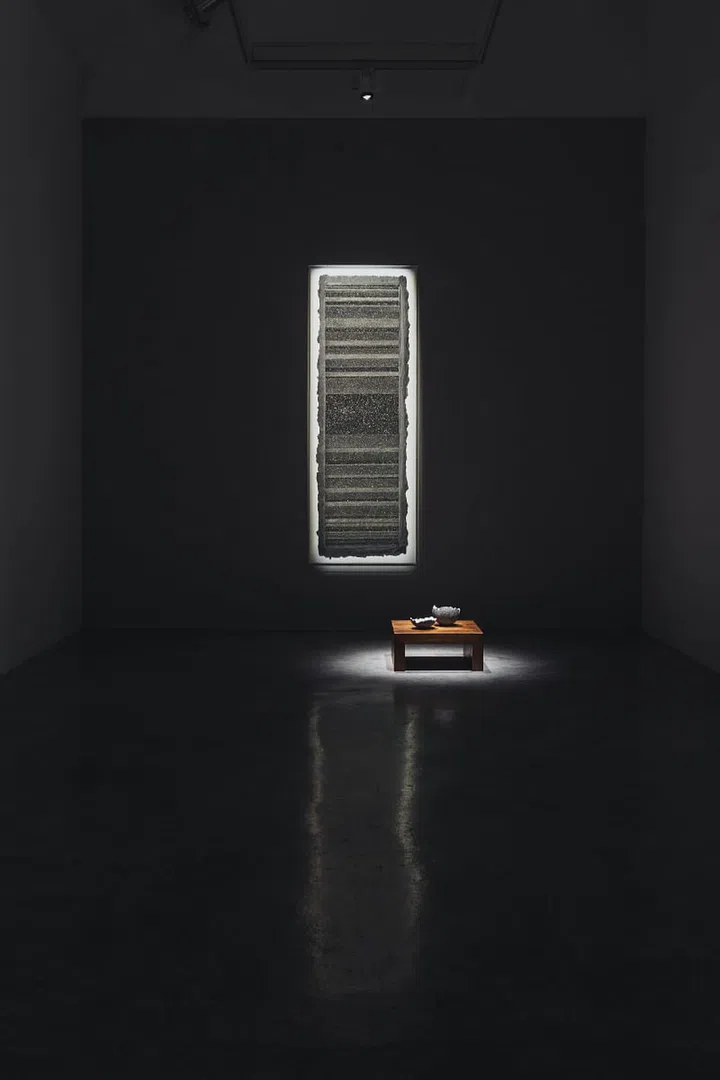
Lee is well-known for multi-dimensional artworks which need to be observed up close in order to be appreciated in full. Image courtesy of STPI – Creative Workshop & Gallery, Singapore.
In Praise of Silence, Installation
That multilayered practice, which is a common thread throughout your work, means your paintings often give off the impression of ‘jumping’ out at the viewer, reducing the spatial relationship between the observer and the observed. Does the closing of that distance, that three-dimensionality, say something about your aims as an artist? Do you think this makes your art more interactive and thus accessible?
JL: One of the elements that really interest me is pushing 2-dimensional works into 3-dimensional works and beyond, and this is something I have attempted repeatedly in my artworks, be it stretching a flat painting into something 3-dimensional, or doing 3D printmaking and paper sculpting. Perhaps this interest was borne from tactile and textural experiences I encountered in my past.
It’s also unexpected to approach what you think looks like a two-dimensional piece from a distance, only to discover that it is, in fact, 3D instead. We use the term trompe l’oeil a lot in fashion, and it’s resurged in recent years probably in large part due to social media. But it’s more than just a trend when you consider its roots in the fine arts. What do you hope happens when viewers come to interact with your works and find themselves deceived by first impressions? What interpretations do you hope they take away from these pieces?
JL: To me, visual art doesn’t involve just our visual senses – all the other senses come into play, literally! Ultimately, art is very much like a game of hide-and-seek. I hope my works allow viewers to engage their senses as they discover, experience and even redefine their personal meaning of ‘art’.
In Praise of Silence utilises the egg motif throughout the exhibit. Image courtesy of STPI – Creative Workshop & Gallery, Singapore.
Lee says the eggshell imagery is meant to evoke awareness of existence, the ultimate force of life. Image courtesy of STPI – Creative Workshop & Gallery, Singapore.
You’re also well-known for using everyday items in unusual ways in your art (or maybe, the rest of us are unusual for thinking it’s unusual!) – take the egg shells in your latest exhibit, In Praise of Silence, as an example. Rarely do any of us question how we might be able to use, and reuse, organic, material or consumerist pieces differently – which speaks to our sustainability problem, too! What inspires you about these objects and what drew you to viewing them in an artistic light?
JL: My exploration of the eggshell imagery for In Praise of Silence 寂靜在說話 focused not so much on the superficial or surface imagery, but rather the inner force that cracks the eggshell open – which to me, is the ultimate force of life in the world. The Existence. Art and life have been inseparable in my world, therefore I try to bridge the gap between the two in my works. In the past, paintings were regarded as only for the elite or the rich. Instead, I hope to bring my art-making as close to the ‘ordinary’ daily life as possible through the processes and the tools I use.
Related article: ART SG Director Shuyin Yang On Launching Southeast Asia’s Biggest Art Fair Yet
One way to interpret the transformation of materials in your work - threads of acrylic paint, enamel and silicone twisted and manipulated - is to see it as a cross-cultural exchange of ideas. The breaking down of barriers. I’m curious what you hope to illustrate through this. Writer Tony Godfrey said your philosophy is about “relating to and performing with the material world…belonging in a world we did not make – but that we can, if not remake, participate in.” What message do you think we humans should take away from your pieces, about how to relate to this material world we live in, the inanimate objects and countless materials we interact with in our daily lives?
JL: Through my art, I hope people can break through old beliefs and knowledge that we inherited from the past, and then relook and question those values imposed on us from generations and years ago.
You speak about construction, deconstruction and reconstruction in your work, as well, in how you commonly take ‘scraps’ and refashion them into an entirely new piece of art. Do you find that this regenerative art of constantly reusing and rebuilding inspires you to look at your own artworks in a different light? Do you find that all your work is connected somehow? Or, do you see your art as one common body of work as opposed to individual pieces?
JL: From a surface, all my artworks may look different, but on a deeper level, they are all closely related. Life is, interestingly, like a puzzle. At the end of the day, all the pieces form together and unite as one.
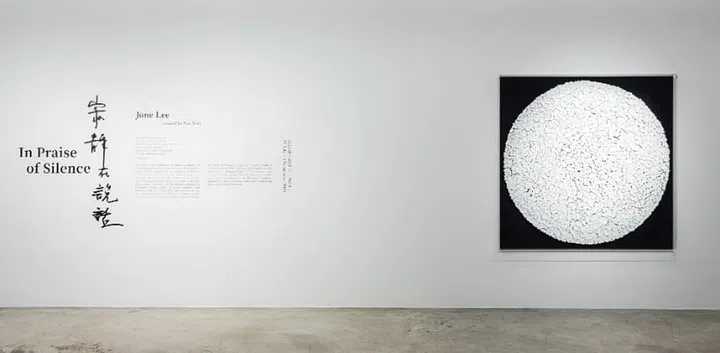
In Praise of Silence was curated by Tan Siuli, an established independent curator focusing on contemporary Southeast Asian art. Image courtesy of STPI – Creative Workshop & Gallery, Singapore.
In Praise of Silence
In Praise of Silence draws upon two distinctly Asian sources of inspiration: Jun’ichirō Tanizaki’s essay In Praise of Shadows and Laozi’s Dao De Jing. Since this latest exhibit reflects a distinct swing back to the Asian side of the pendulum for you, did you ask yourself how Western audiences might perceive these pieces without a prior understanding of Eastern philosophy, let alone any references to those works?
JL: The ‘East’ and ‘West’ are categorised in a relatively superficial way. In fact, all of us are human, and we all share the same qualities – the quality of wanting to be happy, to be calm, to be free, to be silence itself. These universal qualities that make us human, regardless of where we are from, are introduced in this exhibition. Viewers will be able to connect as long as they allow silence within themselves as they experience the exhibition. This experience goes beyond words and explanations – it will be just as it is.
You use the egg motif as a metaphor for many things throughout the exhibition, a method through which you can explore the concepts of rebirth and renewal. How do you think this “return to austerity in form and expression,” in your own words, reflects your own rebirth and renewal as an artist? What sort of ‘new chapter’ does this exhibit mark for you?
JL: I have been practising ‘Return to Zero’, an Eastern teaching, through many phases of my life, through certain beliefs I’ve held onto, or even skills I’ve accumulated over the years. I often let go of things I’ve previously held on to, and start all over again from zero. By doing so, I practise not holding on too tightly to things in the material world. It also allows me to start afresh and view life through a new and different perspective. In this way, I rebirth and renew myself all the time.
Many of Lee's works play with minerals and crystals. Image courtesy of STPI – Creative Workshop & Gallery, Singapore.
This crystal-made installation for In Praise of Silence introduces a natural colour gradient. Image courtesy of STPI – Creative Workshop & Gallery, Singapore.
Related article: Dive Into The Ether Of NFTs And AI At ArtScience Museum’s Latest Exhibition
To me, the use of minerals and crystals, along with eggs, makes this exhibition feel like getting more in tune with nature and mother Earth. Was that a conscious choice for you given your heavy focus on transformation in your art? The reuse and recycling of materials?
JL: Perhaps I was trying to bring everything back to the very beginning – the ultimate essence of things. And somehow, I became more in tune with nature and Mother Earth.
Lastly, what do you hope viewers take away from this exhibition and what can they look forward to in your future projects? Any idea which direction this new energy will take you next?
JL: I don’t dwell too much on planning ahead. Instead, I thrive on the unknown to bring me forward. It is certainly more interesting than pre-planning! One is full of excitement, while the other is dead. There is no flow if everything is predictable.
At-large images of the STPI exhibition space. Image courtesy of STPI – Creative Workshop & Gallery, Singapore.
At-large images of the STPI exhibition space. Image courtesy of STPI – Creative Workshop & Gallery, Singapore.
I traveled through In Praise of Silence, ironically, on my phone - lots of noise, incoming texts, messages and posts on social media. Capturing content at the exhibition for our readers and followers, I realised how little of my experience could be translated online. So many details must be seen up close. Nothing really beats walking through a quiet gallery alone. Given that social media is so prevalent these days, do you consciously think about how your works look digitally? Or is this something that doesn't concern you?
JL: I don’t wish to dictate how viewers should react or respond to my works. While the title of the exhibition is indeed about silence, you are right in that it is best to experience it alone, quietly. However, in this age of social media and technology, being online whilst at an art exhibition can’t always be avoided. There are two sides of the coin: social media helps reach out to more people by sharing digital images of my works, but then again, experiencing the artworks in person is still the best. I accept how modern technology shapes the way of art, and I choose to work with it rather than against it.
You currently have another exhibition on display, Lila: Unending Play, at the Singapore Art Museum. Like its name implies, the exhibit is indeed more playful and perhaps unconstrained compared to In Praise of Silence. Could you walk us through the different approaches you took to creating the works in these two exhibitions? For a first-time viewer of your work, which would you recommend seeing first?
JL: Both exhibitions, while titled differently, point to the same concept of the ultimate essence of life. For me, Silence is the core of our existence, and the essence of true being. In human cultures, we can most easily equate Silence as God, the ultimate, or Tao, the natural order of the universe. Silence is hidden behind all words, all activities—it is the largest, hidden canvas of our life. ‘LILA’, a Sanskrit word, loosely translates to ‘divine play’, which refers to the effortless way Silence, or God, relates and plays with the world.
Both ‘play’ and ‘silence’ are the higher qualities that we humans are born with, and these same qualities will set us free to give us internal happiness and peace. Again, materialising these higher forces of energy through my works is what I am interested in. Which would I recommend seeing first? Possibly see Lila: Unending Play first, then see In Praise of Silence 寂靜在說話.
This interview has been edited and condensed for clarity.