
Catching Up With Jemimah Wei, Singaporean Author Of ‘The Original Daughter’
Her novel even made an appearance in Laufey’s book club.
By Syaza Agape - published
“I really enjoy languages but I’m kind of terrible at all of them, I guess I’m only good at English,” exclaims Singaporean author Jemimah Wei, who refers to herself as a “linguistic tourist” of sorts. Although, she is much more than that—from being selected to become a Stegner Fellow at the University of Stanford, California in 2022, to most recently clinching the title of honouree for the National Book Foundation’s “5 under 35”.
Wei might look familiar to those who caught her on YouTube during her hosting days with Clicknetwork circa 2016/17. Since then, she has made the jump into a literary career and moved to the States after attaining a scholarship with Colombia University to pursue her Master of Fine Arts (MFA) in 2020.
She’s about to release her debut novel The Original Daughter in Singapore, after wrapping up her book tour in the US and the UK. Wei shares, “The Original Daughter follows two sisters, one adopted; growing up in a rapidly modernising Singapore, where their once intimate relationship becomes violently estranged on their path to fame and fortune.” It has even racked up a few famous fans such as Laufey, who featured it on her book club. We caught up with Wei when she was back in Singapore for a short stint to find out what has been keeping her busy and grounded.
Can you recall the first book you ever read? Tell us about it.
I read so much as a kid, but I feel like one of my earliest memories is of children’s books. There’s this one that really stuck with me. I think I was two or three years old, and I remember this book called Love You Forever by Robert Knapp. It’s the one that goes: “I’ll love you forever, I’ll like you for always, as long as I’m living, my baby you’ll be.” And at first it’s a mother reading to a son and by the end the book it’s a son reading to the mother when she’s old. And every time I read that book, I used to bawl my eyes out. I also was really into The Giving Tree [by Shel Silverstein] when I was a kid.
I feel like those were my earliest experiences with narrative and with fiction, and it really opened up my my life to an imaginative realm that you know you would not encounter as a child living in Singapore. Realistically, you just would not climb up trees and see other worlds. As a kid, everything to you seems egalitarian in terms of reality. You believe things that you see, and so I feel like my inner life as a child was very rich because of all these fictional worlds I read about.
Related article: Robert Zhao Might Be One Of The Best Singaporean Artists That You’ve Never Heard Of, Until Now
Who were some authors who inspired you growing up?
I read really widely when I was growing up, so it’s really difficult for me to differentiate which authors kind of made an extremely large impact on me. But as an author now, I think foundational to my literary consciousness as I was growing up was James Baldwin’s Giovanni’s Room.
What career path did you intend to take growing up?
Gosh, so like every English major, I thought I would become a lawyer. But I just don’t think my personality was suited to it. [At the time,] I didn’t know that being a writer could be a career. So I was just kind of figuring [my career] out as I went along.
Although, when I was a kid, I wanted to be an astronaut because I was really attracted to the idea of big dreams. When you’re a kid, you kind of don’t think what is possible and what’s not possible. I wanted to be an astronaut because I thought I was really attracted to this idea of going off for a long period of time by yourself, which I guess is what I do now anyway, as a writer.
How do you get into that writing space?
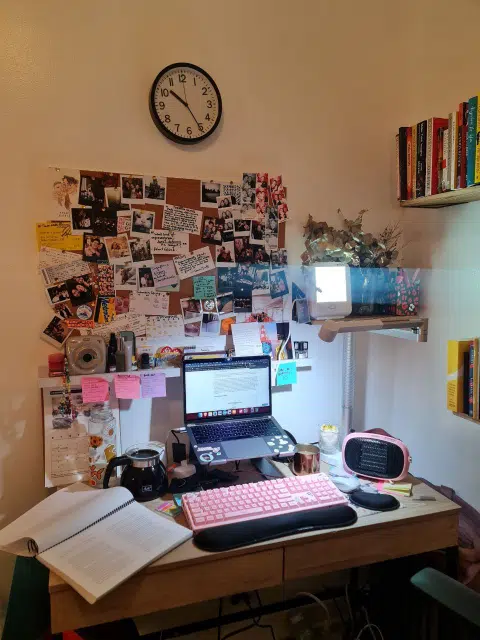
When I was living in Singapore, I actually rented an office, and I would go there and write late at night or early in the morning before I started my working hours. And that, to me, was really important, because when I was growing up, I did not have my own desk. I would work on the kitchen table, which you have to pack away everything when it’s time to eat. There was no space of my own. When I moved to New York, that was one of the first times I had a room of my own, and that was so important to me.
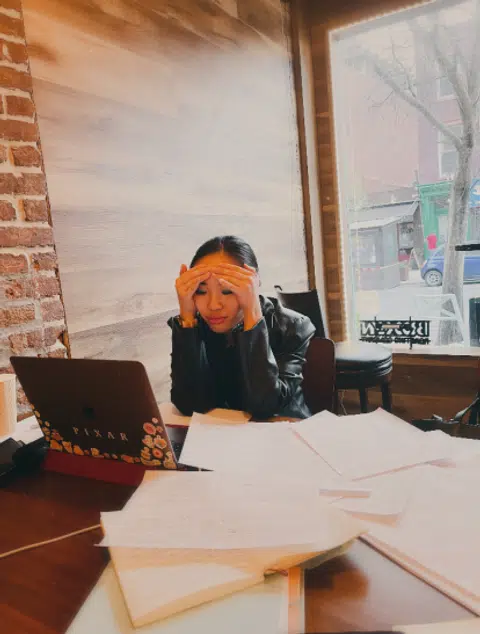
So despite my table being substantially big, basically my papers would still go everywhere. I had like a murder map on my wall, and Post-its, you know kind of like those memes with the guy pointing, that was literally me. And I would pack everything up and bring it in this giant file to the different libraries or cafes around New York and do my work there. And I looked kind of insane; like someone came up to me once, and she was like, “I don’t know what is going on here, but it’s kind of crazy and awesome”. We eventually became friends and I found out she was a poet, which was really cool.
When I moved to California, it was the first time I had a large writing desk and stability, because I was there on the two-year writing fellowship. So for the first time, I knew this is going to be my life for two years, which I had never had for over a decade, because I was a freelancer. And because of that, I really feel that writing became a job, you know?
Was there a moment that made you decide you wanted to become an author or tell stories?
I remember taking a master class with the Malaysian author Tash Aw in Singapore, and that was when it shifted something for me. It was my first time meeting a writer who was writing full-time and who’s from our region. And then I was like, “Well, if he can do it, it stands to reason that it’s within the realm of possibility.” And then that’s when I seriously started thinking if someone can do [writing] full-time that isn’t born in, you know, the UK or America, there is a way to visualise a roadmap for how I can get there. [Tash] then became like an unofficial mentor to me.
I remember once I went to Kinokuniya, and I went to the Singaporean literature section, and wrote down all the names of people on that shelf. And I would just email random people being like, “Hi, I also want to be a writer, and I just want to know what your journey is.” And then I would, you know, read interviews of them online, or people online, seeing how they made that writing life for themselves. But I feel like it’s one of those things where, if you don’t know, you don’t even know what questions to ask. So that’s why I feel like meeting Tash was a real inflection point for me, because before that, [writing a book] was just this idea in my head and I didn’t know what those steps would look like.
Related article: Meet Gen Neo, The Singaporean Singer, Songwriter And Producer Who Has Worked With The Likes Of GOT7 And ENHYPEN
In your opinion, what makes a good story?
The works that I love have a certain skinless quality to them, these stories feel like there is almost no membrane. You can think very deeply into the world of the story, and that is something I strive for very deeply with my fiction, to try and write with that skinless quality. Even if I’m writing about something that is set in a completely different world, or in a totally different reality, it should read as absolutely true, so that the reader feels completely immersed in the world of the story.
The best writers that I love, or the best books that have stayed with me, have not necessarily been the most technically perfect books in terms of craft or in terms of pacing or plot, but it’s really the stories that have the most heart. I’m a chronic re-reader so I feel like every time you re-read a book, you get something new from it.
What propelled you to make the move to the US?
I felt like I hit a ceiling in terms of how much I could progress on my own. Some people can have a day job and write and be very successful, but I really struggled because I didn’t have a traditional day job. I was a freelancer, and it’s really hard to balance that time. So you end up taking on more jobs instead of clocking out a specific time to go home and write. At the back of my mind, I always thought I want to further my studies. And at that point, I didn’t know what an MFA (Master of Fine Arts) was. I thought: if you want to be a writer, maybe you get a PhD in literature and move to the US.
Related article: 18 Singaporean Brands That Have Gone Global
What were some challenges you faced, and how did you overcome them?
At some point, I just thought to myself, maybe I should take the leap and just give myself two years to complete my MFA as it’s not something we have in Asia. I tried to apply for all these internships at publishing houses in the UK and the US, but I had no work visa. When I was in London, I was so hungry for contacts in the book world, and I ended up writing to Tash, and he encouraged me to pursue my MFA at Colombia School Of The Arts.
Just before you finish writing a book, you don’t know that you can finish it. And so, like most writers, or any kind of creative person dealing with art, there is a huge sense of imposter syndrome. Towards the last 10 percent [of writing the book], there’s a sudden burst of momentum where you’re like, “Okay, I can see what it’s supposed to be.” And that feeling, there’s this sudden acceleration towards the end of editing and revising a book by yourself. But everything before that was just so hard.
I think I was also really because I had made this big investment in going to the States, and I was really worried that if I didn’t finish a book and come back, I would have done it all for nothing. Now, in hindsight, I know that’s not true. [Writing] books take the time they take, and there’s no rushing something that’s not ready to be done. But at the same time, as a Singaporean, we have these ideas of KPI and structure. And if I go [to the States] for two years, I must finish a book. It was a real challenge for me, to unlearn my own standards and old methods of thinking, and be willing to embrace kind of the way my work evolved in its own time.
Your novel The Original Daughter was an 11-year long process. How did you stay motivated writing it?
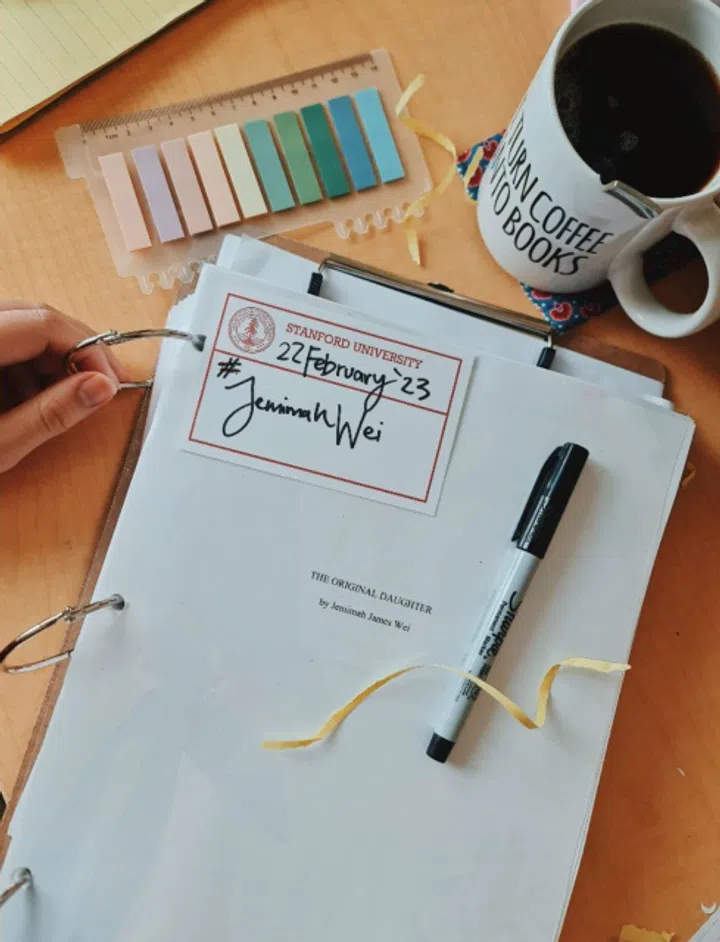
When I moved to California for the Stegner Fellowship, I remember being so stressed by [the probability] of not being able to finish this book that I wrote down every month [leading up to the end of] my visa, and I put Post-it notes above my table, and at the end of every month, I would just tear off a new month so I could literally see the time of my visa running down. Even on the days when I woke up and was so intimidated by this book that I didn’t want to go to my desk, I would just look at the Post-its and be like, “I don’t have time to worry. I have to get to work.”
Do you have any dream collaborators you’d like to work with?
I think it would be so cool to collaborate with a musician to write an angsty ballad or be part of an OST (original soundtrack). Writers work in such isolation, right? And I grew up as somebody who really loved musical theatre, but in Singapore, we don’t always have access to that.
[Another person I’d like to work with is] Nathania Ong, the Singaporean who’s on London’s West End and would be so cool as a vocal collaborator. Also the Chinese-Icelandic jazz musician Laufey—ever since she featured my book in her book club, I’ve become a stan! Now I listen to her music every day.
What keeps you going in your life and career?
I am alive, so that is the card I’ve been dealt, and part of the contract of being alive is that you just keep going because time doesn’t wait for anybody. The works that I’m interested in, a lot of art that I’m interested in centres around the cages that we live in, the cards we’re dealt and how we engage with life despite circumstances. I think for me that does reflect in the way I move forward as well. I am trying to see how I can make the most of the life that I have and engage with it in a way that is meaningful to me.
And honestly, it’s not like I’m moving towards some giant goal, like living to 80 and having all these things. I do think that for me, writing is this only reward. So I’m not quite thinking of what keeps me going. I’m excited actually to return to the page every day, even if it’s difficult. Writing is one of the most consistent sources of contentment and joy for me, even when I’m really, really struggling with it, because it is just a different mode of living and processing the life that you have.
Lastly, do you have plans to write a second novel?
Oh, yeah, I mean, I have all these plans but whether those plans become reality is a different story... which is a tale as old as time for everybody, right? I am working on something but I feel like I don’t want to scare her away, so I’m trying to pretend she doesn’t exist yet. It’s like Schrödinger’s cat, she might or might not exist depending on where you look.
Videographer: Studio +65
Post-production: Studio +65, Brandon Chia
Content producer: Syaza Agape