
Louis Vuitton Continues To Redefine The Memory Of Sport
Louis Vuitton’s long relationship with sport reveals itself not in the play, but in what remains after the final point. Kenneth Goh reports courtside from the Australian Open in Melbourne.
By Kenneth Goh - published
I’ve always thought the most revealing moment in tennis isn’t the winning point. It’s the point just before it.
At the Australian Open men’s final earlier this year, it came late in the third set. Novak Djokovic serving, bouncing the ball longer than usual. A small tell, if you’ve watched him enough. The rally stretched. Fifteen shots, maybe more. Heavy, controlled, a little suffocating.
And then Carlos Alcaraz stepped in early. Too early, you’d think. Took the ball on the rise and carved it cross-court at an angle that felt... unnecessary, almost. It clipped the line.
Related article: BAZAAR Exclusive: Get Ready With BamBam At The Australian Open
But the rhythm was already gone. By the time it was over, in four sets, it felt like the kind of match that comes back to you later. Not all of it. Just fragments. That rally. A return you didn’t expect. The noise came after. The release. Alcaraz rushing to his team, climbing into the stands, that slightly chaotic, unfiltered joy tennis still allows itself. And then, almost as quickly, everything settled into something more composed for the prize-giving ceremony.
Related article: Louis Vuitton’s Bespoke Trunks For The Australian Open Are A Piece Of Fashion History
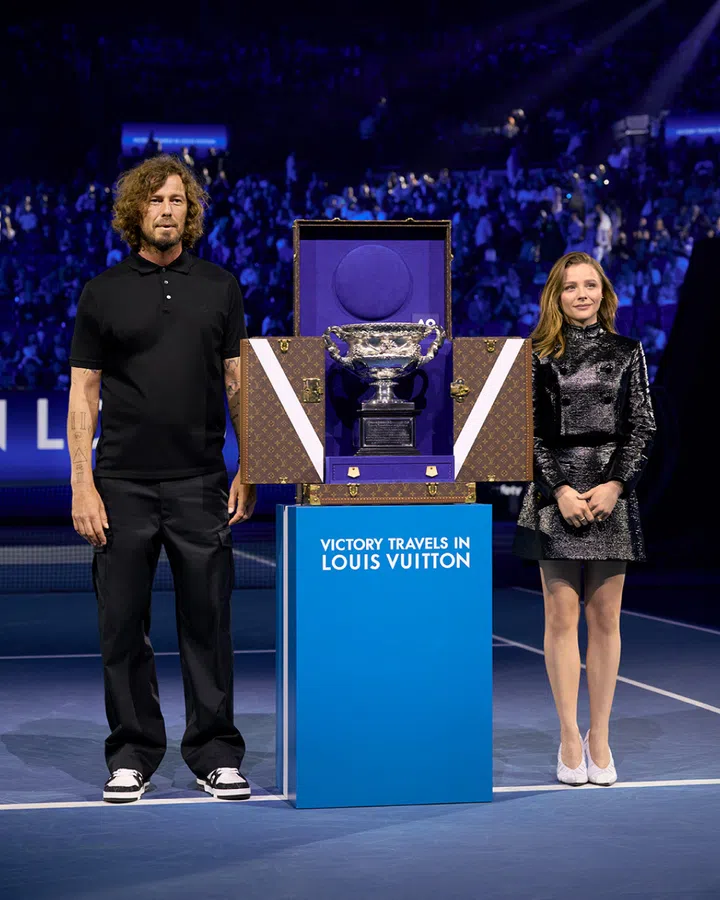
The Louis Vuitton trunk. The Norman Brookes Challenge Cup inside. The Monogram, perfectly aligned. That white “V” catching the light when the panels opened. It’s a beautiful object. Up close, even more so. The kind of precision you don’t question, because of course it’s created with the savoir faire of a House known for its marquetry and craftsmanship.
For a House built on travel, conveying things from one place to another, this has always been literal. Trunks, cases, objects designed to protect what matters. Preserve the object. Preserve its value. But sport complicates that. What matters most isn’t the object. It’s the moment. And moments are difficult things. They slip, they distort, they refuse to stay fixed.
Louis Vuitton’s long relationship with sport feels, in part, like an attempt to answer that. From the America’s Cup in 1983 to the FIFA World Cup, the NBA Finals, and more recently its presence in Formula 1, the House has positioned itself very carefully.
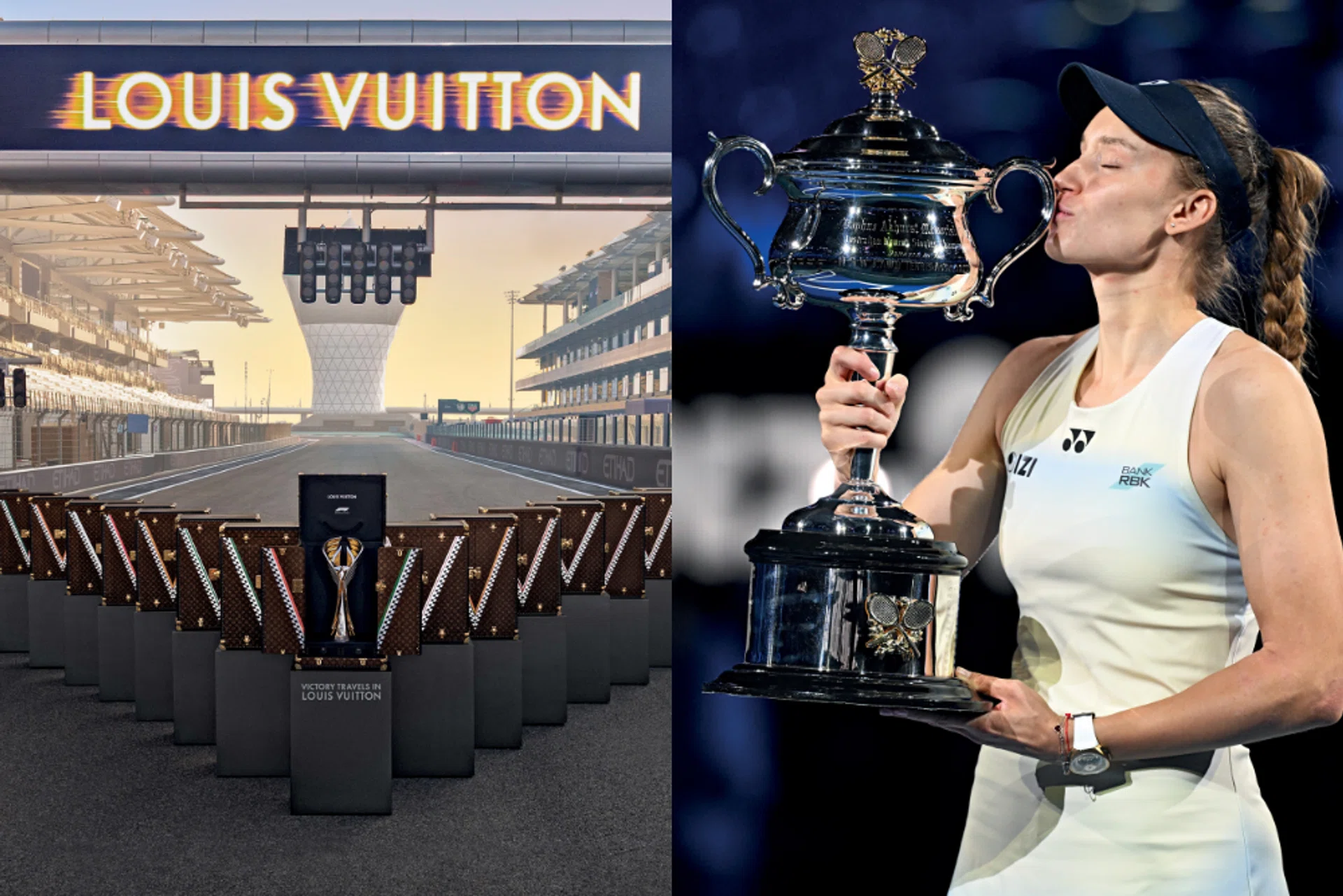
Not in the action but what happens after. I keep thinking about the image from the F1 races in Abu Dhabi last year. Twenty-four Vuitton Trophy Trunks across the starting grid, arranged in a precise V formation. It was striking. Almost too neat.
Tennis resists that kind of neatness. Even with all its structure, its rituals, there’s always a bit of mess to it. A bit of luck, whether anyone admits it or not.
Related article: Game, Set, Slay: Fashion’s Most Iconic Sports Moments
The women’s final had a familiar tension. Aryna Sabalenka playing on the edge, every shot landing with intent, sometimes just missing. Across the net, Elena Rybakina, almost unnervingly steady. Deuce, again and again. Sabalenka going bigger each time, pressing, one forehand drifting just long when it mattered. Rybakina barely shifting. Same tempo. Same flat delivery. When it ended, there was no real explosion. Just a small exhale. Easy to miss if you weren’t paying attention.
That’s what stays with you in tennis. Not the spectacle. The tension. The imbalance. The moments that feel slightly unfinished, even as they happen. And yet, sitting there, you’re aware of another version forming. One that will last longer than the match itself.
This year, the Monogram turns 130. A pattern designed in 1896, now framing some of the most contemporary moments in global sport. What began as protection has become something closer to authorship. Not of the game, but of its memory. Because that’s the shift. Louis Vuitton doesn’t just carry trophies. It shapes how victory is seen, how it settles, how it’s remembered later, when the details have already started to blur.
Sitting there after the men’s final, I realised I was holding two versions of the same match. The one I’d watched. Raw, slightly chaotic, built on instinct. And the one that would endure. Framed. Composed. Almost too perfect.
“Victory travels in Louis Vuitton,” the House states. Très chic. But sometimes the best parts of tennis don’t travel like that. They come back to you. Later. Slightly out of sequence. And never quite as neat as you remember.