
Welcome To The Age Of Bro-Tox
Cosmetic tweaks are no longer taboo, as more and more men seek solutions to better themselves visually.

By Aaron Kok WQ - published
Here are two questions for you to ponder over: when you look at yourself in the mirror, do you like what you’re seeing? And if you had the resources and power to change some or all of that, would you?
It’s no secret that we as a society have always favoured beauty and the pursuit of that eternal fountain of mythic youth. We pore over photos of celebrities; nitpicking at everything that they wear, say, eat, do and how they look. We’re quick to pick up on the fine lines that appear on our favourite actresses’ faces, as if ageing is forbidden under the unforgiving spotlights of public view.
This critical eye isn’t purely reserved for the A-listers of Hollywood. In the privacy of our inner spaces, it raises its sneering voice, telling you that you’re too rotund, your nose isn’t ruler-straight, your jawline isn’t razor sharp.
Yet, while plastic surgery has come to be accepted amongst the beautiful, the famous, and the women, the surprising trend today is this: more and more men are opting for tweaks big and small as well.
Related article: 5 Multitasking Grooming Products Worth Investing In
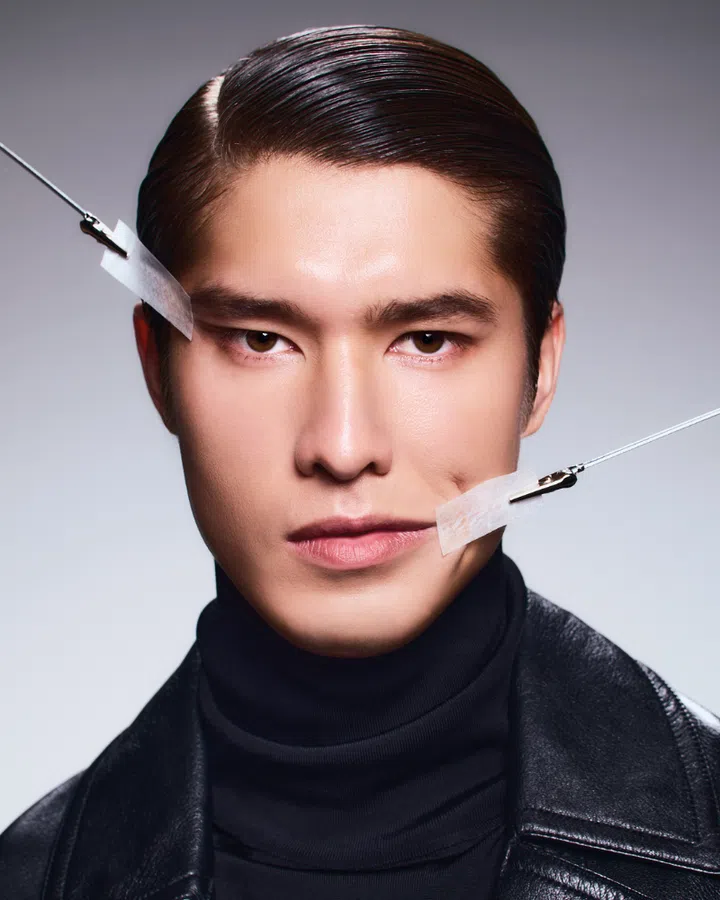
Jacket; turtleneck knit, TOM FORD.
It’s a surprising revelation because a mere decade ago, the idea of plastic surgery among men was often brushed off as being one of two main scenarios: it’s either reconstructive or it’s for the vain.
However, that notion has shifted so much in today’s context, as guys begin to wake up to the idea that their ideal features are just a consult and a knife away.
In July 2024, the All-India Institute of Medical Sciences highlighted that India had seen a 250-time increase in the number of males opting for cosmetic surgery. A study from Grand View Research last year notes that while India is poised to be the biggest growth market for male cosmetic surgery, the Asia Pacific market as a whole is expected to grow more than 15 percent in the next five years.
Related article: Spa Awards 2024/2025: The Best Facials and Aesthetic Treatments in Singapore
And while 2024 figures weren’t yet available at the time of writing, the American Society of Plastic Surgery’s findings in 2023 found that 18 percent more men were doing chest-related cosmetic surgeries, and male patients seeking facial surgery increased 15 percent compared to the year before.
“We don’t have readily published information in Singapore, but anecdotally among my colleagues in the practice, we are seeing more male patients,” shares Dr Rachel Ho, who runs a practice at La Clinic that specialises in minimally invasive aesthetic treatments. “And it’s also different types of guys, as we get more heterosexual and homosexual men both requesting for consults too.”
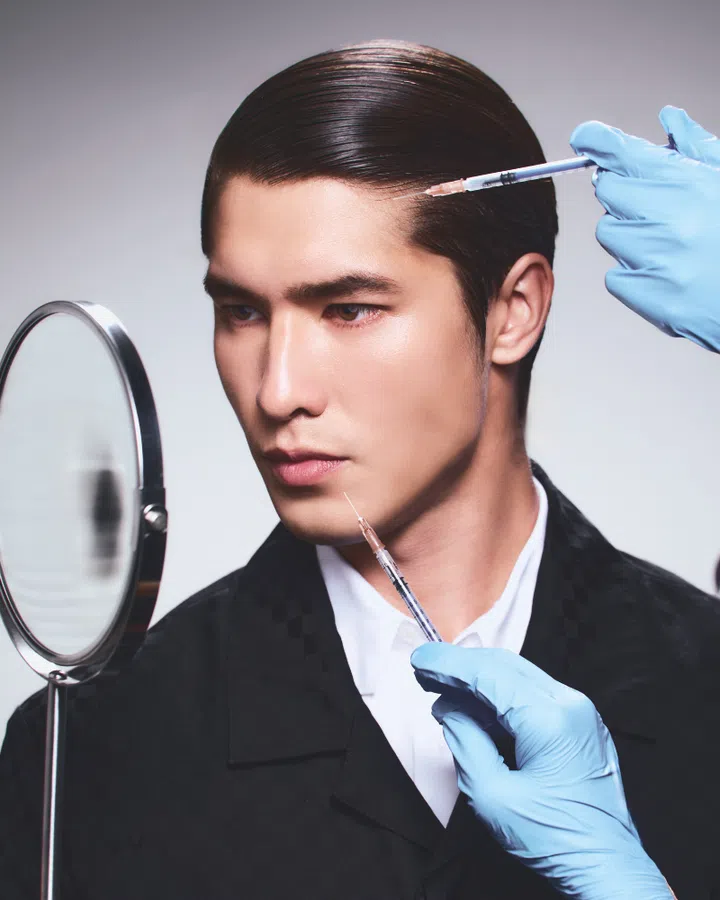
Jacket; shirt, LOUIS VUITTON.
Echoing Dr Ho is Dr Joshua Chong at Terra Medical Clinic, which provides hair restoration services. Dr Chong notes that in the last four years, his clinic has seen an annual growth of 5 percent, with more patients turning towards medical practices to solve their follicular woes. “The big boom came during the lockdown, because medical tourism saw a big dip so it became commonplace for everyday guys to seek help at home. And it’s also through word of mouth—a friend of a friend tells you that he had hair grafts done and it can be applied to you—that we’ve seen the spike in interest because people are more aware of their options now,” says Dr Chong.
He also points out that contrary to the belief that only celebrities are opting for tweaks, many of his patients aren’t in the public eye. “They’re sales people, housing agents, bankers, everyday people. They just want to look presentable at their age,” Dr Chong surmises.
When you view it from this perspective, doesn’t this apply to all of us? The saying goes that when you look good, you feel good inside too. We know that there is empirical evidence that shows that if two people are equally qualified with the right skills for the job, the offer often lands on the better-looking candidate. Throw in the factor of social media, and the pursuit for perfection is further magnified. Social media, after all, is powered by the mirage of perfection built upon the hiding of flaws.
We’re inundated with visuals of perfect men with perfect jawlines and hairlines, wistfully going through life with every door open, followed by vlogs of content creators documenting their blepharoplasty procedures or getting their prized double eyelids.
Related article: Male Fashion Influencers Are Going To Take Over Your Social Media Feed. Are You Ready?
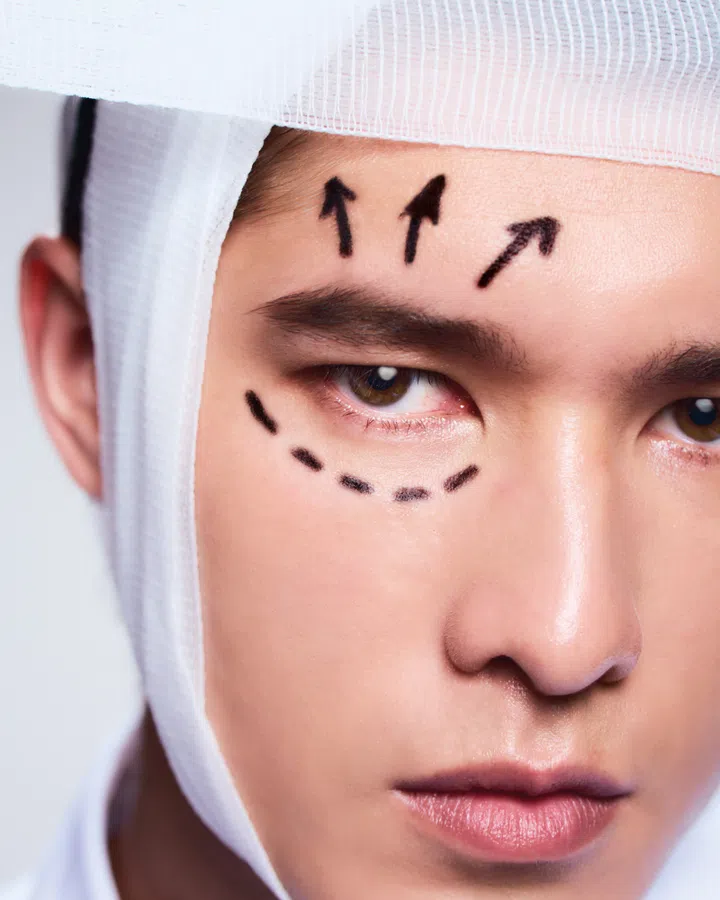
Shirt, KENZO.
“Social media has changed the way that we are exposed to cosmetic surgery,” reiterates Dr Marco Faria Correa, a Singapore-based plastic surgeon with over 35 years of experience in the field. “Beauty has always counted for something, but with social media putting everything on display, the notion of looking your freshest, most energetic and best self has never felt more important than right now.”
Over a call, Dr Marco points out that while his patients often come in due to different reasons—some of them spurred by a yearning to tweak the way they look, and others who are brought in by their partners—he often sees the mental and emotional catalysts that would lead someone to go under the knife.
“More and more, guys are aware that these kinds of procedures aren’t as frivolous as naysayers would have them believe,” says Dr Ho. “To them, it’s a form of self-care. For someone who has been struggling with their appearance so much that it affects their social and sexual lives, to be able to get it treated and find a greater sense of self-esteem is far more fulfilling.”
It’s an interesting thought that more men are viewing cosmetic procedures as an extension of wellness, and why shouldn’t they? If we are to believe that society has wised up to the positive benefits of taking care of one’s mental state of being, and fixing a nose that has long affected one’s mental health through years of bullying, insecurity and so on, then fixing the flaw is an act of self-care. Sure, it’s more radical than journalling or breathing exercises, but it gives the patient a greater sense of confidence.
“I venture down this thread of thought,” says Paul Foster, who has shared openly about his journey of restoring his hair on social media. He shared how it was his longtime hairstylist who first noticed that he was losing hair. This led him to seek hair transplantation help.
Foster also joins a small-but-growing band of celebrities who are open about their journey of tweaks, including the likes of singer Joe Jonas, who was recently unveiled as the face of Xeomin, an alternative to Botox. “When I shared my journey with my followers, I had people reaching out to me and they’ve all highlighted that they’re on this journey for the purpose of self-betterment. They are 30-year-old guys who want to look their age, without having to worry about a glaring bald spot,” Foster says. “It’s really not taboo anymore for men to want to take care of themselves. You can go for a pedicure in the same way that you can seek out cosmetic procedures. It doesn’t make you any less masculine.”
The action of self betterment is perhaps another way of looking at this growing trend, as told to us by Kenn Dayandayan. The 24-year-old Philippines-based content creator has been vocal about his rhinoplasty to his over half a million followers on Instagram and TikTok. For Dayandayan, his search for a better nose was never rooted in an insecurity, unlike many others who turn to surgery as a final option.
“For me, it was more about ‘how can I be myself, but better?’. It was more about a feeling of wanting to continuously improve myself in the same way that people hit the gym to get shredded or eat better to lose weight,” Dayandayan quips.
“I started my career as a content creator being in full view of the world, so it’s not like I can hide my surgery and claim that it’s a natural nose. People follow me because they trusted me, so I wanted to tell other guys that if you choose cosmetic surgery, it’s not taboo anymore,” he maintains.
When both Foster and Dayandayan were asked about the pitfalls of plastic surgery, namely developing body dysmorphic disorder, they firmly said they were not about to go down the spiral. Yet, the addiction to plastic surgery is very real for some, especially for a chronically online generation.
A March 2024 study from the University of Pisa found that of a sample group, 24 percent of participants who admitted to suffering from body dysmorphia also spend anywhere between four and seven hours a day on social media.
When asked about this, Dr Marco shares that he has encountered patients who cannot control their urges to get more procedures done. And while he never rejects any patient who walks through the door, it doesn’t mean that he’s about to approve their procedures either.
“As doctors, we need to know when to tell the patient ‘no’,” he shares. “I don’t usually turn any patient away, even though there are some individuals with body dysmorphia who come to me. I am still a doctor, and my job is to help, even if it means referring you to get mental help instead.”

Glasses, BURBERRY. Jacket, ALEXANDER MCQUEEN
But what do any of them say to the naysayers, then?
After all, we live in a society that is vampiric about beauty standards among those we see publicly, yet we sneer at those who have had to turn to surgical help to live up to such standards. Studies have shown that we are biased in the way we treat better-looking people. So is it shallow to want to get a procedure or two done just so you are part of the good looking crowd?
One of the breakout movies of 2024 was the body gore film The Substance, in which Demi Moore’s character—a fitness-obsessed actress not unlike Jane Fonda in the ’80s—had to grapple with the fact that no amount of aerobics is going to keep age from catching up with her.
Moore is the perfect actress for this role in a meta way, as she has spent four decades in the public eye, and been the subject of criticism for her looks; never mind that she’s human, and hurts just like anyone. Without spoiling it too much, her character seeks help via cosmetic surgery to horrific and visceral results.
“Many times, my patients come to me because they are very conscious about their outward appearances and it eats at them. They’ve had to endure years of bullying,” Dr Ho openly shares when asked about how men should view cosmetic surgery in the light of criticism. “You see the change in their confidence and they are a lot happier. Unless you’ve walked in the shoes of this person and have had to suffer the same low sense of self, no one can fully understand how a guy feels as he begins to seek a more permanent fix. To many patients, the feeling of loving who they see in the mirror is what matters most.”
Editor-in-Chief: Kenneth Goh
Photographer: Athirah Annissa
Stylist: Aaron Kok
Art Direction: Alice Chua
Model: Julian Neukomm/ Mannequin
Grooming: Keith Bryant Lee using Kevin Murphy and Armani Beauty
Photographer’s Assistant: Clement Goh
Stylist’s Assistant: Ynez Loh