
“I Just Want to Do Work That Feels Honest”: Manny Jacinto On Acting, Identity And Finding Emotional Truth
The ‘Freakier Friday’ star is clocking in for the long game.
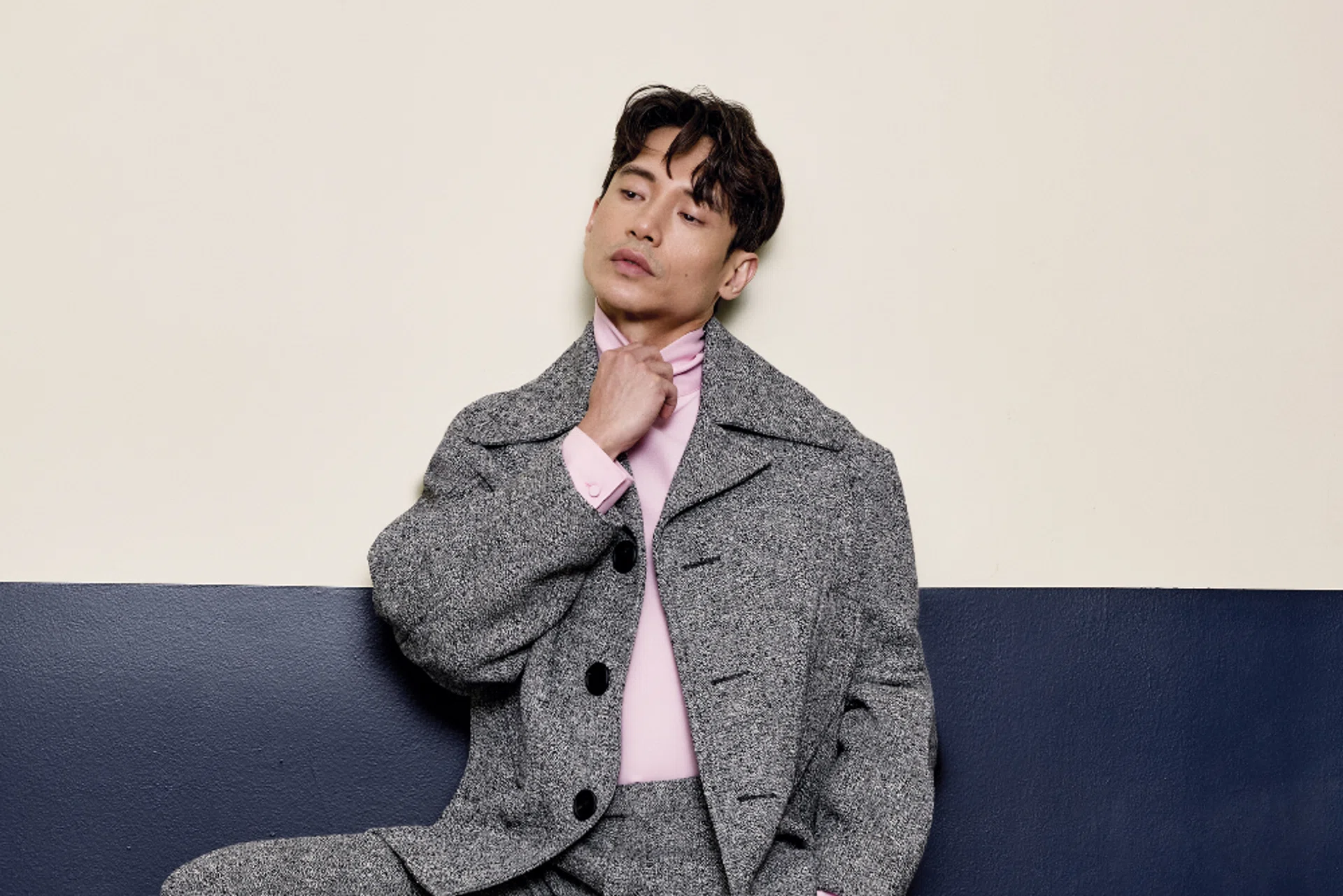
By Aaron Kok - published
The first thing Manny Jacinto says to me is, “Wait, am I that old?”
He laughs, slightly sheepishly, but it’s the kind of self-aware question that catches you off guard in a good way. We’re talking about Freakier Friday, the Disney sequel to the iconic body-swap comedy from 2003, in which Jacinto plays Eric Davies, the soon-to-be husband to Lindsay Lohan’s Anna Coleman, and future son-in-law to Tess, a role reprised by Jamie Lee Curtis.
When we catch him for a chat, Jacinto is home in Los Angeles, just days before embarking on a rigorous press tour to promote the film. Yet any premonition of chaos and fatigue is downplayed by his easy demeanour. He’s dressed in a simple white crew neck shirt, hair tousled and speaks with such affable charm you feel like you’re catching up with an old friend.
Related article: Freen Sarocha On A Whirlwind Year And Being In Her Element
A New Role
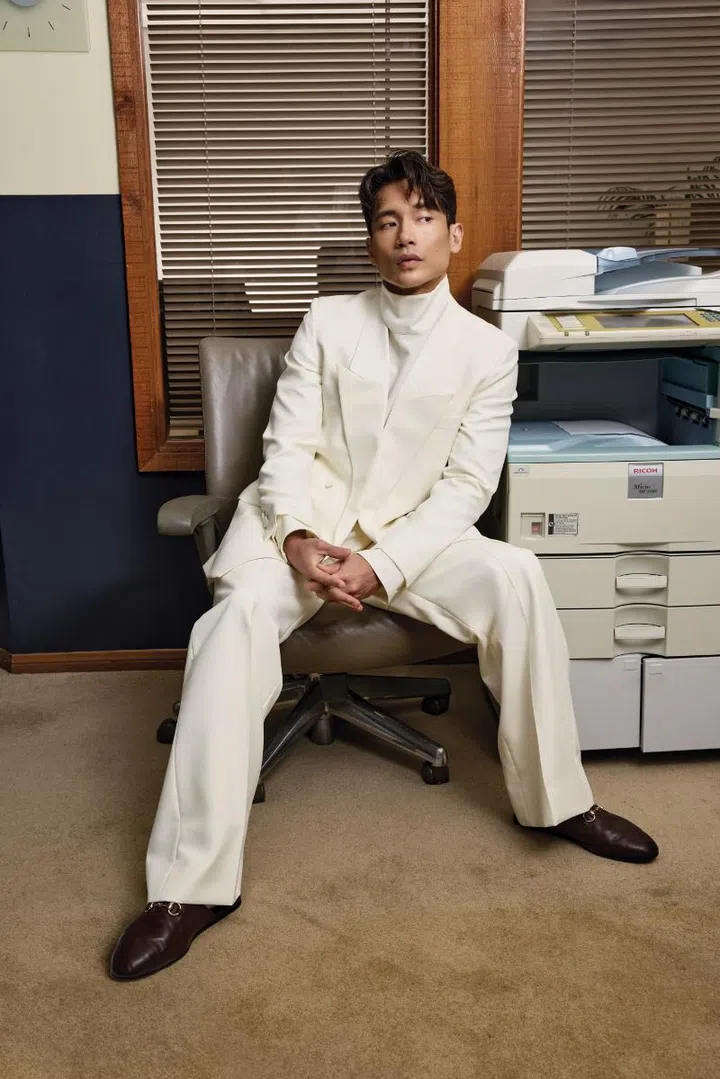
Top; jacket; trousers; loafers, GUCCI.
“It’s my first time playing a dad,” Jacinto tells me, still mildly incredulous. “When I got the call, I had this moment of, ‘Am I really at that stage now?’ I was genuinely about to go out and buy a sports car and embrace my ‘dad’ phase,” he adds with a laugh.
But what the role offered—beyond the existential crisis—was something the 38-year-old actor had long been searching for: the chance to play a romantic lead and a father figure in a mainstream studio film. That it happened to be in a franchise as beloved as Freaky Friday only added to the full-circle moment. “I watched it in theatres with my sister when it first came out,” he says. “It was huge. Lindsay was iconic.”
The updated sequel, helmed by director Nisha Ganatra, blends the family dysfunction and freaky body swap story outline of the original film with a more grounded, heartfelt touch. That balance was what pulled Jacinto in. “Nisha has this grounded comedic sensibility, and she really wanted someone who could do the funny bits but also bring heart to it,” he says. “And the fact that I got to work on speaking in a British accent? Yeah, this was a challenge I was very into.”
Early into the project, he worked with Lohan, Julia Butters (who plays Lohan’s daughter) and Sophia Hammons (who plays Jacinto’s daughter) on building chemistry through intimate, fast-paced rehearsals, including an acting workshop where they reenacted wedding dances and shared notes on how their characters might express love. “It sounds corny, but it really helped. There’s no shortcut to vulnerability, and luckily we all dove into it.”
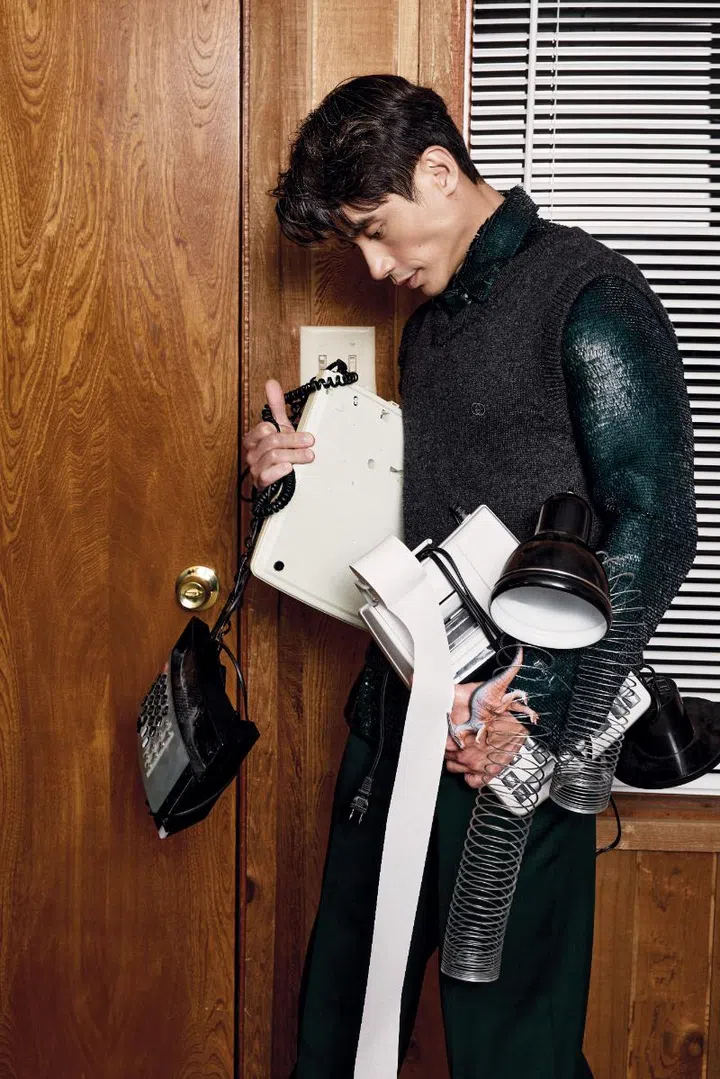
Shirt; vest; trousers, GUCCI.
That word—vulnerability—comes up a lot in our conversation, sometimes as a throwaway line, but more often as a kind of shorthand for the way Jacinto approaches his craft. If you’ve followed Jacinto’s career since his breakout as the lovable airhead Jason Mendoza in The Good Place, you’ll know he’s never been content to play the same role twice. In between, he’s made intergalactic waves on The Acolyte, played a conscience-wracked wellness employee in Nine Perfect Strangers, and now, for the first time, a fiancé and a father.
In Jacinto’s work lies a baseline of humanity. He approaches each role with a mission to find and flesh out the authentic parts of a character, so as a viewer, you trust him to take you on a journey. For an actor with under two decades of experience—the equivalent of a teenager’s age, if you think about it—Jacinto brings a sense of warmth to every role as if he has been acting for much longer. Yet, Jacinto is frank in telling us that he doesn’t always feel this way.
“There’s always an imposter syndrome,” he admits. “Especially with this film, I was like, ‘Can I really convince people I have a 16-year-old stepdaughter?’ But you try to find the emotional truth, even if you haven’t lived that reality. I thought a lot about my dad, and about those moments where we connected, or when he was mad at me. How did I react? How would he react? I tried to put myself in his shoes and bring that into Eric.”
That empathy and realism is part of Jacinto’s magnetism on screen. He’s not a loud actor. He doesn’t go for grandstanding performances. Instead, he leans into the quiet stuff: the pauses, the micro-reactions, the shifts in emotional weather. It makes his characters feel real, even in the most outlandish settings.
Related article: “We’re Done Playing Perfect”: Actors Ross Butler and Lim Yu-Beng On Letting Go And Telling Real Asian Stories
Getting Real
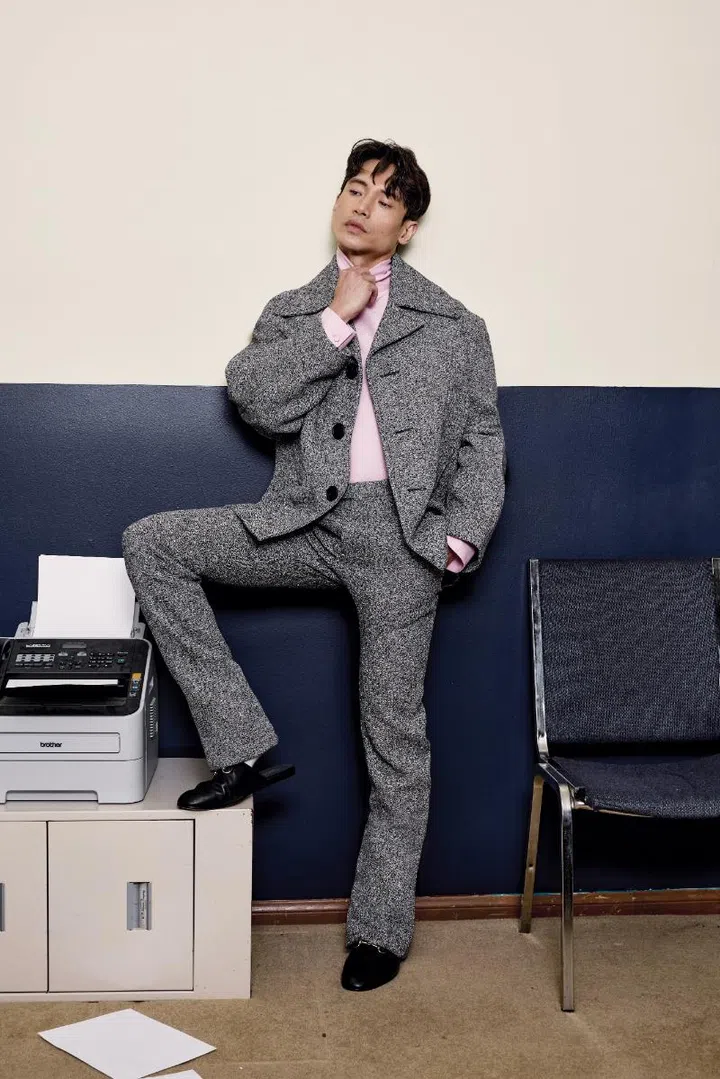
Top; jacket; trousers; loafers, GUCCI. Socks (worn throughout), stylist’s own.
Off-screen, it seems, he’s equally allergic to artifice. There’s no sense of porcelain-surfaced media training when he speaks. Jacinto is just a thoughtful guy, sitting in his Los Angeles home, occasionally getting interrupted by mailmen dropping off looks for the press tour. When I tell him he seems like the kind of actor who cares deeply about emotional truth, he looks shy but flattered. “Thank you,” he says, “I don’t know if I always hit it, but that’s what I’m trying for.”
And then he tells me something I didn’t expect: he doesn’t always feel excited about acting.
“When I first started out, I was just this kid living in a shoebox apartment in LA, paying US$400 in rent, grinding auditions, and I was in love with it,” he recalls. “Now it’s harder to find that spark. There are so many distractions—press, travel, responsibilities—that you sometimes lose the joy. But then I’ll get a script that hits me, and all of that spark, excitement and passion comes flooding back.”
That honesty is refreshing. In a landscape where leading men are expected to have bulletproof confidence, Jacinto is open about the very human feeling of fatigue. He is candid about not always knowing if he still has it, but maybe that’s exactly what makes him the kind of leading man we need now—not the stoic alpha, but the good guy who’s still figuring it out.
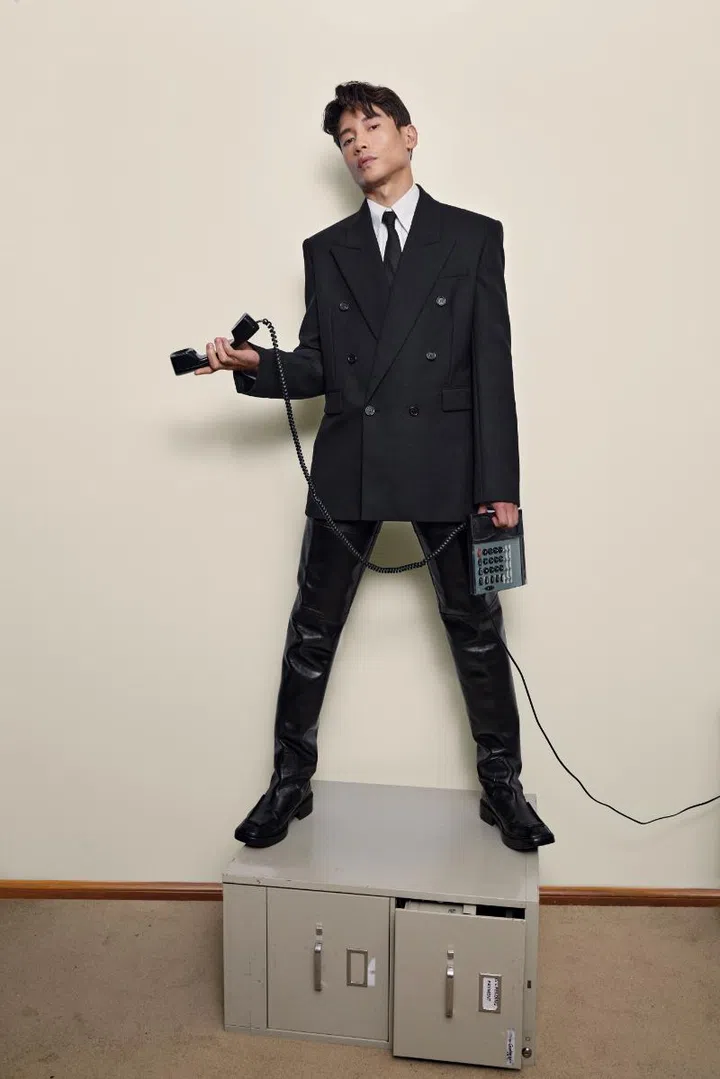
Shirt; tie; jacket; trousers; boots, SAINT LAURENT BY ANTHONY VACCARELLO.
“I think we need to see more of that,” he agrees. “More emotional complexity in male characters. Not just guys who save the world with their fists, but guys who can be afraid and still move forward.” He talks about Pedro Pascal with admiration, highlighting how Pascal is a real example of the male lead who isn’t afraid to show the softer, cushier sides of his person whilst commanding commercial success at the box office. “He started out doing a million different things, and now he’s getting his flowers, but he’s still grounded and still good to people. That’s what I admire.”
This idea of breaking out of the mould that the industry tends to put actors into is a sentiment he echoes when we talk about Asian representation in Hollywood, too. He doesn’t want to be pigeonholed, and he doesn’t want to see future generations inherit a limited menu of roles.
“I’ve been very lucky to have worked with directors, writers, showrunners who didn’t put me in a box. But I’ve also said no to things that didn’t sit right with me. If it felt like a stereotype, or just wasn’t a story I wanted to tell, I have passed on it. That’s something Nicole Kidman told me, actually: to protect your talent. How I’ve learnt to interpret that is to not waste your talent and time on something that doesn’t feed you.”
Now, he’s thinking about stories he wants to tell from the other side of the camera. He’s been working with writers and collaborators on new projects, exploring what it could look like to take on more of a producer or co-writer role.
“There’s just so much we haven’t seen yet,” he says. “Different versions of masculinity. Different love stories. Different families. I think I can help tell these stories.”
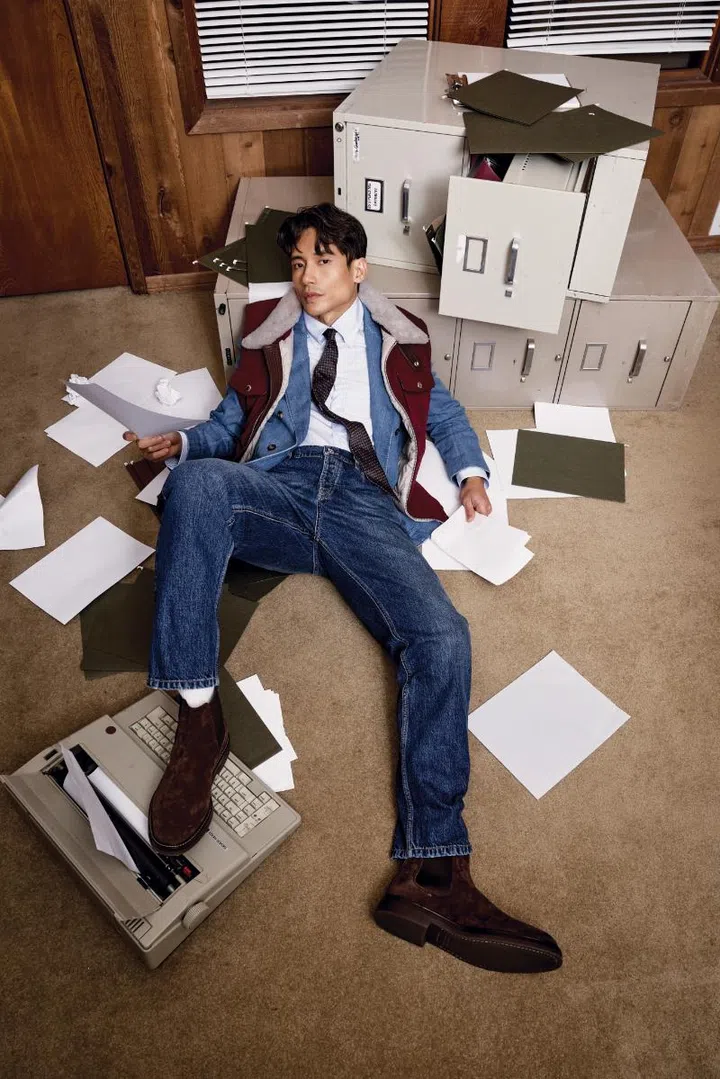
Vest; jacket; shirt; tie; jeans; boots, BRUNELLO CUCINELLI.
Related article: Lullaboy Is Making Music For The Heart, Not The Charts
It’s clear that Jacinto isn’t just ambitious for himself, but he’s hopeful for the entire landscape of representation. He wants more stories told with nuance, more leading men who don’t need to wear apathy like armour, more space for tenderness, gentleness, awkwardness, and resolve.
“Growing up, I never saw someone like me in those roles,” he says. “So if me being visible now helps some kid out there say, ‘Hey, maybe I could do that,’ then I think that’s already a win.”
That idea of doing good work and staying grounded echoes a lot in the hour-long chat. He highlights past working experiences with Ted Danson and Kristen Bell, who set the tone on The Good Place by being professional and kind. He remembers advice he received early on in his career from a co-star telling him to let go of outcomes and stay in the moment. “It’s easy to get caught up in the noise,” he reflects. “But at the end of the day, people don’t remember your exact lines. They will remember how your work made them feel.”
Before we wrap, I ask him what excites him when he thinks of the year ahead. He grins. “Honestly? I have no idea what I’m doing tomorrow! But I’m really excited to keep creating. Maybe one day I’ll direct, or maybe I’ll launch something weird and entrepreneurial. I don’t know. The world feels wide open right now.”
There’s a moment of pause. He looks like he’s about to add something, then changes his mind. “I just want to do work that feels honest,” he says at last. In a world full of performance, the act of honesty might be the boldest move of all.
Editor-in-chief: Kenneth Goh
Photography: Yu Tsai
Producer: Trever Swearingen
Styling: Oretta Corbelli
Grooming: Kim Bragalone / Redefine Representation using Kypris Beauty and Balmain Hair
Barber: Chloe Kim
Digital tech: Luis Jaime
DP: Greg Wonder
EQ: Dust Studios
Photographer’s assistant: Calvin Mendez
Production assistant: Jack Morris