
Creative Technologist Aditi Neti On Humanising Technology, Keeping Traditions Alive And More
Aditi Neti explores how code can become a powerful tool for cultural storytelling
By Larissa Wong - published
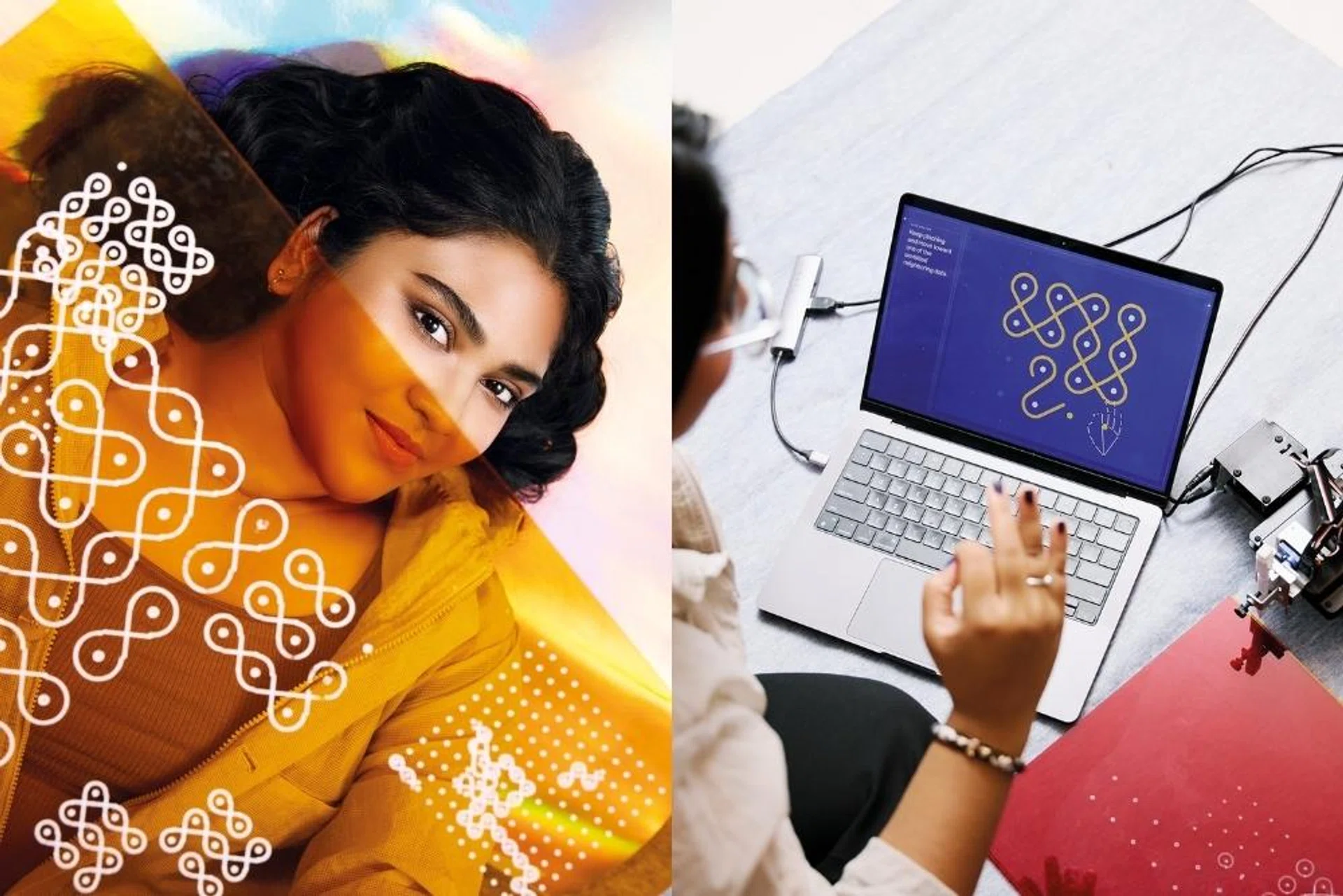
For centuries, intricate geometric patterns called kolams have been drawn by hand at the threshold of South Indian homes, serving both as artistic expression and a daily ritual. For creative technologist Aditi Neti, also known as @functionditi on Instagram, these ancient designs became a starting point for a contemporary exploration of culture, code and human connection.
Neti reimagines the ritual through technology, translating gestures and movement into digitally drawn kolams that retain the spirit of their handmade origins. By bringing together tradition and technology, Neti’s practice challenges the notion that technology and humanity exist at odds, instead revealing how the two can co-exist, collaborate and evolve together.
Related article: Field Pottery On Using Clay As An Outlet To Express Creativity And Their Love For Nature
Tell us about your first encounter with kolams, and what drew you to this motif as a source of inspiration.
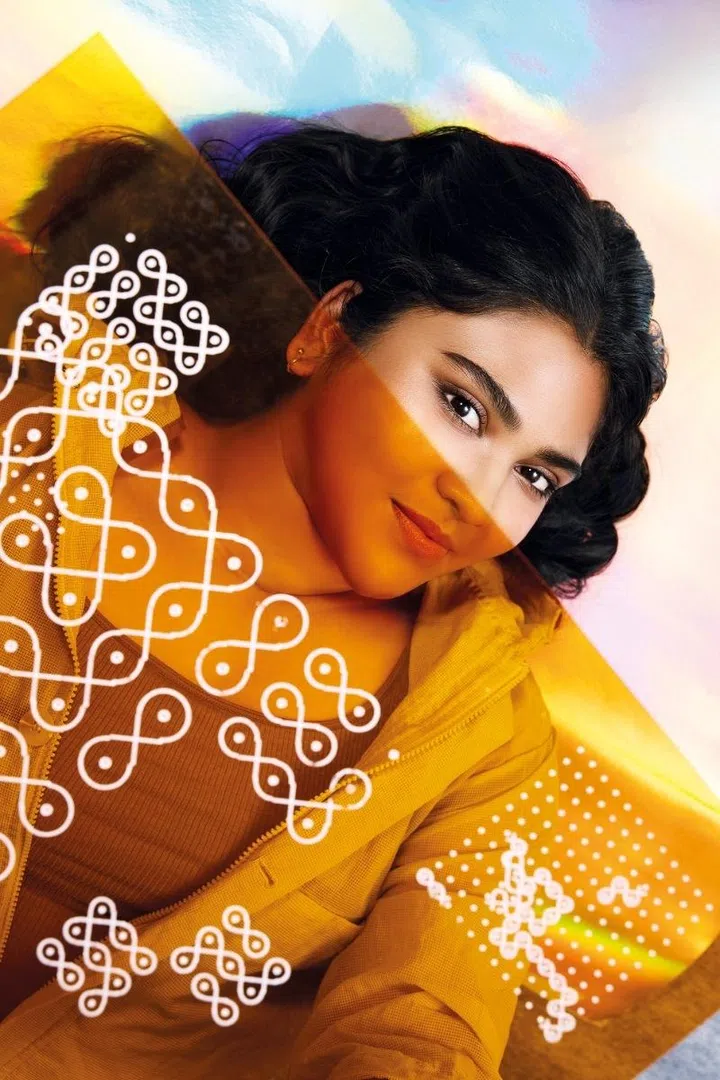
Neti in her own tank top and jacket, shows off one of her coded kolams.
Growing up in Bengaluru, India, I grew up with kolams around me, especially during Deepavali. They were familiar, but for a long time I think I saw them as part of the visual background of home and festival life. Later, during a Deepavali when I felt quite lonely and far from home and my family, I felt like making a kolam. I started off by making one in p5.js, a library that creative coders often use, but then realised I was reducing the practice of kolam to a decorative form.
Kolams, in my opinion, are intentional and carry a sense of ritual, comfort, and a sense of connection. From there, I started looking at them more closely: their rules, their repetition, the role of the hand, the grid, the line, and the way they exist between mathematics and devotion, between structure and softness.
Related article: Rattan Artisan Ng Si Ying On Preserving Traditional Techniques, Exploring New Possibilities, And More
Walk us through how a kolam becomes a coded drawing.
I start by looking at the structure of the kolam: the dot grid, the line, the curves, the symmetry, and the movement around the dots. Then I try to understand what rules are guiding the form. From there, I translate some of those rules into code. I use tools like p5.js, Python and MediaPipe. p5.js is useful for drawing and generating visual systems. Python helps with certain computational processes, and MediaPipe allows me to bring in hand gestures or body tracking. So a kolam can begin as a hand gesture, then become a tracked movement, turned into data, and finally a coded drawing. In some works, that drawing can also be sent to a machine, such as a plotter, so it moves back into the physical world.
Kolams are traditionally created by hand. What aspects of this practice felt most important to preserve in your work?
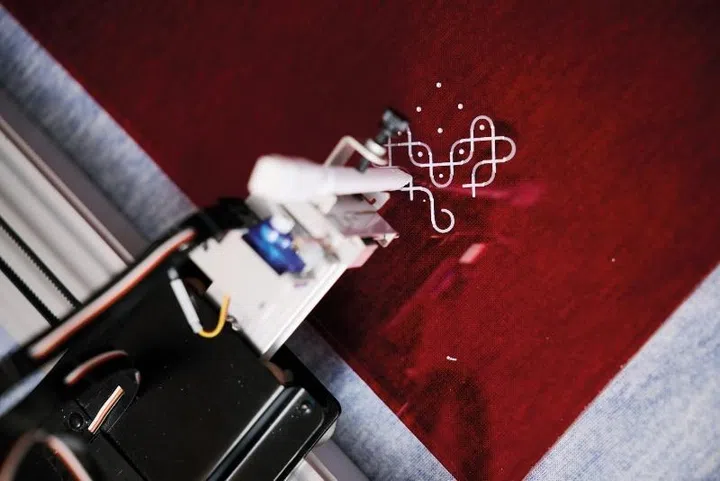
An AxiDraw device drawing a kolam from a series of lines, curves and dot grid.
The embodied aspect felt most important to preserve. A kolam is much more than the final pattern. It also highlights the hand, the rhythm, the repetition, the bending of the body, the small idiosyncrasies, and the time spent making it. I really didn’t want to reduce it to a clean digital motif.
That is why I became interested in hand gestures and interaction. Even when the work becomes coded or machine-drawn, I want the human embodied aspect to remain present in some way. The hand should not disappear completely.
How do you navigate the importance of translating a deeply rooted cultural practice into a technological medium?
I’m here to learn, not to claim authority over the practice. I also don’t want to frame my work as a replacement for kolam-making. A digital or machine-mediated kolam can never fully substitute the lived, daily, domestic and ritual practice. I see my work more as an interpretation, a translation, and even a question. For me, the responsibility is not to flatten the practice into only an aesthetic. The technology should create more attention. It should help people notice the gesture, the care, the rules, and the cultural memory embedded in the form.
How do you balance staying true to traditional motifs while evolving as a contemporary artist?
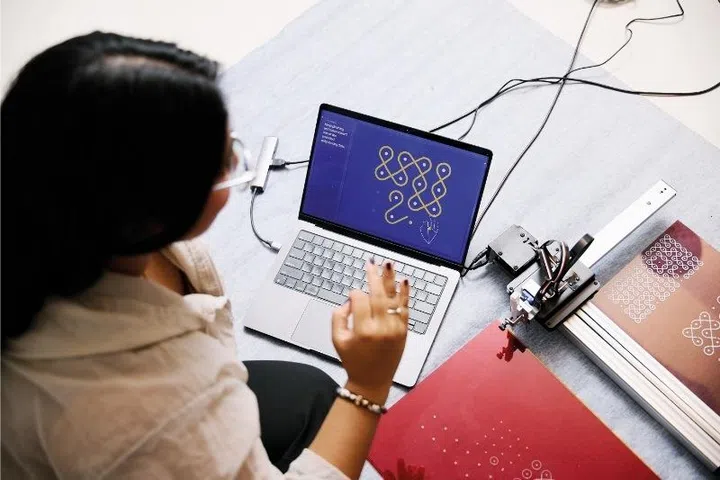
Neti’s self-designed coding system, where hand gestures can be turned into drawings.
I try to stay true to the logic of the practice. With kolams, that means paying attention to repetition, continuity, symmetry, grids, thresholds, temporality and hand movement. Those are the anchors. At the same time, I allow myself to experiment with tools that are part of my own contemporary practice, like code, sensors, plotters and interactive systems.
I don’t think tradition has to be frozen in order to be respected. But I do think it has to be approached carefully, with context and with an awareness of what the form carries.
What is it about this medium that continues to inspire you?
What continues to inspire me is the sense of control and negotiation. With creative technology, you can build a system, but you can’t always fully control what happens. Code produces unexpected results. Sensors misread, machines have their own limits, a gesture becomes data, but not perfectly. There is always some translation, friction, or surprise. I like that! It makes the work feel alive. The final piece becomes something negotiated between my intention, the system, the machine, and sometimes the viewer.
Your work exists between tradition and technology. What kind of conversations do you hope it sparks?
I hope it sparks conversations about how tradition and technology can coexist. They are often treated as opposites: one old, one new; one human, one machine; one emotional, one technical. But I don’t think it is that simple. New things can emerge when they meet. I’m interested in discussions about translation, authenticity, and change. How do cultural practices evolve? What should be preserved? What can be reimagined? And how can technology be used not to erase the human qualities of art practices, but to make us more aware of what the human hand carries?
How have you evolved as an artist over the years?
I think I’m always under construction. Over time, I’ve moved from thinking mainly about visual outcomes to thinking more about systems, relationships, and processes. I’m less interested now in making something that only looks finished, and more interested in what the work is asking, how it behaves, and what kind of relationship it creates. My practice has also become more comfortable sitting between categories: design, art, research, technology, culture, and making. I don’t feel the need to separate them as much anymore.
Related article: Artist Alicia Chow Kirwan On Creating Sustainable Art And Honouring Slowness
Is there a piece you’ve created that feels especially meaningful to you?
One piece that feels especially meaningful to me is my previous project, “Bio-Interfaces”. It explored how we might create more tangible relationships with plants through technology. I was interested in the idea that technology does not only have to mediate human-to-human or human-to-screen relationships. It can also help us pay attention to living things that we often overlook. Through sensors and interaction, the project became a way to think about more-than-human relationships. It still feels meaningful because it shaped many of the questions I continue to ask: How can technology make us more attentive? How can systems help us relate differently to the world around us?