
This Is How Birkenstock Become A Fashion Staple
From its orthopaedic roots to runway-ready reinvention, this is Birkenstock’s stride through centuries of style.

By Windy Aulia - published
In a world where trends come and go with every scroll of your thumb, few brands can claim the cultural longevity and relevance of Birkenstock. From its humble origins in a small German village to its shoemaking tradition started by Johannes Birkenstock in 1774, the brand has transcended centuries, styles, and social movements to become one of the most enduring names in footwear. What’s even more remarkable than its survival is how the brand has redefined itself while staying true to its core values of comfort and craftsmanship.
As a shoemaking family, Birkenstock’s presence on the global fashion runways might seem improbable. The brand was relatively obscure for generations until the late 19th century when Konrad Birkenstock, a descendant of Johannes, began developing flexible insoles, which he named footbeds later on. This was a revolutionary idea in an era when shoes were often flat and provided little to no support. Konrad’s invention of the first flexible arch-support insoles laid the foundation for Birkenstock’s unique selling proposition: ergonomically designed footwear that promoted foot health.
Related article: All The Fashion News You Need To Know Right Now

Jochen Gutzy, Birkenstock's Director of Communications
“What the Birkenstock started and created was disruptive for its time. It was essentially an orthopaedic innovation that changed the industry,” shares Jochen Gutzy, Birkenstock’s chief communication officer. He continues, “At Birkenstock, we have always focused on the product. And the core of it is the footbed.”
This focus on orthopaedic design is not just a marketing angle. What started out as an obsession with the bio-mechanism of feet became a scientific and health-centred revelation. By the 1930s, Birkenstock’s products were already being recommended by doctors and podiatrists across Europe. And it remained primarily a European brand until the 1960s when it made its way into the US market.
The introduction of Birkenstocks outside of Europe is often credited to Margot Fraser, a German-American who discovered the shoes while visiting Germany and began importing them to the States in 1966. Initially, the sandals were sold through health food stores and co-ops; however they quickly gained popularity among the counterculture and hippie movements for their earthy aesthetic and foot-friendly design. That’s why until today, Birkenstock is globally recognised as a symbol of wellness culture, conscious consumerism and sustainable living.
Related article: Ferragamo Celebrates Its Iconic Vara Shoes With New Takes On The Beloved Design
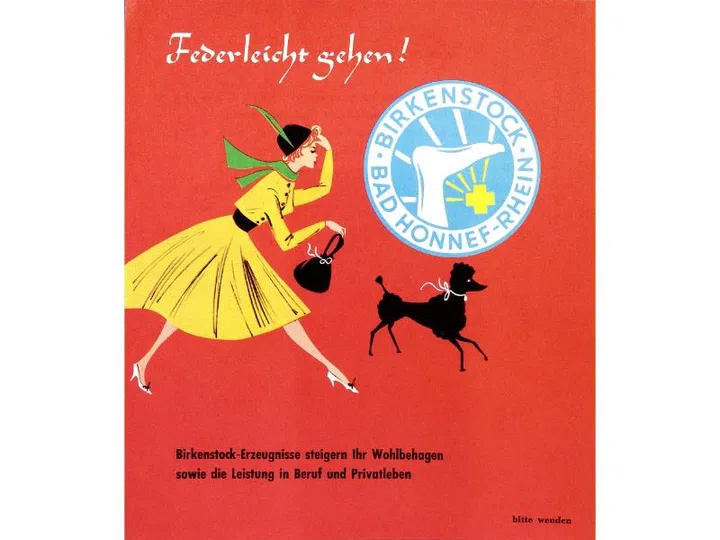
A Birkenstock advertisement from the Fifties
Throughout the ’80s and ’90s, Birkenstock had a kind of quiet cult status, until the fashion industry started to embrace the alternative youth movements. Fast-forward to the 2010s, and Birkenstock found itself under a new spotlight. It was not only seen on co-op floors, but on the runways of New York, Paris, Milan and London.
The fashion world, increasingly obsessed with blending comfort and style, took note. Designers and houses like Valentino, Rick Owens, Proenza Schouler and Dior began collaborating with the brand, reimagining the classic Arizona and Boston sandals in everything from metallic leather and fur-lined straps to platform soles and embellished buckles.
Under Birkenstock’s premium line, dubbed 1774, these luxury houses added their own flavour to the uppers of the sandals, blending in high-quality techniques like stitching, laser cutting, grommets and rivets. All the while keeping the footbed’s shape, contoured in its original mixture of cork, latex and jute—which is the non-negotiable stipulated by Birkenstock every time collaborator brands approach them.
Related article: The Best Walking Shoes, Tested By A BAZAAR Editor

Assembly in one of Birkenstock's factories in Germany
These brands have never diluted Birkenstock’s DNA. Instead, they amplified it. All of a sudden, stylish insiders, models and influencers were pairing Birkenstock sandals with their own oversized blazers, slip dresses and streetwear. Birkenstock had finally entered the hallowed halls of fashion. Not to mention the recent inclusion of Birkenstock sandals in the groundbreaking Hollywood blockbuster, Barbie (2023), which plotted the Arizona sandals’ known cult image into part of the film’s anti-gender stereotype messaging.
When asked whether these fashion and pop culture highs were ever part of the goal for Birkenstock as a brand all along, Gutzy proclaims, “We don’t do influencer marketing nor product placements. We are humble and we are focused. We don’t see ourselves as a footwear brand. We are a footbed company,” and then he punctuates the truth, “Every (Birkenstock) product is a manifestation of walking as nature intended, so we are a universal brand, because walking is a very human need.”