
Phan Huy In Paris: Inside His Paris Haute Couture Week Show
At 26, Phan Huy makes history as the youngest and first Southeast Asian couturier to debut in Paris.
By Aaron Kok - published
When Phan Huy made his debut on the official Paris Haute Couture Week calendar earlier this month, the significance of the moment was immediately clear.
At 26, he became the youngest designer—and the first from Southeast Asia—to present on couture’s most exclusive stage. His spring/summer 2026 collection, titled “Cành Vàng, Lá Ngọc”, arrived with an assurance that these were pieces grounded in craft, cultural memory, and a clear understanding of what couture can mean today.
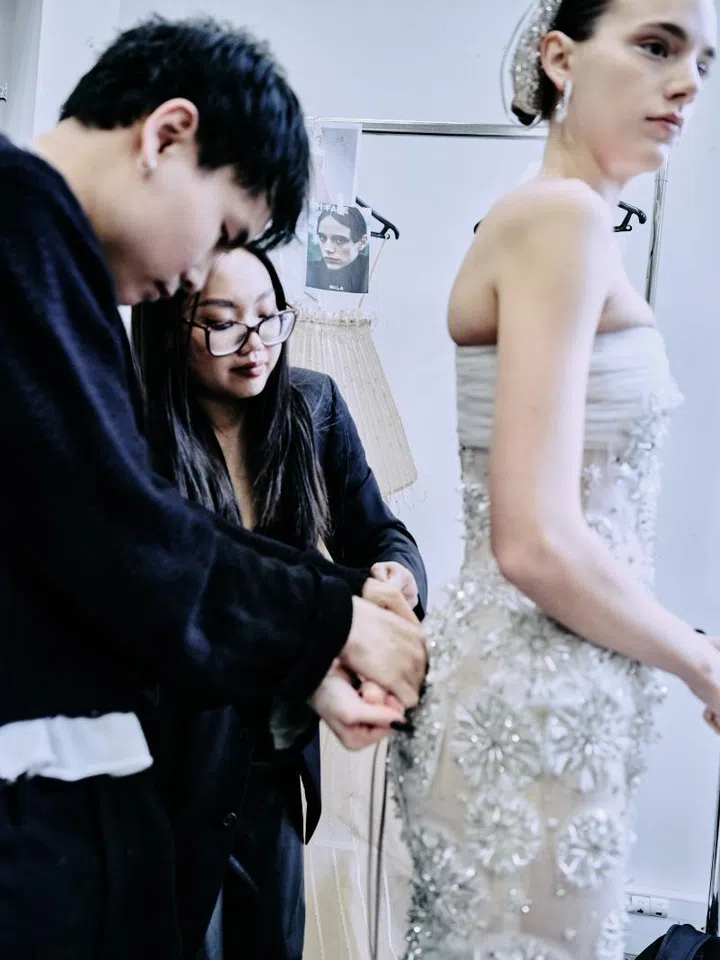
Huy’s team making final adjustments to a model backstage.
Related article: BAZAAR Editor’s Picks: Best Looks From Valentino Haute Couture Spring/Summer 2026
Yet if the milestone felt monumental on paper, the clothes themselves resisted spectacle. “When the show ended, I felt very happy,” Huy says simply, speaking alongside his co-founder and CEO Steven Doan. “And very proud too, to see Vietnamese culture on an international runway.” It is a measured response, one that mirrors the sensibility of his body of work, which values depth over display, lineage over loudness.
Staged in an intimate and historic hôtel particulier tucked within Paris (”This building once served as an atelier for another fashion house,” Doan points out), the show rejected the grandiosity of cavernous venues in favour of something more human-scaled. Models moved slowly through a sequence of rooms, the narrow doorways forcing a kind of closeness between garment and viewer, as well as between past and present. Hair was slicked back with the precision of a ballet mistress. Makeup was restrained, save for fleeting touches of metallic gold and silver on the eyes. A mixture of soaring classical strings and Vietnamese traditional music, romantic and faintly melancholic, filled the space. Everything about the setting suggested intention rather than excess.
This was couture defined by atmosphere and restraint.
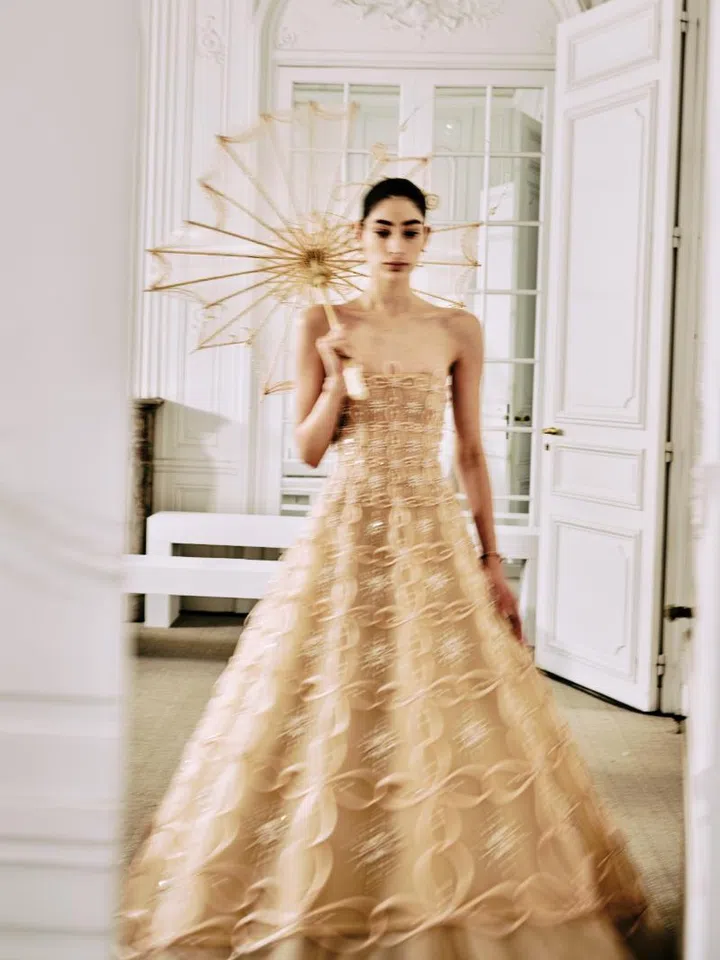
The opening look showcases Huy’s signature way of placing the spotlight on the humble horsehair fabric.
Heritage Without Nostalgia
Huy’s collection takes its name from a rare historical artefact: ornamental floral sculptures crafted from solid gold branches and jade leaves, symbols of nobility and refinement preserved in Huế. The title “Cành Vàng, Lá Ngọc” also alludes to a phrase that carries metaphorical weight in Vietnamese culture, referring to individuals of elevated lineage: those appointed and shaped by grace, discipline, and cultural inheritance. For Huy, this duality becomes the emotional foundation of the collection.
Drawing from the aesthetics of the Nguyễn Dynasty, the collection references figures such as Empress Nam Phương and Emperor Khải Định—icons of a moment when Vietnamese imperial culture intersected with Western modernity. Yet these references are never literal.
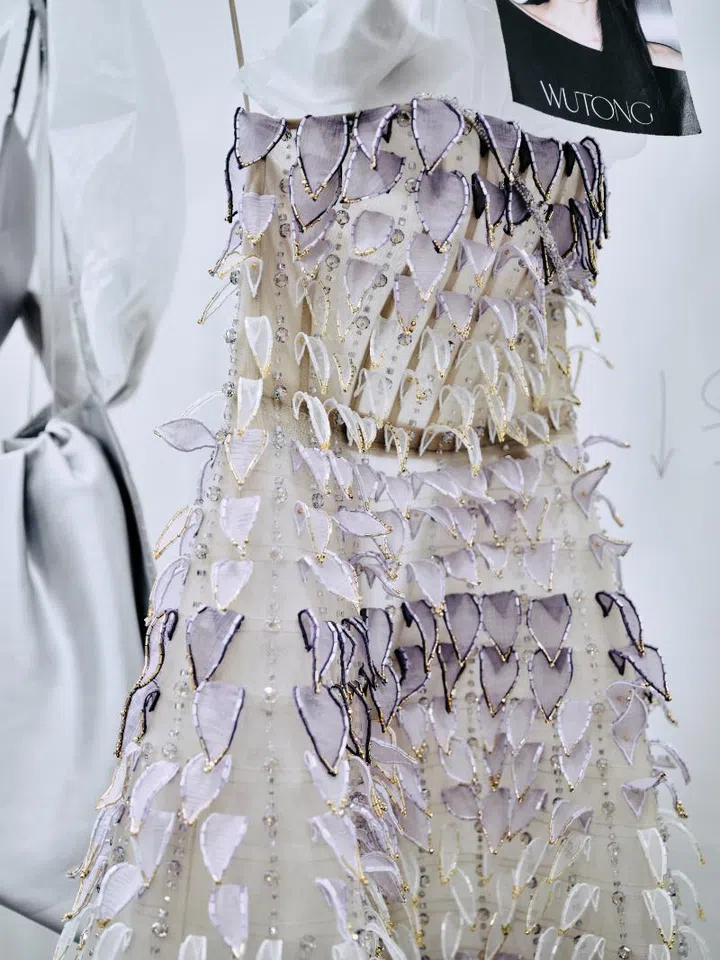
The collection seeks to meld Vietnamese heritage and craft with a distinctively European aesthetic, blending the best of both worlds.
Instead of historical reenactment, Huy opts for abstraction. Silhouettes are gossamer and light but controlled; the cuts are precise, waists shaped with ceremonial restraint. Colours remain within a tightly edited spectrum—ivories, muted golds, washes of lilac and powdery pinks—evoking precious materials without tipping into opulence.
There is a discipline to the way history is handled. “It’s not pressure,” Huy says of representing Vietnamese culture on the couture stage. “It’s about how we translate it.” The distinction matters, because rather than explaining Vietnam to a Western audience, the collection speaks from within its own cultural logic, trusting that clarity of intent will carry across borders.
That restraint is perhaps most evident in the way craft is deployed. Embellishment never overwhelms structure. Embroidery is deliberate rather than ornamental. One of the most compelling technical narratives within the collection lies in Huy’s use of horsehair fabric—a material traditionally relegated to the unseen architecture of garments. Over the past three years, it has become something of a signature for the house. In this collection, it is taken further: the fabric is torn apart by hand, stripped into strands, and painstakingly reconstructed into visible patterns across bodices and skirts, affording the garment featherweight lightness whilst still allowing it to retain its sculpted build.
Related article: American Sportswear Is Fashion’s New Uniform
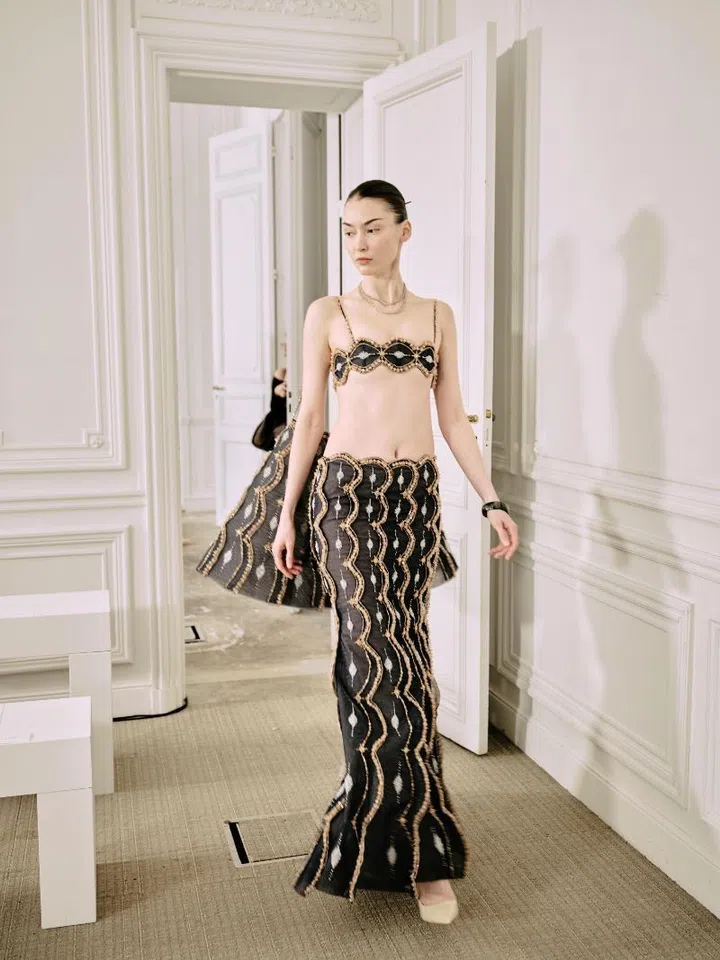
Huy’s inclusion on the couture calendar—which is closely guarded by the Fédération de la Haute Couture et de la Mode—marks the first time a Southeast Asian designer is given a platform on this rarerified stage.
The opening look—structured, radiating outward with almost botanical precision—set the tone. Horsehair now sat at the surface, forming both pattern and structure. “It takes a very long time,” Steven Doan explains. “But it’s honest. You see the work.” That honesty feels central to the brand’s philosophy: couture not as illusion, but as evidence of labour.
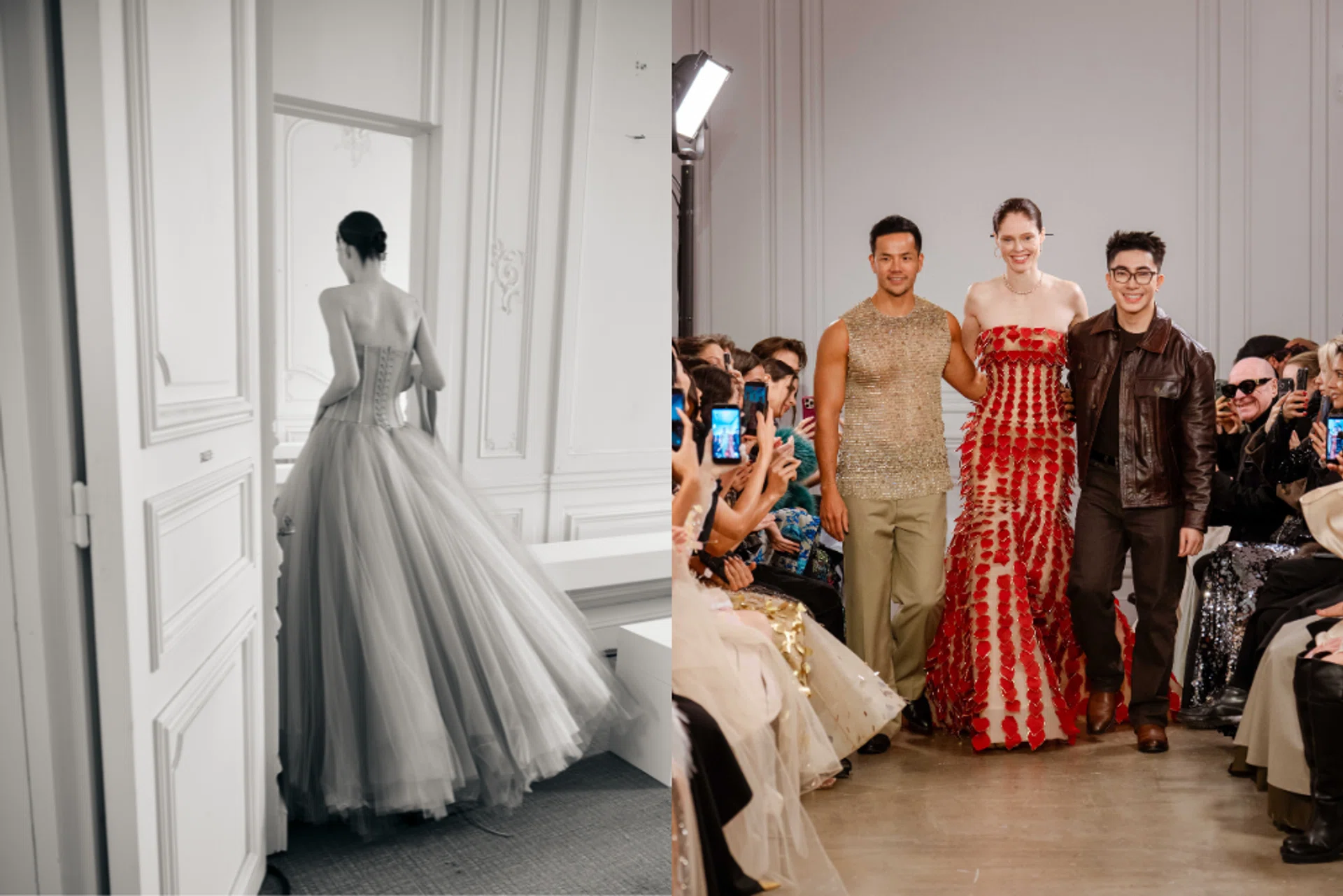
Even the show’s most dramatic moment—the finale gown worn by Coco Rocha—eschewed theatrical excess. Its power lay in proportion and control, in the way volume was balanced against restraint. Strapless and cut into a mermaid fit, the dress is covered with hundreds of lipstick red rose petals, each piece gilded along its edges, and merrily flitting as Rocha struts down the runway.
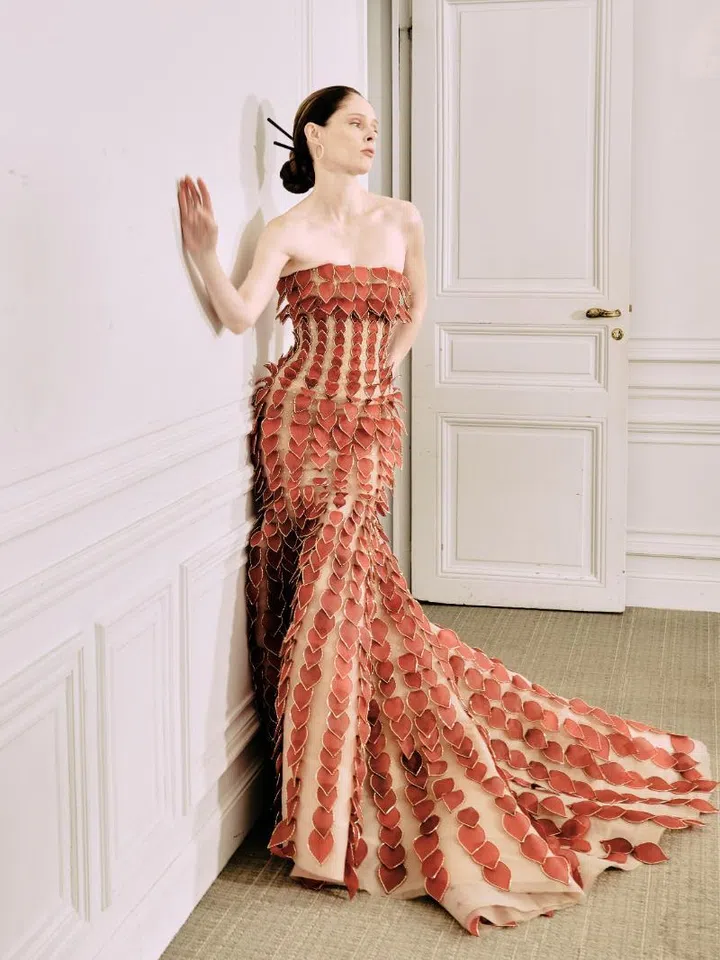
Supermodel Coco Rocha in her closing gown.
Growing Slowly, By Design
Yet understandably, behind the serenity of the runway lay months of logistical anxiety. Organised remotely from Vietnam and Spain where Huy and Doan are respectively based, the show required last-minute venue contracts, oversized luggage shipments, and a lean team working across continents. “We signed the venue after Christmas,” Doan recalls. “Less than a month before the show.” There were also worries about transportation, fittings, coordination...just about a situation where if anything went wrong, they might not have a show.
Yet what emerges from these challenges is not a narrative of struggle, but one of resolve. Founded in 2023, Phan Huy’s brand is still a young maison in comparison to the other established houses on the couture calendar, but this is one brand with a notably clear sense of direction. Couture, for Huy, is not a marketing exercise to sell illusion and perfumes. Nor is it a shortcut to global attention, although Doan cheekily adds that he wouldn’t mind seeing some celebs in Huy’s work. Instead, what surfaces in our hourlong chat is that this is a commitment to craft, to patience, to doing fewer things well.
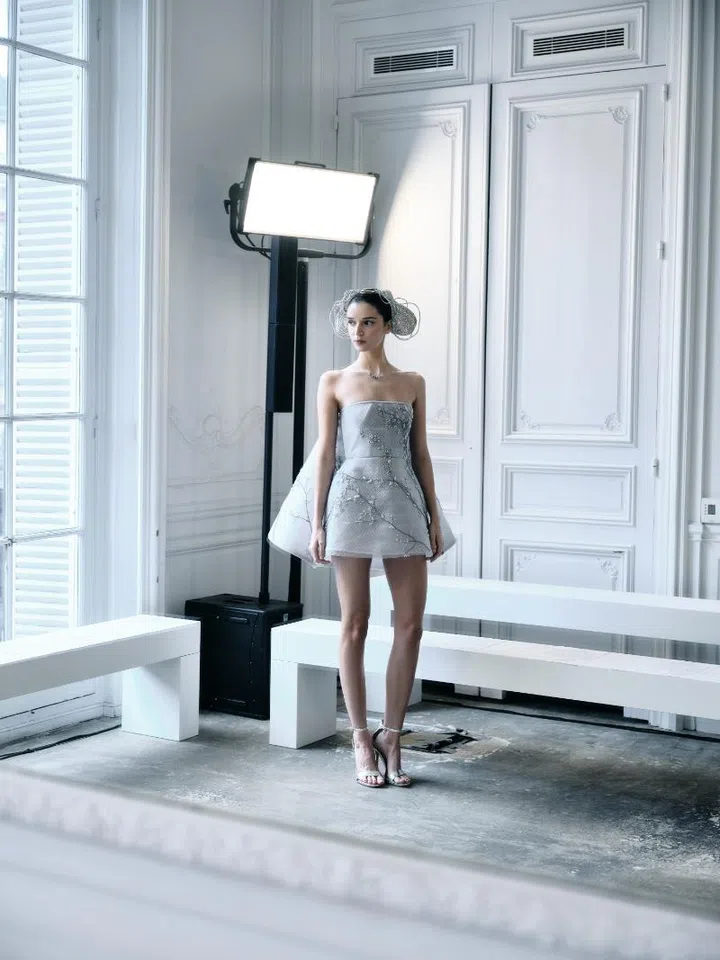
Through his work, Huy wants to highlight Vietnam’s steeped history in the world of couture arts, which he points out has lasted for “over a thousand years”.
“All our clothes are made to order,” Doan explains, who highlights that this principle applies to both their couture and ready-to-wear lines, thereby allowing the brand to do away with stockpiling and overproduction. Menswear remains exploratory rather than strategic—“one or two looks here and there for now”, Doan says with a laugh.
Growth, when it comes, is intentional. “We want to take it slow,” he adds. “Fashion moves very fast now, but we want to do this properly.”
Related article: Game, Set, Slay: Fashion’s Most Iconic Sports Moments
This measured approach extends to how the brand positions itself globally. While the Middle East has already responded positively to Huy’s couture offerings, the focus moving forward is in markets where the conversation around Southeast Asian design is still unfolding. “We hope people will take us seriously,” Huy says. “Because we are serious.”
That seriousness feels timely. For too long, Southeast Asia’s role in global fashion has been framed primarily through manufacturing rather than creativity. Huy’s presence on the couture calendar challenges that narrative—not through confrontation, but through excellence.
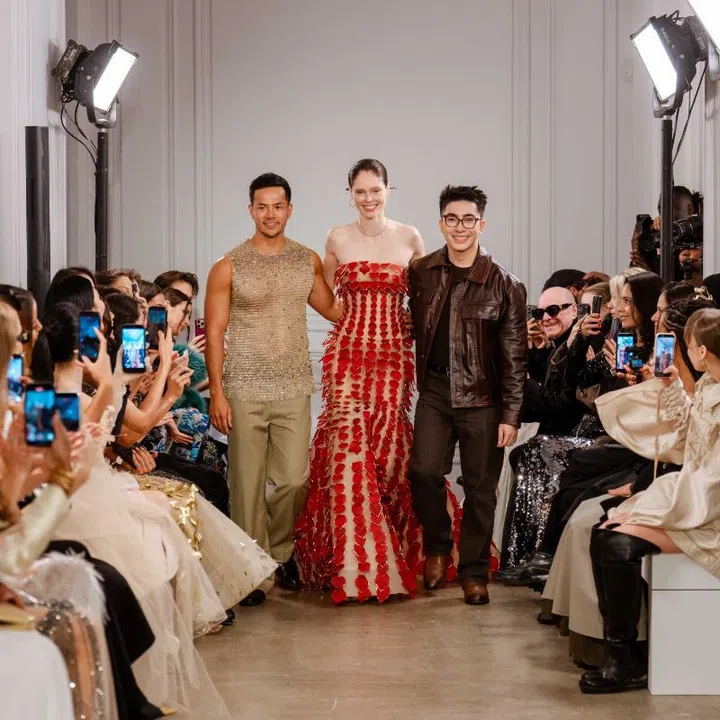
Steven Doan (left), Coco Rocha and Phan Huy (right) take their bow at the end of the show.
The collection does not argue for Vietnam’s place in fashion in spite of its millennia-long and culturally-rich history in the fine arts of garment creation. Huy would rather demonstrate it. His debut offers an alternative proposition: that couture can still be slow, that heritage can be modern without being diluted, and that ambition does not have to announce itself loudly to be felt.
If this season is any indication, Huy’s future will not be defined by how quickly he expands, but by how carefully he builds. And in couture, that patience may be the most radical gesture of all.