
By Aaron Kok - published
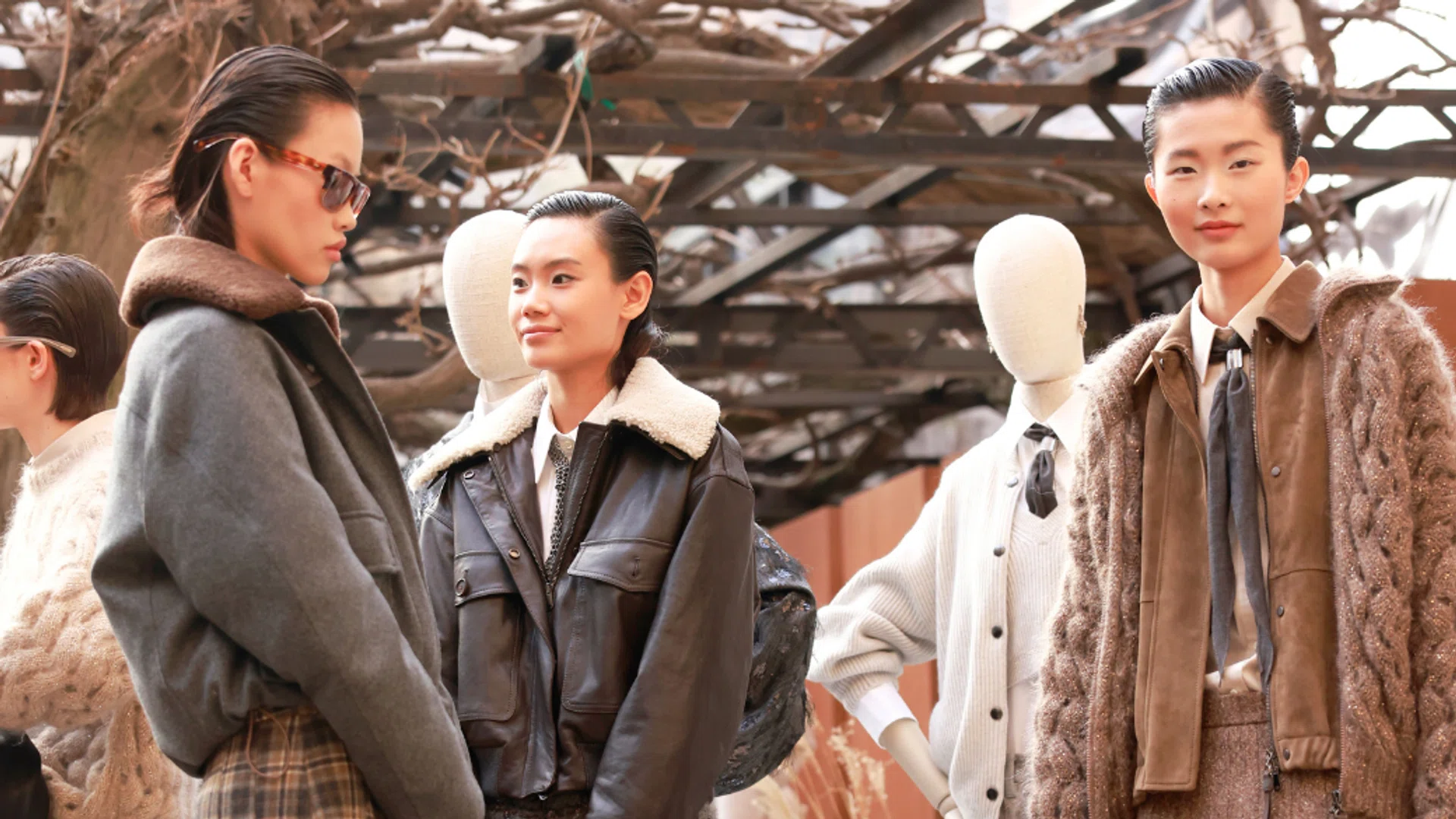
Brunello Cucinelli has never been a brand for theatrics, but for fall/winter 2026, the designer makes a persuasive case that quiet can be radical.
Presented at Casa Cucinelli in Milan—inside a luminous glass greenhouse that saw guests like Eileen Gu and Kim You Jung weave around the warmly-lit and lushly-decorated scape—the collection unfolded as a kind of chaptered novel in Mr. Cucinelli’s work at his eponymous house. “The collection is a story,” reads the opening line of the house notes, and indeed, this season felt composed in a reflective way.
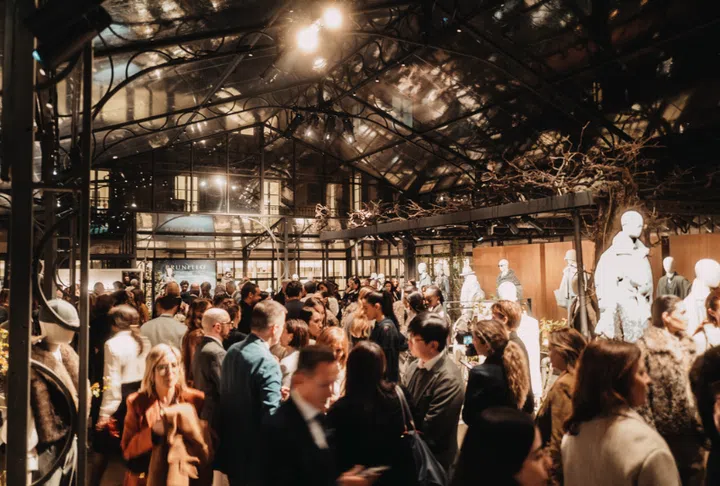
The greenhouse at Casa Cucinelli played host to Milan’s fashionably-dressed crowd.
Related article: Maria Grazia Chiuri Introduces The New Spirit Of Fendi For Its Fall/Winter 2026 Collection
Throughout the night, guests bore witness alongside Mr Cucinelli himself to this journey of craft, but the true protagonists were the hands. This was a celebration of what hands can accomplish over time: twist, stamp, tease, embroider, persuade yarn into something deceptively like fur. Craft, here, was spoken fluently.
The headline act? Couture knitwear. Forget knitwear as cosy underpinnings forgotten in the back of your closet, because here, the pieces came as outerwear, as punctuation, as climax.
Yarns were coaxed into wool lace lattices interlaced with sequins; mohair was teased into buoyant, almost feral fringes that shimmered with embedded filaments. One shaggy long coat, in a hazy tobacco tone, appeared to ripple with light as its sequined strands caught the greenhouse glow. Elsewhere, a bomber that read like plush mink revealed itself, on closer inspection, to be pure wool knit engineered into pillowy fullness with illusionistic bravura.
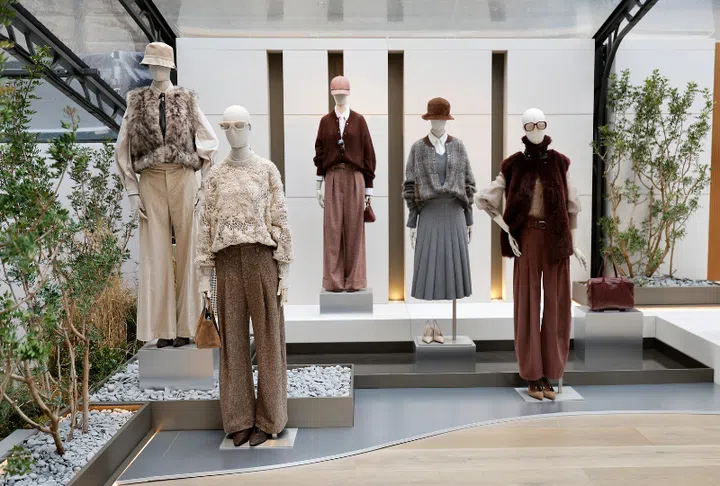
In our gallivant through the space, the term “couture knitwear” constantly came up, except that’s not hyperbole. These pieces carried the labour intensity of atelier work: hand-finished flowers webbing across sweaters, sequins scattered not for sparkle alone but to fracture the surface, to complicate it. Knit here was narrative, and oh how marvellously it lingered.
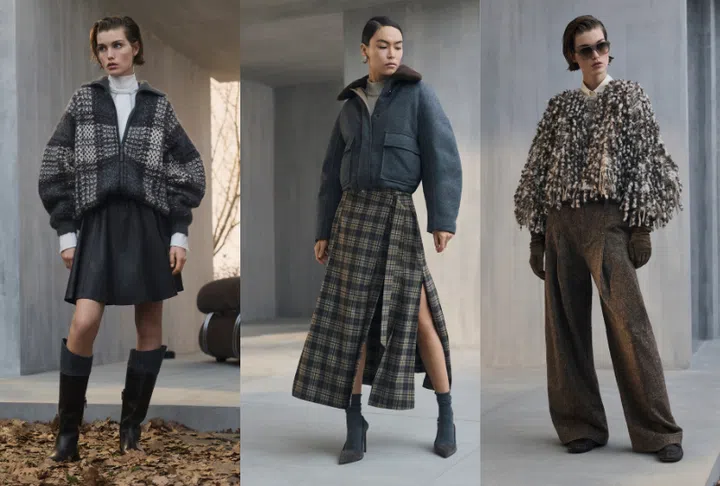
Texture, in fact, was the collection’s true plot device. The palette—an expanse of misted browns, cordovan, peat, flint, and creamy stone—felt lifted from an English countryside at dusk. According to the brand, the British landscape serves as backdrop and you could see it in the orthogonal checks, Prince of Wales patterns, houndstooth and tartan that surfaced across jacquards, printed silks, and even shearling.
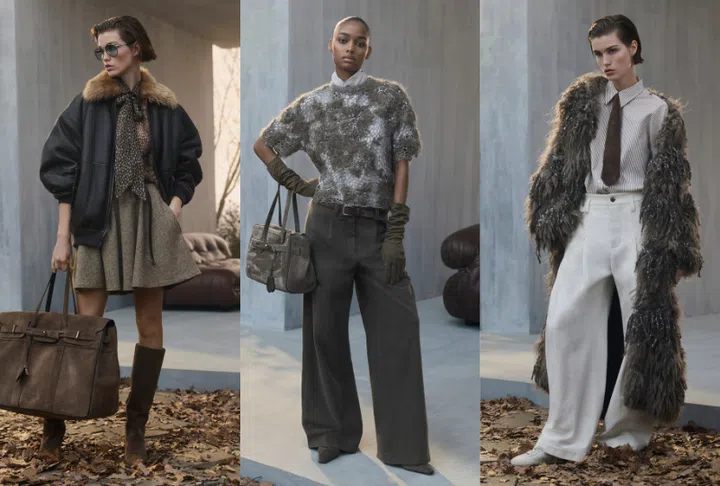
But this was no heritage cosplay. Instead, the codes were reworked into new proportions: a pleated tartan skirt sliced with a high slit; roomy trousers pooling beneath aviator-inspired shearling gilet; a tweed rendered in crochet and cashmere, reportedly requiring over 30 hours of handwork.
Most striking were the shearling furs—stamped painstakingly by hand to mimic sable or lynx, yet remaining resolutely cruelty-free. Each one subtly different from the next, each bearing the irregularity of the human touch. In an era of algorithmic symmetry, that irregularity reads almost rebellious.
Related article: Fashion’s New Guard: Breaking Down What The SS26 Debuts Mean For Fashion
Cucinelli dubbed the collection “country couture,” and it’s an apt oxymoron. The tailoring, while softened, never lost its spine. Louche trousers—wide, fluid, almost insouciant—were paired with sleeveless blazers that skimmed the torso with surgical precision. Sequinned ties glinted against chalky shirting, a sly wink at masculine tropes recontextualised. Tailoring precision meets rustic-romantic inspiration, as the notes put it, and the tension between those poles is where the collection breathes.
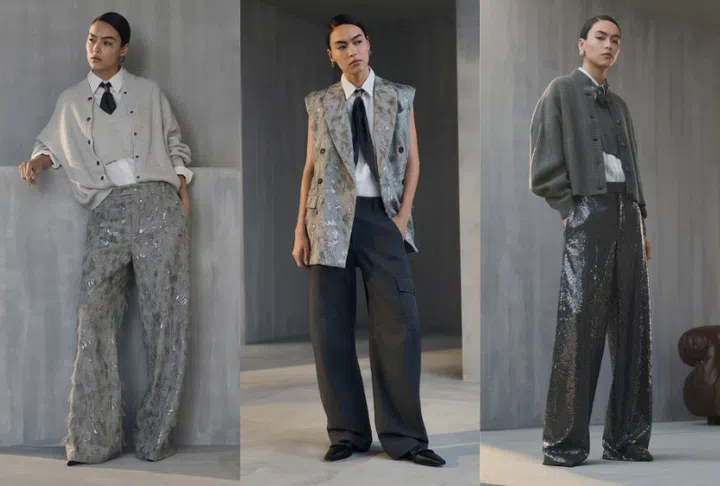
There was also a clear sense of wardrobe building at play here, as is with much of this season’s shows. Looks were styled in layered, considered combinations, but could be easily disassembled. A mohair-fringed knit worn over wide-leg cords could just as convincingly top a fluid silk skirt. A checked bomber shrugged over a schoolgirl pleated skirt could, in another life, meet denim all the same.
The boundary between day and evening gently dissolved—“a tale of day to night,” according to the house—not through gimmickry, but through proportion. Maxi and mini coexisted; oversized coats enveloped slim skirts; fitted knits met waterlike sequins. It was modern soft tailoring in pursuit of comfort without surrendering polish.
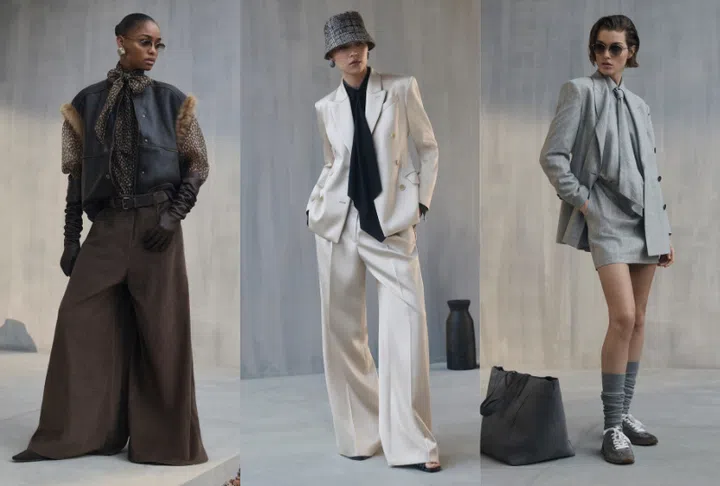
For a brand that built its empire on the purity of cashmere sweaters, this was maximalism by Brunello standards, given its act of accumulation: of textures, of techniques, of hours. “It’s no time for minimalism,” Cucinelli has said, and he’s right. The appetite now is for substance—for garments that justify their existence through process.
In that greenhouse in Milan, surrounded by misty hues and whispering fringes, Cucinelli proposed a thesis: that luxury’s future lies not in stripping back, but in deepening and letting the hand be visible. In allowing clothes to feel like pages from landscapes—familiar, yes, but rewritten with each season.