
Alessandro Michele Is Valentino’s Great Disruptor
Alexander Fury enjoys an audience with Alessandro Michele, whose bold, disruptive approach —one that blends beauty with chaos, and tradition with innovation—is adding an unexpected chapter to the iconic Roman house’s mythology.
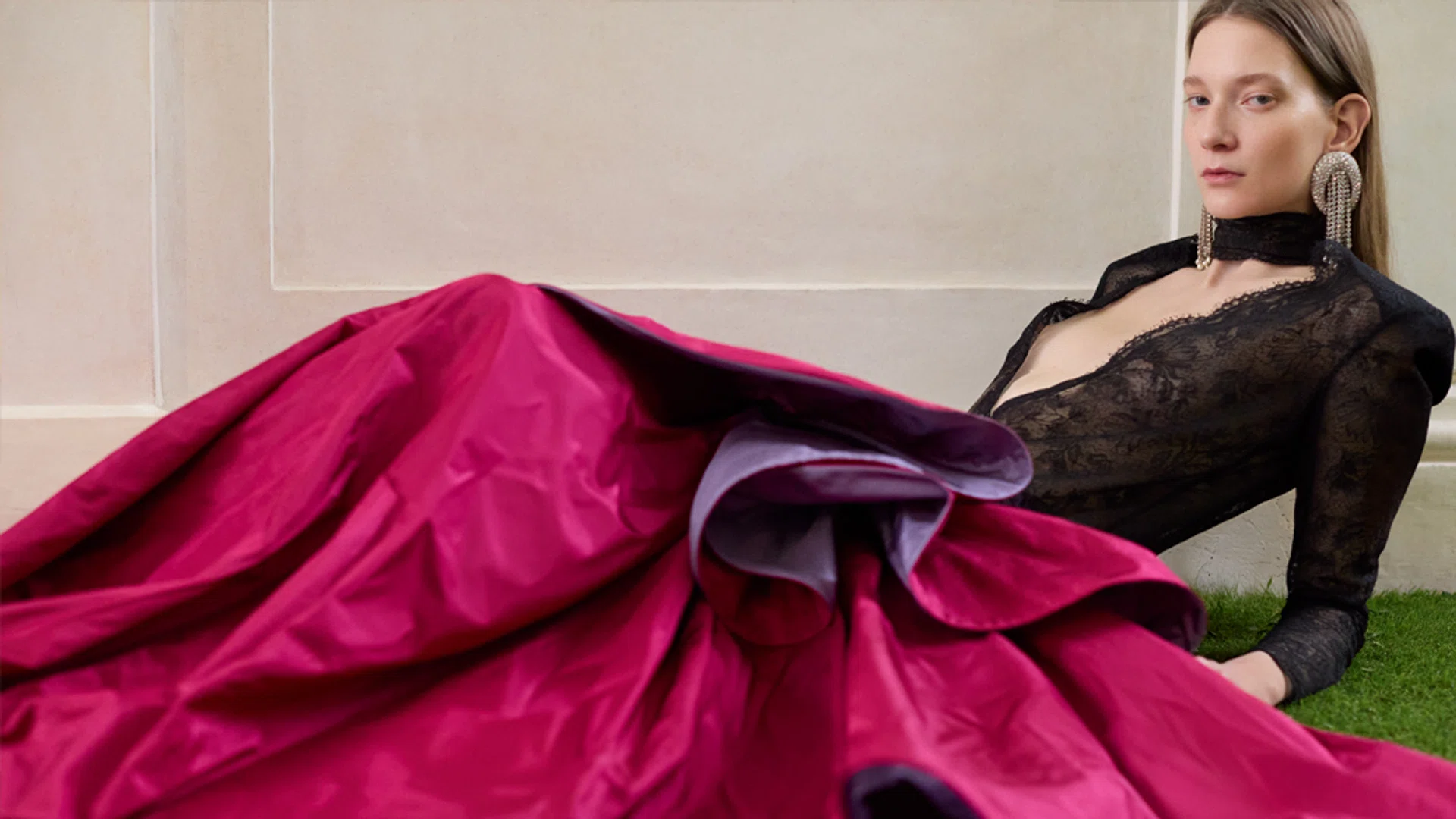
By Alexander Fury - published
In a grand office, in the grand Palazzo Mignanelli that serves as the imposing headquarters to the grand house of Valentino in Rome, its creative director Alessandro Michele looks oddly at home. It’s odd because that grand office, a former ballroom on the palazzo’s piano nobile, proportioned accordingly and with an intricate vaulted-wood ceiling, looks like nothing less than some Vatican offshoot, a set primed and ready for Conclave to film a few extra scenes. The vast room was specifically chosen for the late, great Valentino Garavani—known universally, respectfully, as Mr Valentino. He wasn’t a pope of fashion but, in the words of Women’s Wear Daily, the ‘Sheikh of Chic’, and this room was intended as a suitably impressive ‘frame’, according to his business partner Giancarlo Giammetti. During the palazzo’s renovation by Tommaso Ziffer and Massimo Zompa in the 1980s, Giammetti declared: ‘One has to know one has arrived in Valentino’s study.’ Oh, you still know it today.
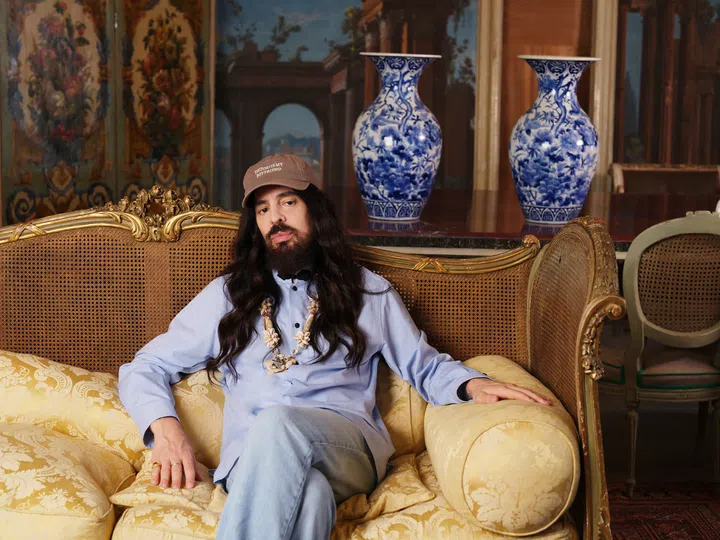
Alessandro Michele, photographed in Rome.
You do, however, also know that Michele isn’t Valentino. The two don’t look—nor indeed design—alike. Actually, they couldn’t be more different. With his beard and flowing Twelve Disciples hair, 53-year-old Michele—the former creative director of Gucci, now two years into his new role—more readily resembles the beatific Renaissance saints whose likeness once hung on his studio’s soaring walls than the dapper, suited-and-booted Valentino-male archetype. Today, he’s seated before an oil painting of an Elysian scene that almost looks like a theatrical backdrop, and is wearing a white T-shirt printed with the slogans APOLLON and DYONISOS in that bright, signature shade of scarlet known throughout the world as Valentino red.
Those two gods—Greek, incidentally, rather than Roman—represent opposite poles: harmony and divine order versus passion, emotion and instinct. Valentino definitely belongs to the former camp; Michele is more 50/50. He’s kind of the fashion god of chaos, honestly—he has sent models trailing pellucid satins in the gutters of Hollywood Boulevard, out onto an operating-theatre catwalk carrying facsimiles of their own heads and, for his debut Valentino haute couture show, wearing ballgowns of breathtaking beauty and Luchino Viscontian proportions juxtaposed with lucha libre-inspired masks. He has already staged a Valentino presentation in a sweaty reproduction of a public bathroom, which raised many eyebrows and some hackles.

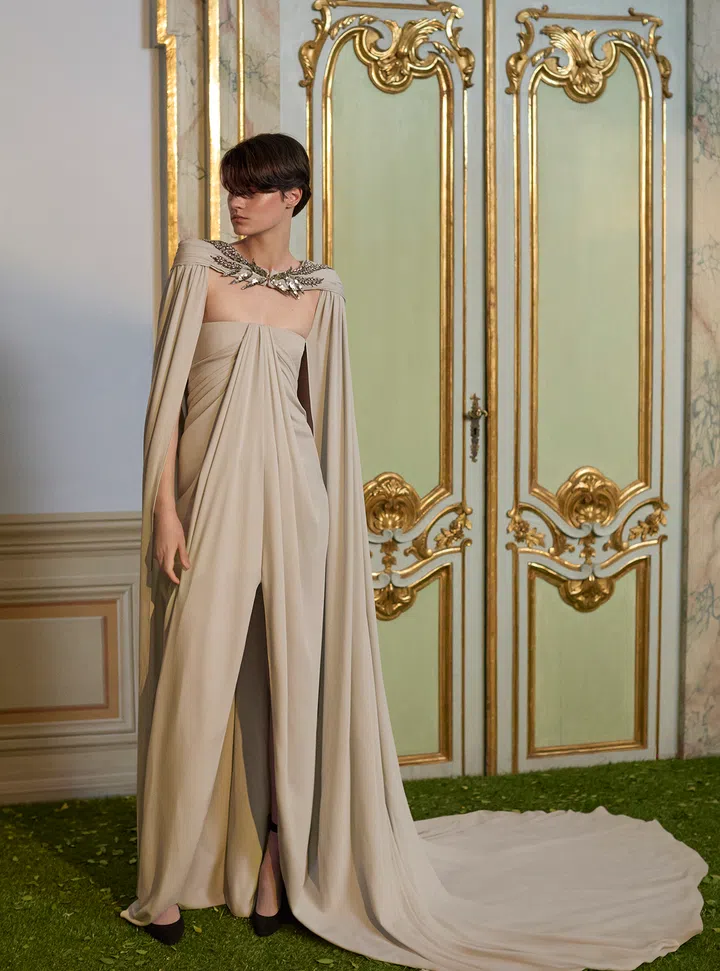
The opposing poles at play in his reimagined Valentino were amply demonstrated by a spectacular autumn/winter 2026 ready-to-wear show. It was held in the rather more refined environs of the Palazzo Barberini in Rome, the first in his own and the brand’s hometown. Rome is, for Michele, an essential component that shapes his approach to fashion, and that of Mr Valentino, too. But their perspectives of the city are divergent.
‘Rome, it’s about very different kinds of beauties,’ he says. ‘There is one that is solemn; it’s incredible; it’s big. The beauty of the Greek and Latin language of the goddesses and gods, the majesty of the marble of the fontana.’ He allies those goddesses with Valentino’s idealised women, perfectly draped in stylised plissé silk. ‘But, on the other side, there is the mess of all these layers, different kinds of messages and emotions.’ Indeed, traipsing through Rome to the Piazza di Spagna, overlooked by Valentino’s palazzo, is to time-travel with mind-boggling speed through architecture that runs the gamut from the ancient world to the Renaissance, the Baroque period to the 1900s bourgeoisie and 1930s rationalism, all at once.
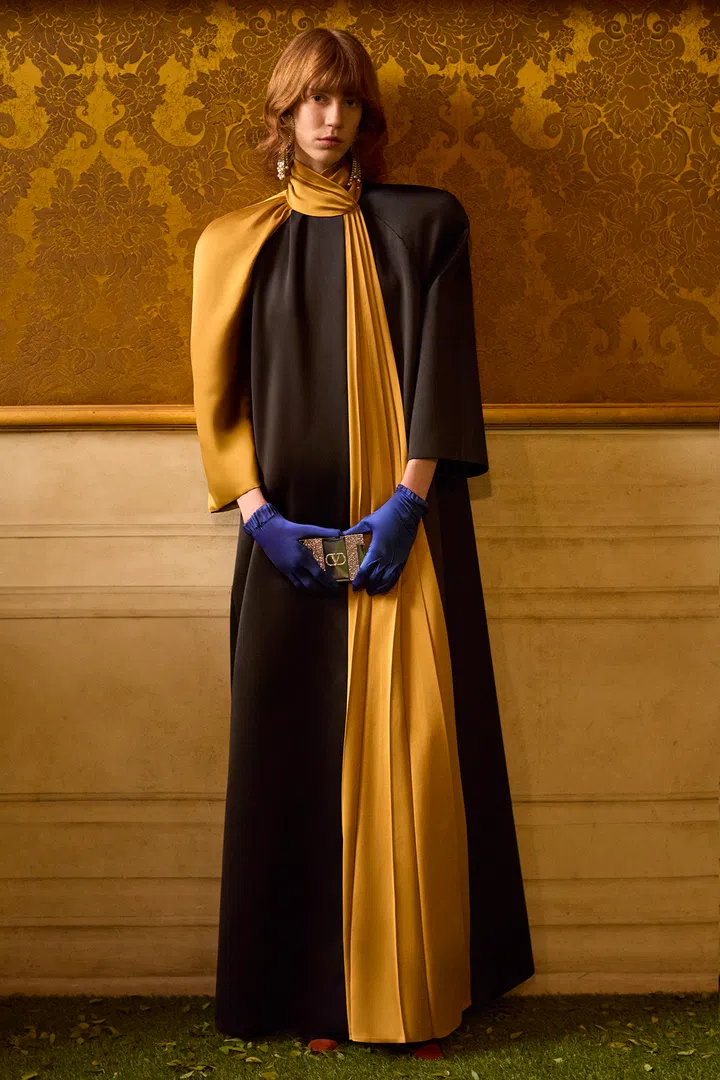
All clothes, from a selection of the Valentino autumn/winter 2026 collection.
‘It’s like you are in front of the most colossal movie from Hollywood with the biggest budget for the biggest ceiling, the biggest room, the biggest window, the biggest palace,’ He’s laughing. ‘And also the biggest mess.’ You can see that mix in his Valentino clothes—if there’s one thing Michele is bringing to Valentino’s impeccable Roma, it’s a welcome bit of messiness.
That is perhaps why Michele called this collection Interferenze. Indeed, the parade of post-modern beauty, comprising unanticipated combinations of full-length fur coats, leggings and exquisite lace and chiffon gowns worn with globules of gems, felt like just that, as they passed through frescoed salons that, Michele says, seem larger than a football field. They didn’t belong. But the title was broader than just these clothes.
Related article: Freen, Film, And View On Personal Style And Emotional Keepsakes

‘The way I work, it’s always like an interference,’ Michele says softly, thoughtfully. ‘The work of a creative director over the past 20 years, it’s being an interferenza or interference in the story of a brand, in the work of someone else. And it’s beautiful, the way that two different things, they go together, they come together, to create something new.’
His interferenza is especially pointed at Valentino. You wonder at the common ground to be found between a fastidious couturier who, as a child, perhaps apocryphally, cried until he vomited when his mother tried to make him add a coarse bow-tie to an outfit, and the aforementioned madcap creative chaos that had characterised Michele’s approach to fashion since he first emerged on the global stage as creative director of Gucci a decade ago. You can imagine the legendarily soignée Swans who comprised Valentino’s imperious aristocratic clientele turning up their noses at the grubby, bohemian, rock-and-roll waifs and strays that Michele adores. And, although he fits right in to Valentino’s office, Michele himself readily acknowledges those dichotomies, even in terms of the continuum of the house’s creative direction.
‘Pierpaolo and Maria Grazia, they were like the nephew and niece of Valentino,’ says Michele of Piccioli and Chiuri, the designers who led the house’s creative direction—first as a duo, then Piccioli solo—between 2008 and 2024. They began work at the label in 1999, just before Michele himself joined Gucci, culminating in a long stint as its creative director. ‘I’m the really new one,’ is how Michele describes his place at Valentino, given that many members of staff have served for multiple decades. ‘I’m looking at the things as a guest or the new inhabitant of the house.’
“I think that I’m trying to invent and create a movie around the world. I always see the big picture.”
Related article: A Constellation Of Love And Hope At Valentino
That is how Michele can challenge our preconceptions of Valentino, by mashing together edge with elegance, by twisting those hallmark evening dresses with something as simple as the kind of wrong shoe, glove or skew-whiff hat that Mr Valentino himself would never have dreamt of adding. Yet there are undeniable links forged between the founder and his newest guest. An unexpected one is glamour, something you readily associate with Valentino’s sleek evening gowns, for instance. They’re almost synonymous. Michele? With collections that have referenced the geek chic of The Royal Tenenbaums, not so much. But Michele begs to differ.
‘I’ve been very attracted to the glamorous world when I was younger, from Hollywood, from Jean Harlow... I’m discovering that I like glamour also from my point of view.’ He smiles. ‘I think I’ve been very rebellious, playing this game.’
Hollywood is an interesting take—because cinema is something else that directly connects the two. While an assistant at Jean Dessès in the 1950s, Valentino sketched ‘dream dresses’ for the actresses of his day—one of the first was named Elizabeth, as in Taylor. (Valentino would later dress her, possibly most famously for her final wedding, to Larry Fortensky, in 1991.) Michele, too, has a fascination with film; his mother worked at Cinecittà, the famed Roman studios, assisting a movie executive, exposing her son to the spectacle of Italy’s own Hollywood, peopled with Fellini, Rossellini, Bertolucci and the rest—including, actually, Taylor, during her turn in Mankiewicz’s 1963 Cleopatra. Michele’s mother used to tell him stories about rubbing shoulders with her at coffee shops in the city.
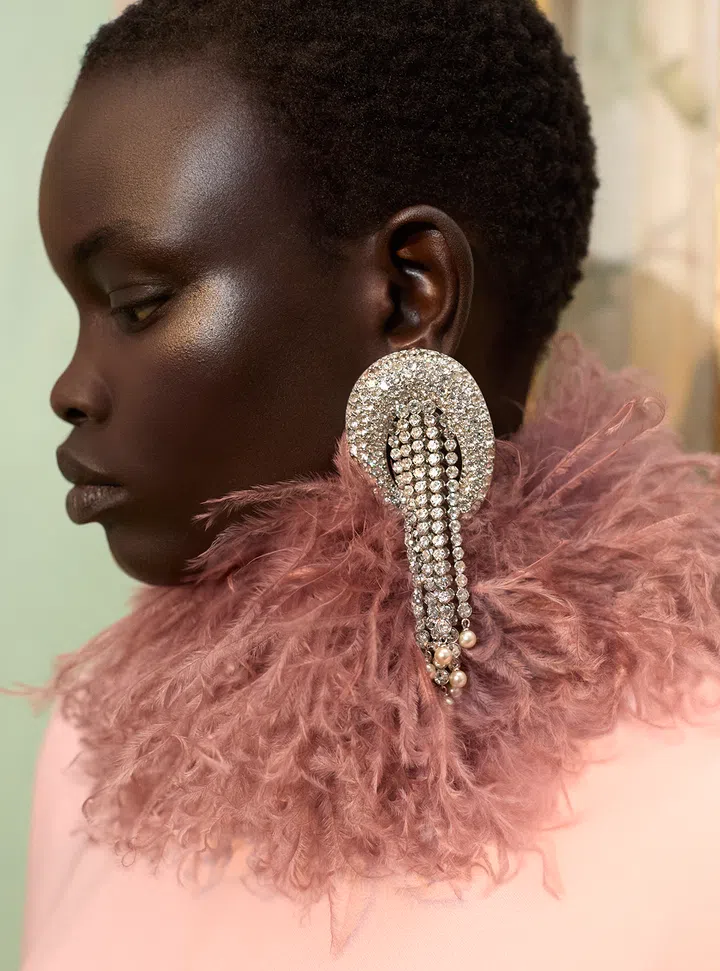
A crystal and pearl drop earring, worn with a feathered collar, from Valentino’s autumn/winter 2026 collection.
Michele, accordingly, compares himself to a film director. ‘I think that I’m trying to invent and create a movie around a world,’ he says. ‘I always look at the big picture.’ And, like a director, he sees his role as trying to ‘invent with this script something new.’
Unlikely though it seems, it is undeniably true that Michele’s Valentino is rooted in the script written by the founder, to a far greater degree than his predecessors. ‘I don’t feel guilty taking different things,’ he says, and he has, accordingly, plundered the archives, referencing obscure grabs from Valentino’s 1980s heyday, which Michele finds perpetually fascinating. In his first collection, there was a jumble of outright referential pieces, from filmy lace dresses to Coromandel-sequined jackets (a note: Valentino’s versions predate Karl Lagerfeld’s at Chanel by six years). His first haute couture show proposed a jumbotron-scale reissue of a red ruffled tulle dress photographed by Deborah Turbeville in 1977. And some other looks might graft the exquisite draped bodice of a Bonfire of the Vanities Valentino evening gown to jeans, say, or transpose a filmy lace lady-who-lunches blouse to top off a pair of grungy Y-front briefs on a guy.
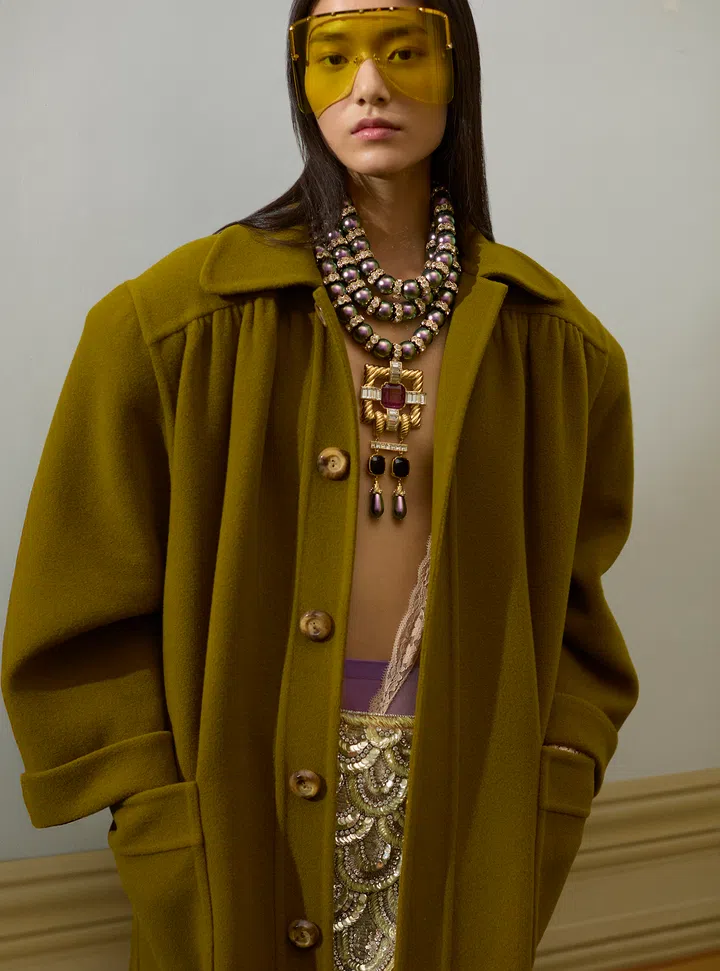
Detail, Valentino autumn/winter 2026 collection.
Michele was born in 1972 and grew up in Rome; he remembers his first sighting, aged 13, of Mr Valentino, clutching his pugs and framed through the windows of the new McDonald’s in Piazza di Spagna. (How about that for the type of high-low contrast that electrifies Michele’s work?) ‘He was like an epiphany,’ he says, recalling that unlikely first sighting. ‘Like a god.’
Mr Valentino was—is —thus revered in his adopted hometown. He actually grew up in Voghera in Lombardy, some 300 miles away, but through sheer force of will, became the most Roman of couturiers, indelibly entwined with the Eternal City. When the designer died in January, aged 93, his funeral had the scale and ceremony of that of a state potentate. As a form of homage, Michele opened his following haute couture show with a slender column dress in Valentino red. The Roman ready-to-wear offering closed with a similar number that seemed a throwback to a Valentino original, but wasn’t.
‘That dress, it looked so Valentino,’ he says. ‘I was thinking about the era of Elsa Peretti working with Tiffany—the shape must be very organic and chic, but also sexy, because you can really feel the body inside. I was trying to say, this is not just a colour, this is a statement, it’s a state of mind, of life, of the way that you want to look and how the women were... There was nothing, just a pair of earrings and the dress. And it’s not really me.’
Related article: A Look Back At Valentino Garavani’s Greatest Fashion Moments
Facing off with that legacy must be daunting—to throw out another Roman reference, a designer like Michele has to be Janus, looking back and forwards at the same time. He was also, perhaps, glancing over his shoulder to see the reactions of Valentino and Giammetti, both looming presences. Giammetti attended Michele’s shows for the brand, applauding loudly—and although Valentino was too unwell to be there in person, Michele could still sense him. ‘It’s very strange, that he is not any more with us.’
Did he ever seek Valentino’s approval? Michele takes a moment to pause, to reflect. ‘It probably was something unconscious,’ he says, slowly. ‘I would say yes, because knowing that Mr Valentino was probably watching the show... I feel always very free and very connected with the things that I’m doing, but I think that, in a very unconscious way, something was going on inside me. And, as you know, sometimes that’s stronger than the conscious way.’
It’s also a natural question to ask what he feels he has inherited from Valentino aesthetically, and philosophically. ‘He founded this brand and he really showed the world the power of imagination, the power of creativity, the power of a colour, the power of an attitude. It’s like the power of the little detail, on these huge frescoes. I have never been in such a powerful brand in terms of creation.’
This article originally appeared in Harper’s BAZAAR UK.