
6 Creatives Who Are Taking The Road Less Travelled
Instead of following the expected route, these creatives took the less obvious path, building successful careers on their own terms.
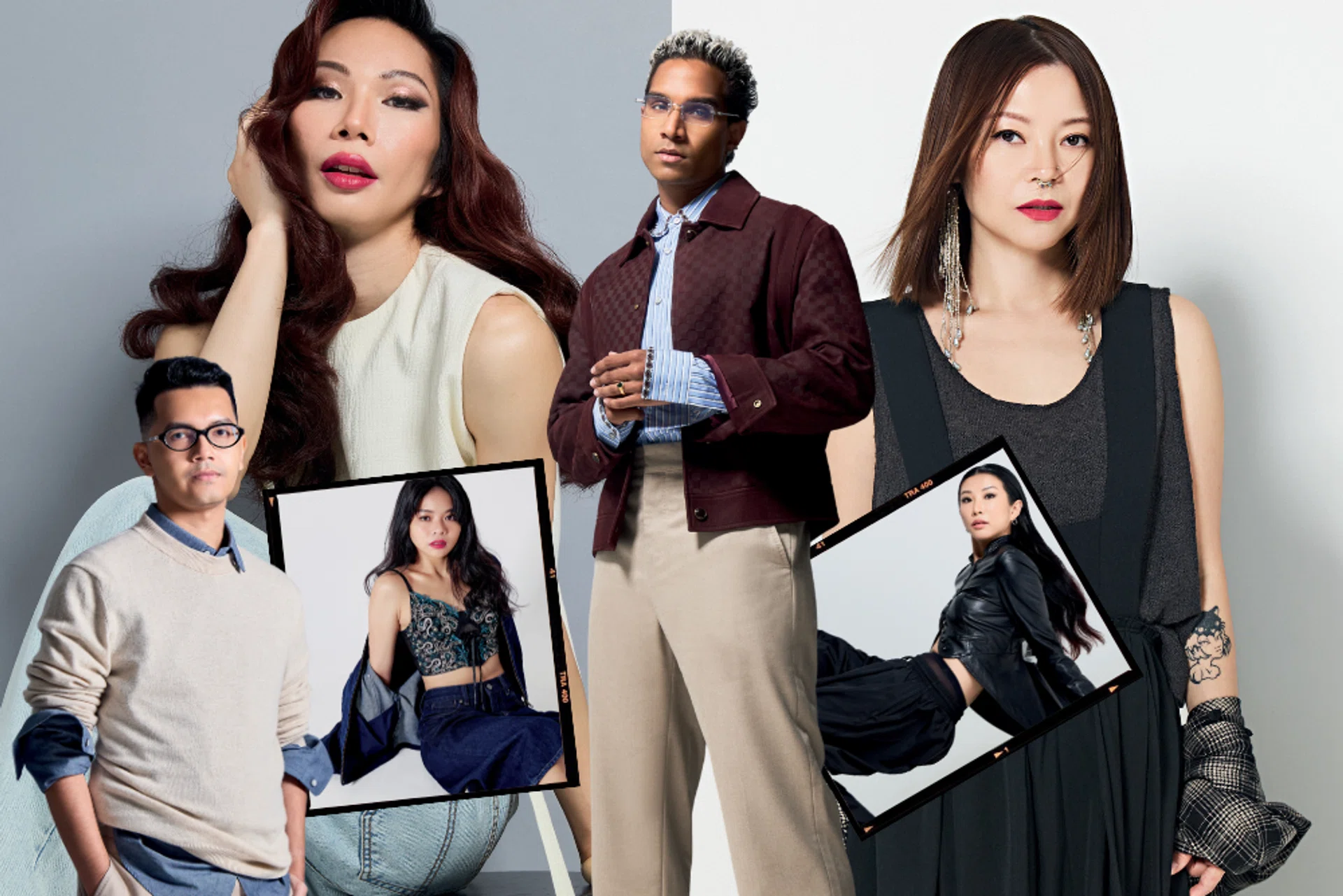
By Hayden Ng and Aaron Kok - published
A creative career rarely follows a clean or predictable route. For this group, uncertainty became fertile ground. Their practices span food installations, circus, drag, music, academic research and visual art, fields that sit beyond conventional ideas of what a viable career should look like. Some built opportunities where few existed; others moved between disciplines, identities and modes of expression without waiting for permission. Their work is shaped by curiosity, personal conviction and a willingness to remain difficult to categorise. Together, they reveal the possibilities that emerge when success is defined on one’s own terms, whether that means supporting a family through music, building an industry for other performers or making space for questions that resist easy answers.
About “25 Creatives, 25 Stories”
As Harper’s BAZAAR Singapore marks its 25th anniversary, we spotlight 25 rising and established creatives helping to shape Singapore’s cultural landscape, and driving Singapore’s creative community forward.
Read more of their stories below:
5 Creatives Who Are Redefining Tradition
5 Creatives Who Are Rethinking Craft In Singapore
5 Creatives Who Are Shaping Culture In Singapore
4 Creatives Who Are Putting Singapore On The World Stage
Related article: New Restaurants, Cafes And Pop-Ups In Singapore: August 2026
Gong Hua, 36, Food Artist
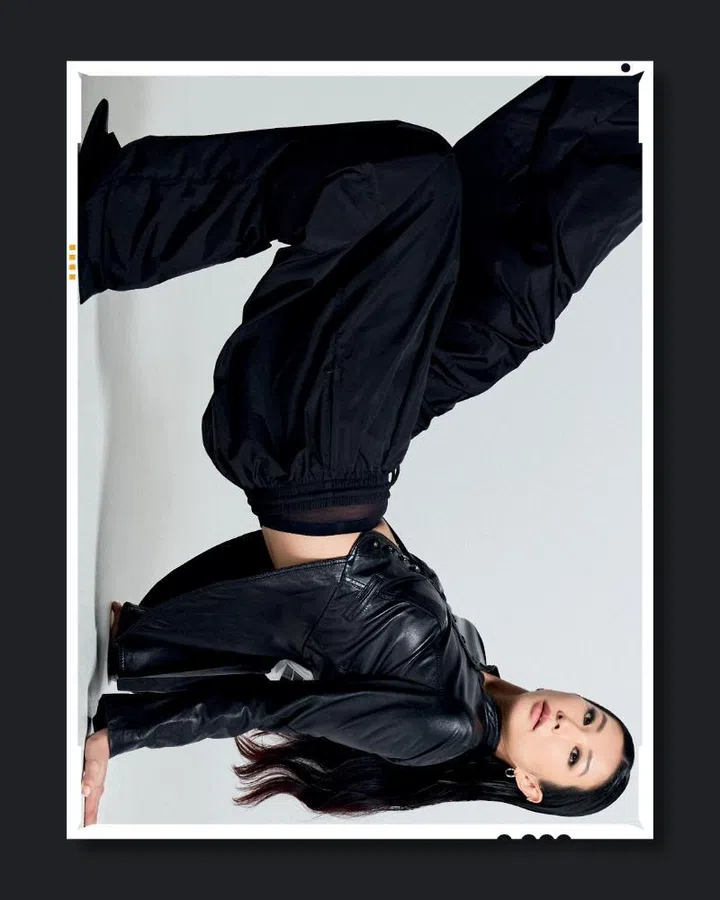
Jacket; boots; jewellery, Gong Hua’s own. Trousers, H&M x WARDROBE.NYC.
“Don’t play with your food” is a warning most of us grew up with. For Gong Hua, “playing” with food began as a personal project during the Covid-19 pandemic, when she started creating edible art installations that challenged the status quo of conventional food experiences. She explains, “I work with the material food not merely as sustenance but as a medium, metaphor and memory.” Today, she works as a food artist, taking everyday ingredients and staging them in ways that spark conversation and curiosity.
Her debut, Void Egg—a display of hard-boiled eggs and their shells strewn across a metal table beneath an HDB void deck—means the most to her. Gong had used eggs to symbolise new beginnings and birth, setting them against the void deck to create a visually arresting effect that piqued the interest of locals and foreigners alike. “Sometimes, all it takes is seeing something as ordinary as food through a different lens to remind us that wonder can still exist in the everyday,” she surmises.
What has food art taught you?
So, so much. I don’t think I am the same person as I was before I started playing with food. It has been five years and people around me can definitely sense the shift in energy. I am happier. I eat, sleep, breathe food art. There’s never a moment where I don’t think and dream of food art. It has taught and showed me the meaning of life. I call “Who Eats Art” my child because it is truly an extension of myself, a better version of myself. Food art has given me a deeper sense of purpose. It has taught me to pay attention—to people, emotions, memories, and the small details that often go unnoticed. Through the work, I’ve come to understand myself better and feel more connected to the world around me.
What’s one thing that outsiders get wrong about being a creative in Singapore?
I think people outside the creative industry sometimes assume that creativity is spontaneous and effortless—that ideas simply appear and the work somehow makes itself. Ideas may come quickly, but bringing them into the world is a different matter altogether. Behind every installation lies countless hours of research, testing, production, coordination, problem-solving, refinement and prayers. The visible part is often the most exciting part. What people don’t see is the amount of care, persistence (and stubbornness), and labour required to transform an idea into an experience that feels effortless.
Could you name one creative you’ve always been inspired by, and why?
I’ve long admired Kengo Kuma. The first time I encountered his work, I didn’t even realise it was his. It wasn’t credited at the time, but years later I discovered it was a Kengo Kuma project and have followed his work ever since. I wouldn’t necessarily describe him as a direct source of inspiration, nor do I consciously reference his work in my own practice. What I appreciate is his sensitivity towards materials and his ability to create emotional experiences through something as simple as light, shadow, texture, and form. Although I work with food rather than architecture, I often find myself thinking about similar questions—how a material shapes an experience, how people move through a space, and how small sensory details can leave a lasting impression.
Related article: The Best Mooncakes Of 2026, Tried And Reviewed By The BAZAAR Team
Beverly Wan, 29, Circus Artist
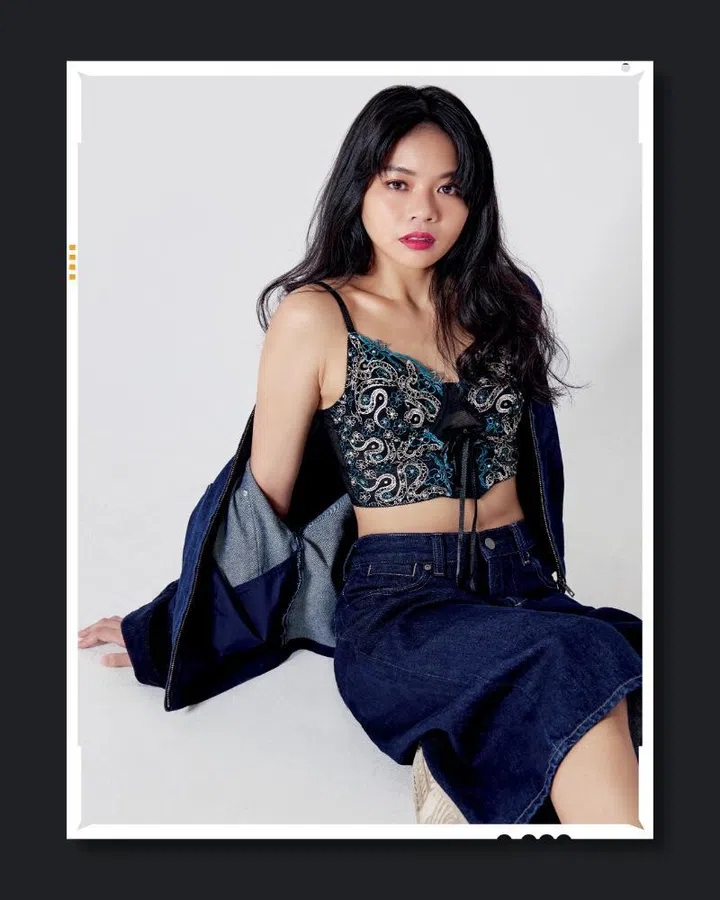
Jacket; culottes, UNIQLO. Top; sneakers, Beverly’s own.
Beverly Wan is known as a professional circus artist, performer and coach. What most of us don’t know is that she’s also been quietly carrying the weight of an entire vision in her head for years. In 2024, that vision came to life as 来Frisque一下Leh!, Singapore’s largest homegrown circus production to date. Staged at the Marina Bay Sands Convention Hall, the 90-minute show brought together a largely Singaporean cast, along with a guest performer from Cirque du Soleil, and a Malaysian fire artist. Wan produced, directed and performed in it.
Success has since grown beyond the spotlight she once wanted for herself. Now, she wants to uplift other artists by creating full-time jobs for them, so that others have access to opportunities that she once had to fight for. “That’s a lot, honestly, but when we get there, that’s when I would consider this a success,” she says.
What inspired you to start Frisque?
Frisque is my proudest achievement! The vision of Frisque, even before it had a name, has been in my head ever since I started my circus journey. I’ve always imagined the show I’d want to create, and the more shows I watched both locally and overseas, the more I wanted to see my own vision come to life.
What is creativity to you, and how has that definition shifted over the years?
I think my approach to creativity hasn’t shifted over the years. I have never believed in trying to make something different. Different doesn’t always mean better. Creative doesn’t always mean better too. I create the vision that I dream of.
What do you do to spark your creativity?
When I watch movies, dance films, music videos, circus shows, theatre shows, or when I read books and poetry, my mind catches the exact moment that I love. Then, I remember that feeling, and I want my show to give people that same feeling. The strongest influence for me is music. Oftentimes, I hear a piece and immediately I can see the act in my head. It may not even be the full piece, it could be just a 5-second moment, a transition, a crescendo, a dramatic pause—anything.
Related article: All The Latest Lifestyle News In Singapore Worth Keeping Up With
Zulkhairi Zulkiflee, 35, Artist-Curator and PHD Candidate
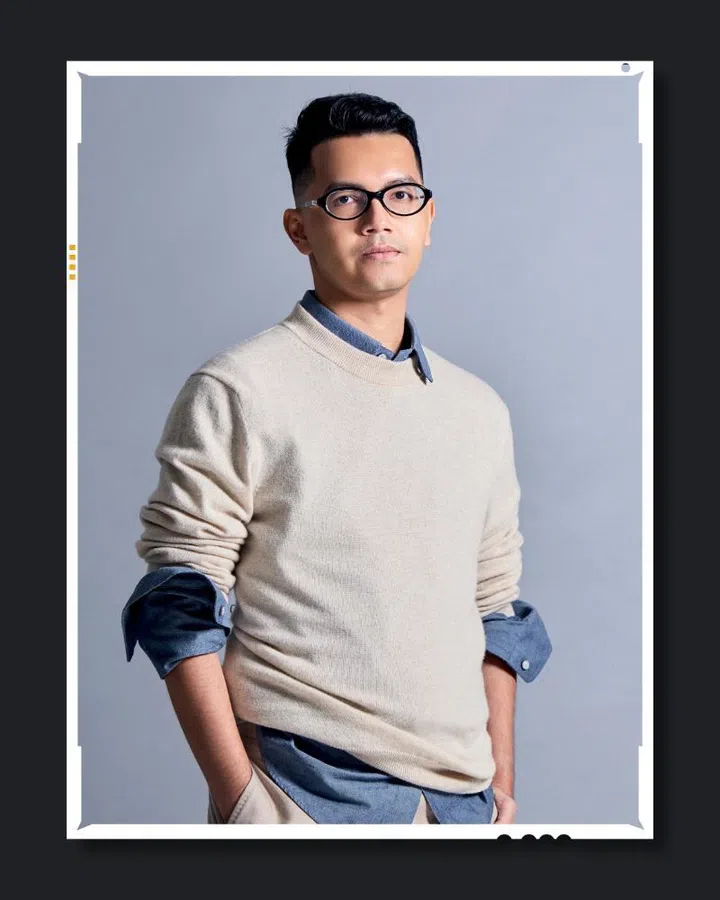
Sweater; shirt; trousers, Louis Vuitton.
At the heart of Zulkhairi Zulkiflee’s lens-based work lies a single, persistent question: what does it mean to be Malay? He often works with found images, recontextualises them and creates something new. During the creation process, Zulkhairi rarely considers who his audience will be, even when his research interest appears to focus on one community on the surface. Instead, he wants his work to spark curiosity and stoke questions among people. “I don’t particularly fancy making art with clear answers,” he shares. “This is precisely because we often want certainty.”
Zulkhairi’s artistic practice has received consistent recognition, including the title of Joint Curatorial Winner at Art Outreach Singapore’s IMPART Awards. Earlier this year, he held his solo exhibition, “The World Rolled off His Tongue”, as part of Singapore Art Week 2026.
For Zulkhairi, success has slowly shifted over time, and it now looks like working at his own pace. “Not fearing that taking a pause would take anything away comes with its own privileges, but I think an antithesis to successful art is extreme productivity.”
What is creativity to you, and how has that definition shifted over the years?
Creativity, to me, began as style and aesthetics, but it shifted into something more holistic. Today, I see it as an inherent human quality which involves tasks like problem-solving and innovation.
How would you describe your artwork?
A core interest in my work is the exploration of “Malayness.” My earlier works have touched on personal visual archives of my father in the ’80s, where a group of men “performs” a kind of subcultural self-fashioning shaped by rock music of that time. I also did an artistic series looking at the bare-bottomed, Malay boy trope in the artworks of Singapore’s pioneer artist Cheong Soo Pieng. In my recent artistic research, I am interested in public space, spatial practices of racialised bodies, creative linguistics and memory.
What do you think your profession will look like in 10 years, if AI development continues at its current pace?
I read somewhere that AI is imagined as something of the future but it actually leverages on knowledge that has been produced, hence something from the past. A creative will always be relevant even 10 years from now because, like thinkers, we steer knowledge. AI is just one of many tools.
Related article: Your Guide To SG Culture Pass-Maxxing: Where To Use, Top Activities And More
Ginette Chittick, 49, Researcher, Educator and Musician
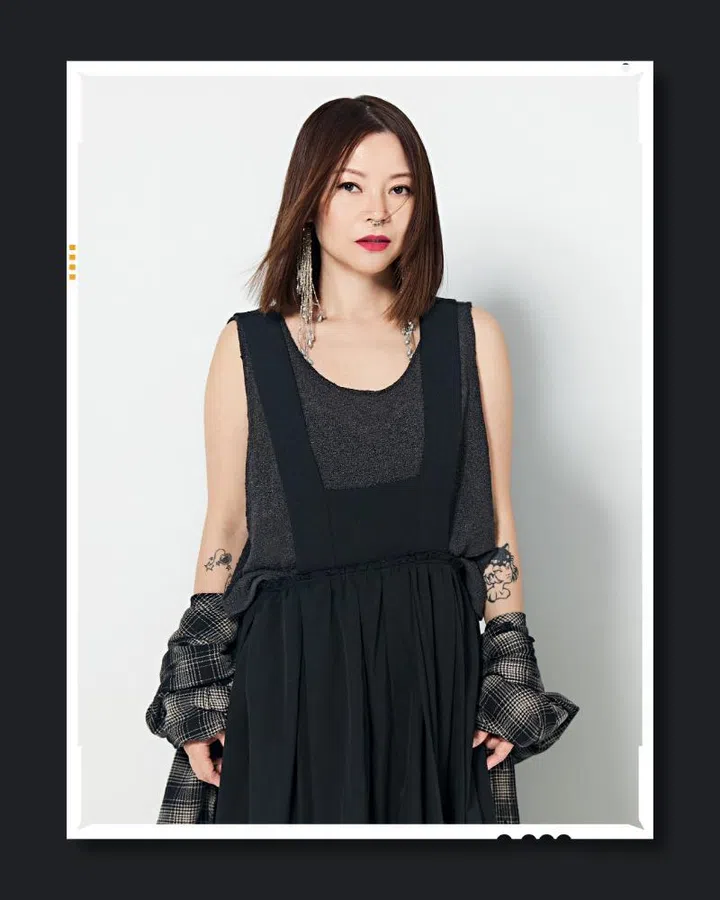
Top; dress; earrings, Ginette’s own. Shirt, UNIQLO.
There was no straight line from where Ginette Chittick started to where she stands today. From subculture researcher and educator to musician and DJ, Chittick wears multiple hats. Holding different titles in the creative scene, Chittick has always approached each with the same curiosity and ardour. “Creativity has always felt very intuitive to me,” Chittick shares. “To me, creativity is the ability to make connections.” One of her proudest moments of late has been presenting her doctoral research at conferences, where she spoke about her academic research on the Singaporean punk scene—a culture close to her heart, given that she was part of Singapore’s all-female punk rock band Psycho Sonique in the 1990s.
“Subculture is probably not the first thing people outside of Singapore associate with our country,” she says. “To be able to introduce new ideas regarding subculture from our part of the world is a real honour.”
What is creativity to you, and how has that definition shifted over the years?
Creativity has always felt very intuitive to me. It has been shaped by the large amounts of popular culture and subculture I have consumed over the decades, and by the curiosity I naturally have about my environment and specific kinds of histories. In my current research, I am looking at creativity through a very different lens—examining the conditions under which subcultural work was made, how subcultural activities were framed, and what may have been overlooked. So I’m not looking at a text to just illustrate a context, but I look at it as a primary object through which identity can be expressed.
What do you do to spark your creativity?
To be honest, it is really by being interested in people, their creative processes, how things were made, why things were made, why movements were forged, what statements were made—so generally just being kaypoh lah.
Why is creativity important in today’s world?
Creativity is what keeps culture from becoming flat and overly sanitised. This is why creativity and subcultures are so intertwined. Subcultures emerge from people wanting to present perspectives that counter dominant views, take risks and experiment, and refuse mainstream expectations. And I think that’s super important in today’s climate.
Related article: 12 Pop Culture Trends Singaporeans Were Obsessed With Over The Last 25 Years
Yung Raja, 30, Rapper and Songwriter
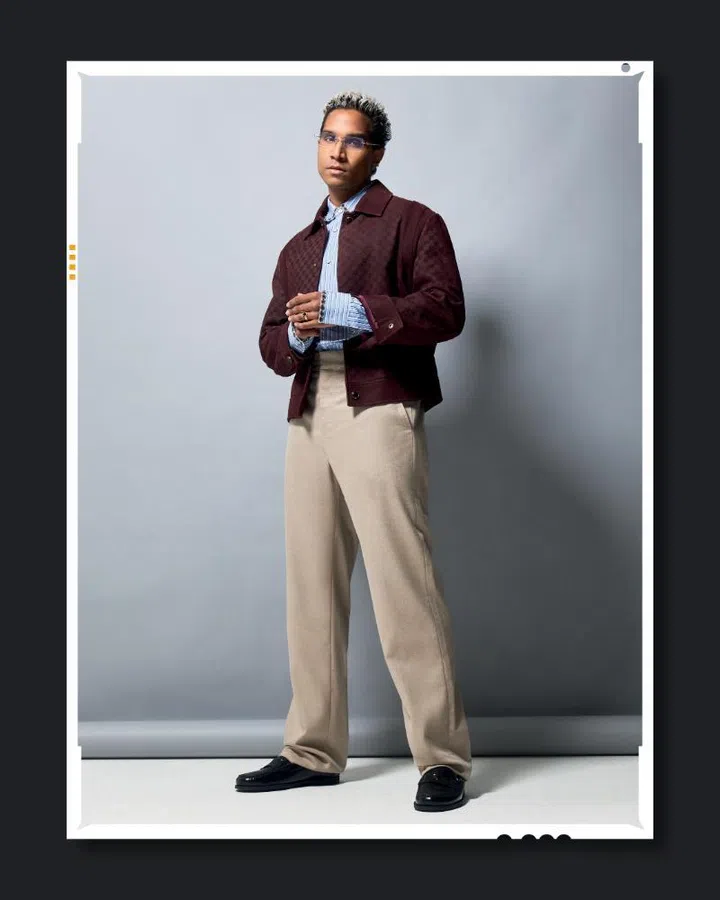
Jacket; shirt; trousers; shoes, Louis Vuitton. Glasses, Yung’s own.
Since his 2018 single “Mustafa”, Yung Raja has built a reputation as a Tanglish (Tamil and English woven together) rapper. “I am first and foremost an artist that conveys my stories through Tanglish,” he says.
Naturally, music is inseparable from his identity. “It’s shaped who I’ve become,” he says. “An ever-evolving canvas, painting as I move through every facet of my life.” His proudest moment came with “Missed Call”, a 2025 collaborative single with Korean-American rapper Jay Park. Raja sent over a demo missing its second verse; Jay returned it within days, mid-tour, having folded Tamil words into his own verse. “It’s a cultural crossover unlike anything I’ve seen. It was truly a blessing,” he recalls.
Success, for this rapper who’s taking the road less travelled, has never shifted shape. “It is to be able to feed my family and put food on the table by doing what I love to do, for as long as I live. I intend to keep it that way no matter how challenging it can become.”
What’s your advice for those who wish to pursue a career in the creative field?
I truly feel like you have to be a child about it. Be wide-eyed and excited about the creative work you do. Most times, I feel so alive about the fact that this is my path. I feel so lucky and blessed that in my life I get to see or do certain things that I think it’s pretty cool. It takes time to build something great so I also feel persistence together with consistent effort is key.
Could you name one creative you’ve always been inspired by, and why?
Pharrell Williams. His journey as an artist, creative and entrepreneur has been on a continuous state of incline and I am very fascinated by how his mind operates. I just came back from fashion week and had the opportunity to witness what he created with Louis Vuitton. One word: mindblowing.
What’s one thing that outsiders get wrong about being a creative in Singapore?
I think the common misconception is that there is no creative scene just because of the fact that we have been making so much waves as a business hub. However, I feel that our creative scene is as progressive as the rest of the world, just that we are probably not getting the exposure we need because of our geographical location. But that is slowly changing from how I see it.
Related article: All The Upcoming K-Pop Comebacks To Keep An Eye Out For
Opera Tang, 30, Drag Artist
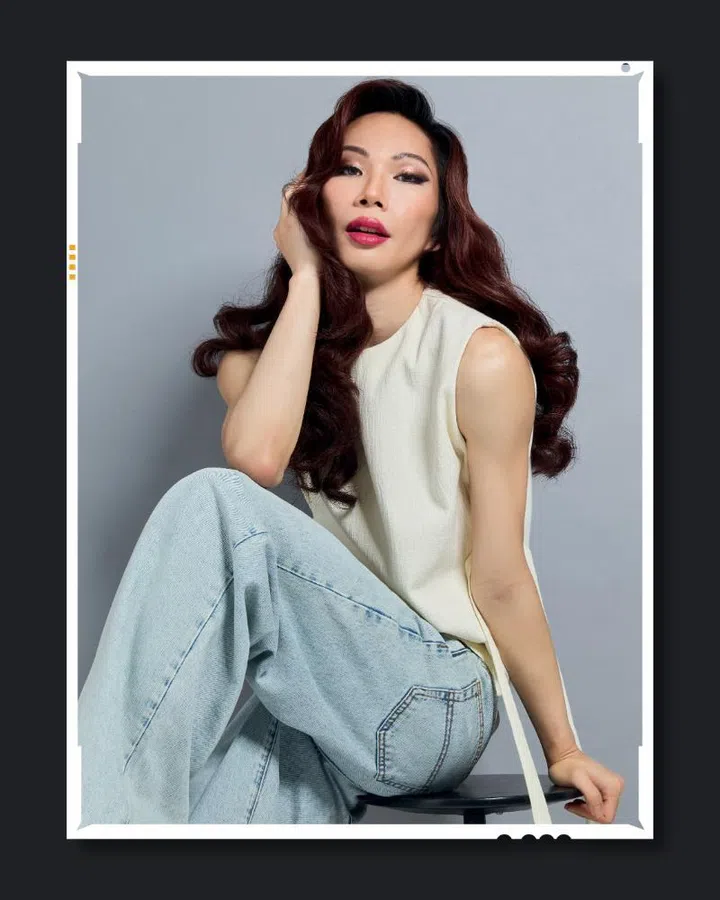
Top, In Good Company. Jeans, Coach.
Through drag, Opera Tang reclaims her identity as a proudly queer Singaporean, drawing on heritage iconography, national symbols, and her own lived experiences. The result comes forth in her performances, all of which are elaborately crafted and intrinsically queer.
Her signature Chinese opera-inspired aesthetic is unmistakable, marked by a wave-like fringe and high pink blush often sported by traditional opera artists. Tang draws inspiration from “mundane everyday objects” and “national symbols we all know by heart and sight.” One example is the unforgettable Year of the Dragon get-up, inspired by the iconic Toa Payoh dragon playground, and handcrafted by Tang and her grandmother.
“Creativity allows us to explore beyond the conventional and what was done before,” she says. “Especially now with the rapid advancement of artificial intelligence, human creativity allows us to stay relevant and connected to each other.”
How did you become interested in drag performance?
I was a freelance dancer and theatre performer prior to doing drag. But I’ve always loved the art form. Well before stepping into the nightclubs at Neil Road, I was watching RuPaul’s Drag Race since season one in secondary school, and drag films like To Wong Foo, Thanks for Everything! Julie Newmar, The Adventures of Priscilla, Queen of the Desert, and was mesmerised by the glamour and audacity of drag.
Why is creativity important in today’s world?
Creativity is important because it offers us options and opportunities to discover new and alternative ways of seeing, knowing, feeling ... it allows us to explore beyond the conventional, beyond what was done before, and especially now with the rapid advancement of AI, human creativity allows us to stay changing, relevant, connected to each other.
What’s the one piece of advice you’d give to someone who wishes to pursue a creative path in Singapore?
Do it with a healthy sense of delusion, and a knack for what your creative passion is. And maybe don’t quit your day job just yet, until after you can start supporting yourself.
Photography: Lawrence Teo and Angela Guo
Creative direction: Windy Aulia
Styling: Gracia Phang
Production: Aaron Kok
Makeup: Rina Sim using Chanel Beauty
Hair: Jimmy Yap/Kimistry; Grego using Revlon Professional
Stylist’s assistant: Jolin Lam, Laila Mishazira
SPH Media is a principal partner of National Day 2026.